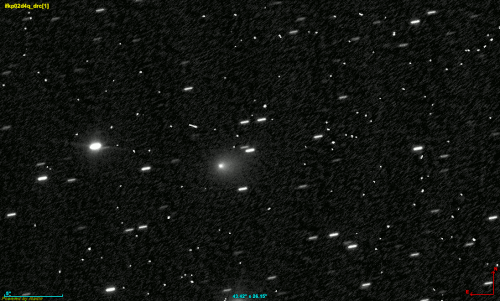
What is 3I/ATLAS, and why are scientists intrigued
The interstellar object 3I/ATLAS—only the third known visitor from outside our solar system—has sparked new questions in the astrophysics community after NASA confirmed unexpected changes in its trajectory and speed following its closest approach to the Sun.
Initially detected in July 2025, 3I/ATLAS was moving at an astonishing 209,000 km/h as it entered the solar system. But after perihelion on October 29, NASA’s latest tracking data revealed that it accelerated to nearly 244,000 km/h—a 17% speed increase that scientists cannot yet fully explain.
The anomaly deepens as the comet’s path slightly deviates after leaving the Sun’s proximity, suggesting an unaccounted-for force may have acted upon it. While NASA attributes the event to the Sun’s gravity and potential outgassing, several researchers remain skeptical.
How NASA’s observations challenge gravitational models
NASA’s official statement notes that the Sun’s gravity likely deflected 3I/ATLAS after perihelion, but the degree of acceleration exceeds what solar forces alone can produce. The agency’s latest figures also show that the object’s course shifted slightly “beyond gravity’s control,” a phrase that has fueled speculation about non-gravitational influences.
This isn’t the first time an interstellar object has puzzled scientists. In 2017, ‘Oumuamua—the first recorded interstellar visitor—also displayed an unexplained burst of acceleration after passing the Sun. At the time, Harvard astrophysicist Avi Loeb controversially suggested it could be an artificial probe propelled by solar radiation pressure.
The parallels between ‘Oumuamua and 3I/ATLAS have reignited debate over whether natural outgassing, fragmentation, or artificial mechanisms could explain the latest anomaly.
Could a “terrestrial engine” explain the acceleration?
Harvard scientist Avi Loeb once again finds himself at the center of discussion. Loeb theorizes that 3I/ATLAS may be surrounded by a 5-billion-ton gas and dust cloud, potentially masking an energy source within. If no significant outgassing (the release of vaporized ice and gas typical in comets) is detected, it might suggest an unknown propulsion-like effect.
Loeb refers to this phenomenon as a “terrestrial engine”—not in the literal sense of alien technology, but as an unidentified process mimicking powered acceleration. This could include magnetic interactions, exotic chemical reactions, or even micro-scale nuclear decay within the object’s core.
However, NASA’s own spectroscopic analysis so far has not detected signs of artificial material. Scientists caution that such interpretations must await direct observation through the James Webb Space Telescope (JWST) later this month.
What data says about its trajectory and potential Earth approach
According to NASA’s orbital projections, 3I/ATLAS will pass relatively close to Earth in December 2025, though still at a safe distance. The Mars Reconnaissance Orbiter (MRO) reportedly captured high-resolution images of the object during its perihelion phase, but these images have not yet been publicly released.
The James Webb Space Telescope will soon conduct near-infrared and mid-infrared scans to determine the comet’s composition, mass loss, and heat emission. Astronomers expect clearer Earth-based observations by late November, as 3I/ATLAS becomes brighter and more visible in the night sky.
The comet’s sudden slowdown in early November also intrigued researchers. NASA’s early readings suggest this deceleration isn’t fully tied to solar influence, but may stem from a 13% loss in mass near the Sun, possibly due to ejection of volatile material.
Why are scientists divided over the cause?
The global astronomy community is now split between two major interpretations:
- Conventional Explanation:
- 3I/ATLAS accelerated due to outgassing—jets of gas expelled as frozen materials sublimated near the Sun.
- The shift in trajectory could be a result of uneven ejection of material, not an external force.
- Alternative Hypothesis:
- The motion could involve non-gravitational propulsion, possibly linked to magnetic fields or radiation pressure.
- Some even suggest the comet might be a fragment of an interstellar spacecraft or a natural object with advanced internal physics unknown to current models.
While NASA emphasizes caution against sensational interpretations, the agency admits that 3I/ATLAS “does not behave like typical solar system comets.”
What comes next: JWST, December flyby, and future missions
In the coming weeks, JWST will play a pivotal role in decoding the mystery behind 3I/ATLAS. Its advanced sensors can detect chemical traces invisible to optical telescopes, helping confirm whether outgassing or exotic processes are at play.
If JWST confirms an abnormal acceleration pattern unrelated to solar or thermal forces, it could reshape existing models of interstellar dynamics. In that case, 3I/ATLAS might become one of the most studied objects in modern space history.
NASA and the European Space Agency (ESA) are also reportedly considering rapid-response missions for closer examination, similar to how probes once intercepted Halley’s Comet and 67P/Churyumov–Gerasimenko.
The bigger picture: Why 3I/ATLAS matters
Every interstellar object offers a snapshot of another planetary system—a piece of material formed around a distant star and ejected across light-years. 3I/ATLAS, if properly studied, could:
- Reveal chemical markers of life-forming elements beyond our solar system.
- Provide clues to interstellar propulsion mechanisms or material properties.
- Test the limits of gravitational and radiation-based motion models.
More importantly, it challenges the idea that our solar system operates in isolation. Each anomaly—each unexpected turn or acceleration—reminds scientists that cosmic mechanics are not yet fully understood.
TL;DR
3I/ATLAS, an interstellar object detected in July 2025, has baffled scientists by accelerating and changing trajectory after passing the Sun. NASA data shows its motion may be “beyond gravity’s control,” raising debates about non-gravitational forces or unknown physics. JWST will soon observe it up close, potentially offering answers about its mysterious behavior and composition.