
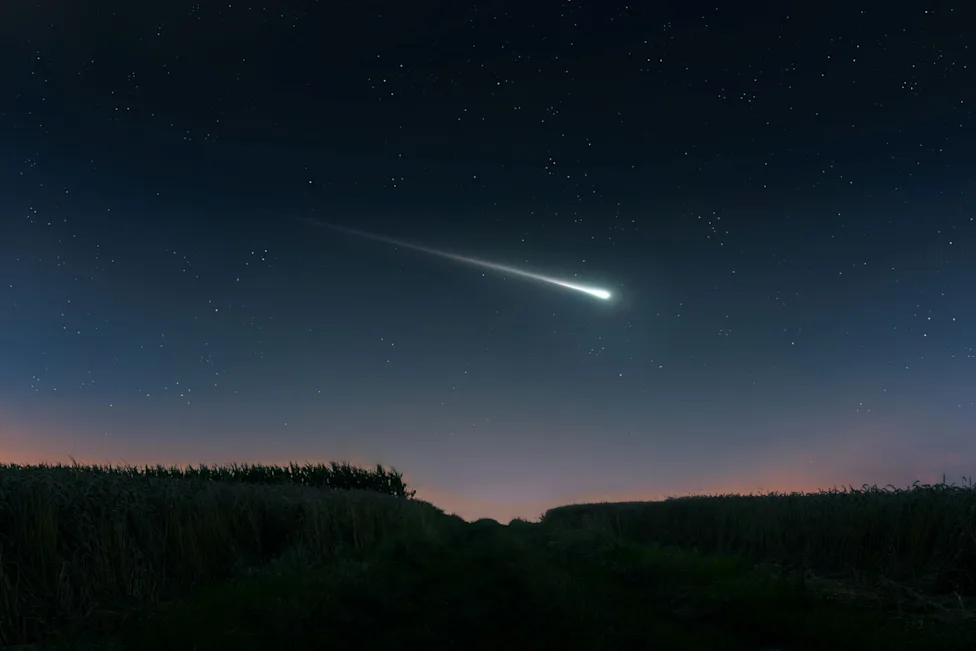
A brilliant green fireball streaked across the evening sky over New Zealand on August 30, giving skywatchers a brief glimpse of a piece of material that may have been around since the earliest days of the solar system.
The meteor was spotted over the upper North Island shortly before 7:45 p.m. local time. Cameras operated by the Tauranga Astronomical Society and Fireballs Aotearoa captured the object as it traveled from west to east.
The spectacle lasted nearly 10 seconds before the object burned up over the ocean.
But the meteor was remarkable for more than its dramatic color. Researchers say the space rock likely originated in the asteroid belt between Mars and Jupiter and formed about 4.6 billion years ago, when the solar system was still taking shape.
Where did the New Zealand meteor come from?
According to David Greig, president of the Tauranga Astronomical Society and a member of Fireballs Aotearoa, the object came from the asteroid belt, a vast region between Mars and Jupiter containing millions of rocky bodies left over from the solar system’s formation.
These objects are essentially cosmic leftovers.
When the planets formed billions of years ago, not all of the original material was incorporated into larger worlds. Much of it remained as asteroids and smaller fragments. Some of those fragments occasionally get nudged onto paths that bring them toward Earth.
The New Zealand fireball appears to have been one of those ancient travelers.
How fast was the space rock moving?
The meteor entered Earth’s atmosphere at roughly 17 kilometers per second, equivalent to about 61,200 kilometers per hour.
That enormous speed caused the surrounding air to become intensely compressed and heated as the object plunged through the atmosphere.
The resulting glow is what people saw as a fireball.
As the object slowed, its speed eventually dropped to between 5 and 6 kilometers per second before it disappeared.
Fireballs are particularly bright meteors, usually produced when a relatively large piece of space rock enters the atmosphere and releases substantial energy.
Where did the meteor disappear?
The fireball traveled across the upper North Island before burning up approximately 30 kilometers above the ocean.
Steve Wyn-Harris, director of Fireballs Aotearoa, said the event occurred over the ocean north of Tauranga and southeast of Whitianga.
Importantly, experts found no indication that the object produced smaller fragments that reached the water.
That means the spectacular green streak was likely the final stage of the space rock’s journey rather than the prelude to meteorites landing on the surface.
Why was the meteor green?
The striking green color was linked to the chemical composition of the incoming space rock.
David Greig explained that magnesium can produce a bright teal or cyan-green glow when it vaporizes during atmospheric entry.
As the meteoroid heated to extreme temperatures, elements within it began to vaporize. Magnesium likely played the leading role in producing the distinctive green color, while other metals such as iron and nickel may also have contributed to the light.
This is why meteors can appear in different colors.
Their glow is influenced not only by how hot they become but also by the elements present in the object and the gases through which they travel.
Why are scientists interested in ancient meteors?
A meteor may last only a few seconds in Earth’s sky, but the material inside it can preserve clues about the solar system’s distant past.
Asteroids formed during the early stages of planetary development can retain relatively primitive material that has undergone far less geological processing than rocks on Earth.
Studying such material allows scientists to investigate the conditions that existed when the planets were forming.
In that sense, the New Zealand fireball was more than a bright streak in the sky. It was a brief encounter with material that has been traveling through space for billions of years.
Did the meteor hit Earth?
Not in the sense of a large impact.
The object entered Earth’s atmosphere but appears to have burned up before reaching the surface. Experts said it disintegrated roughly 30 kilometers above the ocean.
That process is common with smaller meteoroids.
As they race through the atmosphere, intense heating can cause them to fragment and vaporize. If pieces survive all the way to the ground, they are called meteorites.
In this case, there was no reported meteorite fall associated with the event.
Why was the fireball visible for so long?
Most shooting stars disappear in a fraction of a second. The New Zealand fireball remained visible for nearly 10 seconds, making it particularly noticeable.
Its brightness and duration were likely related to its size, composition, speed and trajectory through the atmosphere.
Because the event occurred over a populated part of New Zealand and was captured by dedicated meteor cameras, scientists were able to reconstruct important details about its path.
Several members of the public also reported seeing the object, with one witness describing it as a bright green light with a white tail.
A tiny visitor from the asteroid belt
Earth is constantly being bombarded by material from space, although most incoming objects are tiny and burn up high in the atmosphere without anyone noticing.
Occasionally, however, a larger object produces a spectacular fireball.
The August 30 event over New Zealand was one such example.
What made it especially fascinating was its likely age. The rock may have formed around 4.6 billion years ago, roughly the same period when the solar system itself was emerging from a disk of gas and dust surrounding the young Sun.
For about 10 seconds, that ancient material became visible to people on Earth before disappearing over the Pacific.
The universe had effectively sent New Zealand a postcard from the solar system’s childhood and then promptly set it on fire.