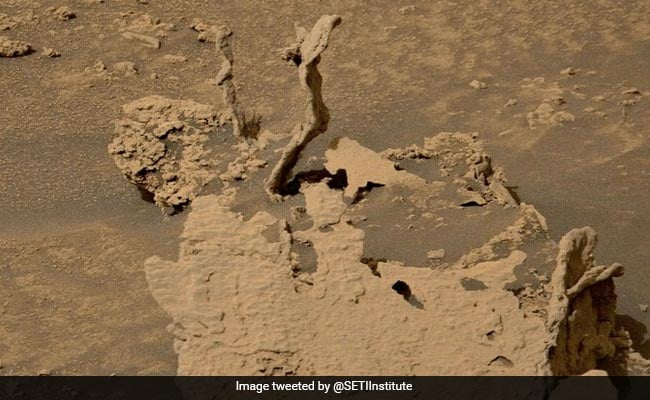
Perseverance discovers an unusual sculpted rock
NASA’s Perseverance rover has stumbled upon a mysterious, unusually shaped rock on Mars that appears to have originated from far beyond the Red Planet. The object, roughly 31 inches wide, was spotted in the Vernodden region of Jezero Crater, where the rover has been exploring since 2021.
NASA’s Jet Propulsion Laboratory has named the rock “Phippsaksla” and believes it is likely a meteorite. What caught scientists’ attention was its tall, sculpted structure, which contrasted sharply with the flat, low-lying stones scattered around it.
Initial scans using the rover’s SuperCam instrument revealed high levels of iron and nickel, materials typically found in meteorites formed inside the cores of ancient asteroids. This early analysis suggests the rock may have travelled from elsewhere in the solar system before landing on Mars.
Checking for possible links to ancient life
Perseverance is now examining whether the rock holds any clues related to potential ancient life on Mars. Scientists have long believed the planet hosted water billions of years ago, raising the possibility that microbial life once existed.
NASA’s previous findings support this line of inquiry. In September, the agency announced that a sample named “Sapphire Canyon,” collected from an ancient riverbed within Jezero Crater, carried chemical signatures that may be of biological origin. The site, located in a region shaped by flowing water, offered the strongest evidence yet of past Martian life.
Other rovers have found meteorites too
Meteorite discoveries on Mars are not new. The Curiosity rover found several, including “Lebanon” in 2014 and “Cacao” in 2023, inside the Gale Crater. NASA’s earlier rovers, Opportunity and Spirit, also encountered iron-nickel meteorites while traversing the planet’s surface.
If confirmed as a meteorite, Phippsaksla would add Perseverance to the list of rovers that have identified extraterrestrial rocks on the Martian landscape.