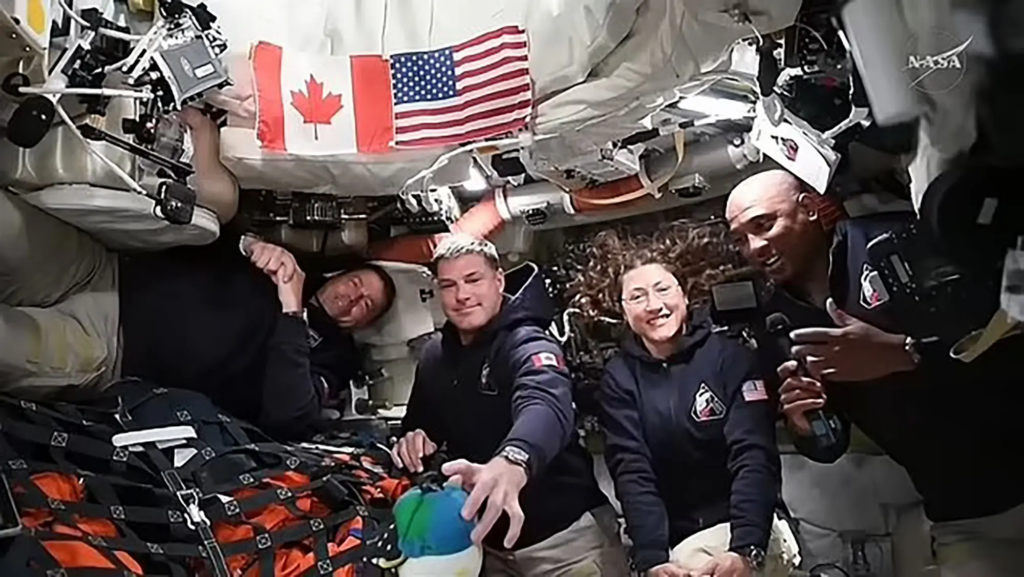
Within days of NASA’s Artemis II mission making headlines, a different kind of buzz took over social media: claims that the mission was staged using a green screen.
The spark? A grainy cellphone recording of a TV interview with astronauts speaking to CNN, where a floating plush toy appeared to flicker with stray letters.
To conspiracy-minded viewers, it looked like a glitch. To experts, it looked like something far more mundane—and explainable.
What Is the Artemis II “Green Screen” Conspiracy?
The Artemis II conspiracy theory centers on a short clip filmed off a television screen during a live broadcast interview. In the video, a plush zero-gravity indicator toy—nicknamed “Rise”—appears to show flickering fragments of text such as “TAN” and “OW.”
Online commentators quickly framed this as evidence of digital compositing, arguing:
- The floating toy looked “digitally inserted”
- The text fragments resembled overlay errors from editing software
- The entire scene felt “too clean” to be real space footage
Posts on X (formerly Twitter) amplified the claim, with some users alleging that taxpayer money was being spent on a staged production rather than an actual mission.
What Actually Happened in the Viral Clip?
The simplest explanation is also the most likely: the clip is a recording artifact, not a space hoax.
Filming a Screen Creates Visual Distortions
When a smartphone records a television display, several technical issues can occur:
- Refresh rate mismatch between the TV and the camera
- Pixel grid interference, causing flickering patterns
- Compression artifacts, especially in bright or moving areas
These effects can distort colors, shapes, and even text.
Broadcast Overlays Can “Bleed” Into Footage
Live TV interviews frequently use chromakey overlays—the same underlying technology as green screens—to add:
- Lower-third captions
- Name tags
- Logos
- Scrolling text
During fast motion or high-contrast scenes, these overlays can briefly misalign. When that happens:
- Text fragments may appear to “stick” to moving objects
- Bright surfaces (like a plush toy) can reflect overlay artifacts
- The illusion of embedded text can emerge
In short, what looks like CGI interference is often just a broadcast rendering glitch.
Why the Original Footage Tells a Different Story
The version circulating online is not the source footage.
Clean feeds from NASA and CNN show the following:
- The plush toy floating naturally in microgravity
- No flickering letters or distortions
- Stable lighting and consistent motion
This discrepancy highlights a key issue in viral misinformation: context gets lost when content is re-recorded, compressed, and shared.
How Zero-Gravity Indicators Like “Rise” Actually Work
The floating toy isn’t a gimmick, it’s a standard spaceflight tool.
Astronauts use zero-gravity indicators to:
- Confirm when the spacecraft reaches microgravity
- Provide a visual cue for audiences on Earth
- Add a human, relatable element to broadcasts
These objects float freely once the spacecraft is in orbit or deep-space trajectory, behaving exactly as physics predicts.
Why Conspiracy Theories Persist Around Space Missions
This isn’t the first time a space mission has faced skepticism. Even historic missions like Apollo 13 and the Apollo moon landings have been targets of similar claims.
Visual Complexity Breeds Doubt
Modern space missions involve:
- Advanced imaging systems
- Digital overlays
- Real-time communication delays
To untrained viewers, these elements can look artificial—especially when glitches occur.
Social Media Amplifies Misinterpretation
Platforms reward:
- Sensational claims
- Short, out-of-context clips
- Emotional reactions
A 10-second glitch can spread faster than a detailed technical explanation.
Distrust in Institutions
Broader skepticism toward governments and institutions often spills into science and space exploration narratives, making conspiracy theories more appealing to certain audiences.
What Artemis II Is Actually Accomplishing
Lost in the noise is the significance of the mission itself.
Artemis II represents a major milestone:
- First crewed lunar mission in over 50 years
- A multinational effort involving the U.S. and Canada
- A deep-space journey exceeding previous human distance records
The spacecraft is expected to travel approximately 252,757 miles from Earth, surpassing the distance reached during Apollo 13.
How to Spot Misleading Space Videos Online
If you come across similar clips, here are quick ways to evaluate them:
- Check the source: Is it original footage or a re-recording?
- Look for compression artifacts: Blurring, flickering, or pixelation
- Compare with official feeds: NASA and major broadcasters publish raw clips
- Watch for overlays: Text and graphics can behave unpredictably in motion
Why This Matters Beyond One Viral Clip
The Artemis II conspiracy isn’t just about a toy or a glitch, it’s about how easily misinformation can spread when technical phenomena are misunderstood.
Space exploration is inherently complex. When that complexity meets low-quality video and high-speed social media, confusion is almost inevitable.
The takeaway isn’t that people are foolish for questioning; it’s that context and technical literacy matter more than ever.
TL;DR
- A viral clip claims Artemis II is fake due to “green screen glitches.”
- The distortions are likely caused by filming a TV screen and broadcast overlays.
- Original NASA and CNN footage shows no such anomalies.
- The mission itself is real and marks a major milestone in human spaceflight.
- Always verify viral clips against primary sources before concluding.