
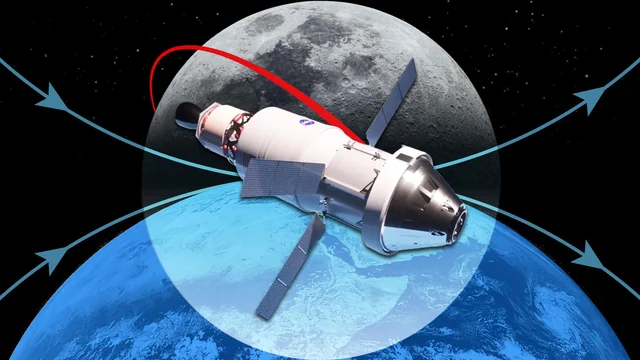
Humanity is about to stretch its legs beyond low-Earth orbit again, and this time the ride looks less like a cramped capsule and more like a cleverly packed studio apartment in space. The Artemis II mission will send four astronauts aboard NASA’s Orion spacecraft on a 10-day journey around the Moon, testing systems that could eventually support lunar landings.
Led by NASA, Artemis II marks the first crewed mission beyond Earth orbit since the Apollo era. Here’s a clear, complete look at Orion’s design, what astronauts will live with, how long the trip lasts, and yes, the surprisingly important toilet situation.
What is Artemis II, and why does it matter
Artemis II is not a landing mission. Think of it as a full-system dress rehearsal.
The crew includes:
- Reid Wiseman (Commander)
- Victor Glover (Pilot)
- Christina Koch (Mission Specialist)
- Jeremy Hansen (Mission Specialist)
They will travel aboard the Orion spacecraft, launched on the Space Launch System from Kennedy Space Center.
The mission’s goal is simple but critical: prove that humans can safely travel to deep space and back before attempting a lunar landing in future Artemis missions.
What does the Orion spacecraft look like inside?
Orion has been described as a “deep-space minivan,” but that undersells the engineering puzzle inside.
Cabin size and layout
- Total pressurized volume: ~330 cubic feet
- Roughly 50% more space than Apollo capsules
- Open-plan design with no separate rooms
All four astronauts share a single cabin, meaning every inch is multifunctional.
Key inclusions
Despite the tight space, Orion packs in essentials:
- Sleeping stations strapped to the walls
- Six windows for navigation and breathtaking views
- Compact kitchenette (about suitcase-sized)
- Food warmer and water dispenser
- Exercise setup for microgravity movement
- Radiation shelter using storage compartments
After launch, the crew reconfigures the cabin by folding seats and setting up living systems, turning a launch cockpit into a livable habitat.
How long is the Artemis II trip?
The mission is expected to last about 10 days, covering roughly 900,000 kilometers (560,000 miles).
What the journey includes
- Launch and Earth orbit checkout
- A free-return trajectory around the Moon
- Travel beyond the Moon’s far side
- Return to Earth without propulsion corrections
At its peak distance, the crew will travel thousands of kilometers beyond the far side of the Moon, farther than any human has gone before.
How will astronauts live for 10 days in one room?
Living in Orion is less like camping and more like a carefully choreographed routine.
Daily life includes
- Monitoring spacecraft systems
- Conducting demonstrations and experiments
- Exercising to maintain muscle health
- Eating pre-packaged meals
- Sleeping in vertical or horizontal strapped positions
There’s no wasted motion. Every activity is planned, timed, and optimized for a space where drifting into a wall is just one careless push away.
The toilet problem: why it’s a real engineering challenge
Space toilets are notoriously tricky. Gravity, the silent partner in every Earth bathroom, is missing.
What Orion uses
- A toilet system similar to the one on the International Space Station
- Airflow-based suction to guide waste
- A do-it-yourself installation by astronauts on Day 1
Yes, the crew has to assemble part of their own bathroom.
What happens if it fails?
NASA has backup plans:
- Urine collection bags
- Alternative waste disposal systems
- A “poop chute” mechanism for solid waste
Privacy is also… creative. With a single cabin:
- Curtains or partitions are used
- Scheduling becomes part of mission etiquette
It’s a reminder that even in cutting-edge spaceflight, some problems remain stubbornly human.
How Orion handles deep space dangers
Beyond comfort, Orion is built to survive harsh conditions.
Key protections
- Radiation shielding, especially in the storm shelter area
- Life-support systems for oxygen, temperature, and pressure
- Heat shield for re-entry at extreme speeds
- Autonomous navigation systems
The mission will test whether these systems can support humans safely outside Earth’s protective magnetosphere.
How Artemis II compares to Apollo missions
Orion may echo Apollo in purpose, but it’s a different beast.
Major upgrades
- More living space
- Digital flight systems instead of analog controls
- Improved radiation protection
- Longer mission duration capability
Yet the core idea remains unchanged: send humans out, bring them back safely, and learn everything possible in between.
What comes after Artemis II?
If Artemis II succeeds, it sets the stage for:
- Artemis III, which aims to land humans on the Moon
- Long-term lunar exploration
- Future missions to Mars
This mission is less about footprints and more about confidence.
TL;DR
- Artemis II will send four astronauts around the Moon for ~10 days
- Orion is a compact, open-plan spacecraft with living essentials
- The trip will cover about 900,000 km
- Astronauts will eat, sleep, and work in a single shared space
- The toilet system exists, but it’s part DIY and part backup planning
- The mission is a critical step toward future Moon landings