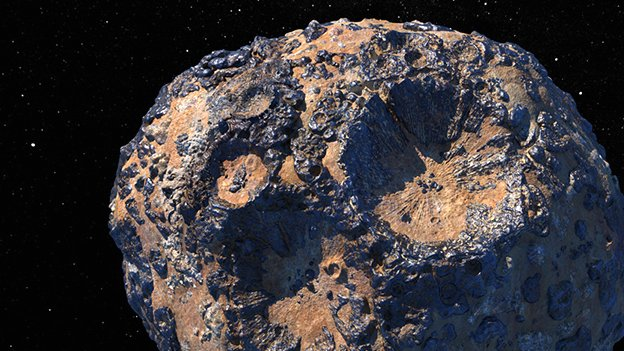
Asteroid 16 Psyche has earned a reputation as the “most valuable object in the Solar System”, with estimates suggesting its metal content could theoretically be worth around $10 quintillion (sometimes reported as $10,000 quadrillion). The figure is so enormous that it exceeds the value of the entire global economy many times over.
But scientists caution that this headline-grabbing number is often misunderstood. Psyche is not a giant floating vault waiting to be mined. Instead, it is one of the most scientifically important objects ever discovered—offering researchers a rare opportunity to study how rocky planets like Earth formed billions of years ago.
What is Asteroid 16 Psyche?
Asteroid 16 Psyche is a large, metal-rich asteroid located in the main asteroid belt between Mars and Jupiter.
Discovered in 1852 by Italian astronomer Annibale de Gasparis, it was the 16th asteroid ever identified, giving rise to its name.
Unlike most asteroids, Psyche appears to contain unusually high amounts of metallic material, particularly iron and nickel.
Current observations suggest:
- It measures roughly 280 km by 232 km across at its widest dimensions.
- It follows an orbit between Mars and Jupiter.
- Metal may account for roughly 30% to 60% of its volume, according to NASA’s latest estimates.
Scientists believe Psyche could represent a partially exposed interior of an early planetary building block, although newer research suggests its history is more complex than originally thought.
Why is Psyche supposedly worth $10 quintillion?
The famous valuation comes from a simple thought experiment.
Researchers estimate the amount of iron and nickel the asteroid may contain and multiply those quantities by today’s commodity prices on Earth.
The result is a theoretical value approaching $10 quintillion.
However, this calculation assumes several unrealistic conditions:
- Every ounce of metal could be extracted.
- All of it could be transported to Earth.
- Commodity prices would remain unchanged.
- Mining and transportation would cost nothing.
None of those assumptions reflect economic reality.
The figure is better understood as a way to illustrate the asteroid’s enormous metal content rather than its actual financial value.
Why the asteroid isn’t a trillionaire’s treasure chest
If even a tiny fraction of Psyche’s metal reached Earth, global commodity markets would change dramatically.
Supply affects prices
Iron and nickel prices depend on scarcity.
Introducing vast quantities into Earth’s markets would likely:
- Collapse commodity prices.
- Reduce the value of additional material.
- Make much of the theoretical valuation meaningless.
Economists call this a supply shock.
In other words, an asteroid cannot simply be multiplied by today’s market prices to determine its real economic worth.
Is Psyche actually made entirely of metal?
Probably not.
For many years, scientists suspected Psyche was the exposed metallic core of a failed planet.
More recent research paints a more complicated picture.
Current evidence suggests Psyche contains:
- Iron-rich regions
- Nickel
- Rocky silicate material
- Impact debris
- Uneven surface composition
Instead of being a giant solid metal sphere, Psyche is increasingly viewed as a mixed world shaped by billions of years of collisions.
Why is NASA visiting Psyche?
NASA’s Psyche mission has nothing to do with mining.
Instead, it aims to answer fundamental questions about planetary formation.
The spacecraft launched in October 2023 and performed a gravity assist flyby of Mars in May 2026.
If everything proceeds as planned, it will arrive at Psyche in late 2029 before beginning approximately two years of scientific observations.
What will NASA study?
The spacecraft carries several scientific instruments designed to investigate the asteroid’s composition.
These include:
- A multispectral imager
- A gamma-ray and neutron spectrometer
- A magnetometer
- A radio science experiment to measure gravity
Together, these instruments will help scientists determine:
- How much metal Psyche contains
- Whether it once had a magnetic field
- How its surface formed
- Whether it truly resembles a planetary core
Could Psyche really be the core of a planet?
That remains one of the mission’s biggest questions.
If Psyche is the exposed metallic core of an ancient planetesimal, it would provide scientists with a rare opportunity to study material similar to Earth’s inaccessible core.
However, recent observations suggest a more complicated history involving:
- Partial melting
- Multiple impacts
- Mixed rock and metal
- Surface reprocessing
Regardless of which theory proves correct, Psyche promises to reveal valuable information about the earliest stages of planetary evolution.
Could humans mine Psyche someday?
Not with current technology.
Several major obstacles remain:
- The asteroid lies hundreds of millions of kilometers from Earth.
- Mining equipment capable of operating autonomously in deep space does not yet exist.
- Returning large quantities of material would be extraordinarily expensive.
- International laws governing asteroid resource extraction continue to evolve.
While companies have explored asteroid mining concepts for years, no commercial mission has demonstrated economically viable extraction beyond Earth.
Why scientists care more about science than money
Although headlines often focus on Psyche’s theoretical price tag, researchers view the asteroid differently.
Its greatest value lies in the clues it may hold about:
- Planet formation
- Differentiated worlds
- Metallic planetary cores
- Early Solar System evolution
Understanding how Psyche formed could improve our understanding of Earth, Mars, Mercury, and other rocky planets.
What happens after NASA arrives?
Once the spacecraft enters orbit in 2029, scientists hope to answer several longstanding questions:
- Is Psyche truly a planetary core?
- How much metal does it actually contain?
- Is the metal evenly distributed?
- Did the asteroid once generate a magnetic field?
- How did billions of years of impacts shape its surface?
The answers may fundamentally reshape scientists’ understanding of planetary evolution.
TL;DR
- Asteroid 16 Psyche’s famous $10 quintillion valuation is a theoretical calculation, not a realistic market value.
- The asteroid is unusually rich in iron and nickel but likely contains significant rocky material as well.
- NASA’s Psyche mission is focused on planetary science, not mining.
- The spacecraft is expected to reach the asteroid in 2029 after launching in 2023.
- Scientists hope the mission will reveal whether Psyche is the exposed core of an early planetesimal or a more complex mixture of rock and metal.