Cowboy Space has unveiled a rocket that turns into a data center. The California startup, run by Robinhood co-founder Baiju Bhatt, designed Big Iron so its upper stage stays in orbit as a satellite with about 1 megawatt of AI computing. It wants 20,000 of them.
Bhatt showed the design on Monday, October 26, at a Palo Alto event called “Big Sky Rising,” Space.com reported. The company is aiming for a first launch in December 2028. Nothing has flown yet, and the company’s own website calls its capabilities and timelines “design objectives,” not demonstrated results.
From power beaming to data centers
Cowboy Space started in 2024 as Aetherflux. Its first goal was to beam solar power from orbit to the ground with lasers. It rebranded this year and moved into orbital data centers and launch, Via Satellite reported in May. The company has offices in San Carlos, California, and Seattle.
Investors are betting heavily on the pivot. Cowboy closed a $275 million Series B in May, SatNews reported. Index Ventures led the round at a $2 billion valuation.
The company’s press release also lists Breakthrough Energy Ventures, Construct Capital, Interlagos and IVP as backers.
Bhatt summed up the turn to rockets in the release: “We set out to build data centers in space and found there weren’t enough rockets to get them there.”
How a rocket stage becomes a satellite
On paper, Big Iron looks a lot like SpaceX’s Falcon 9. The stainless-steel rocket would stand 282 feet (86 meters) tall and 15.4 feet (4.7 meters) wide, Space.com reported. It also copies Falcon 9’s layout: nine engines on the first stage and one on the upper stage.
Cowboy’s Clydesdale engines burn liquid oxygen and methane, and the company says each makes 300,000 pounds of thrust. It rates the rocket to lift more than 15,000 kilograms to sun-synchronous orbit.
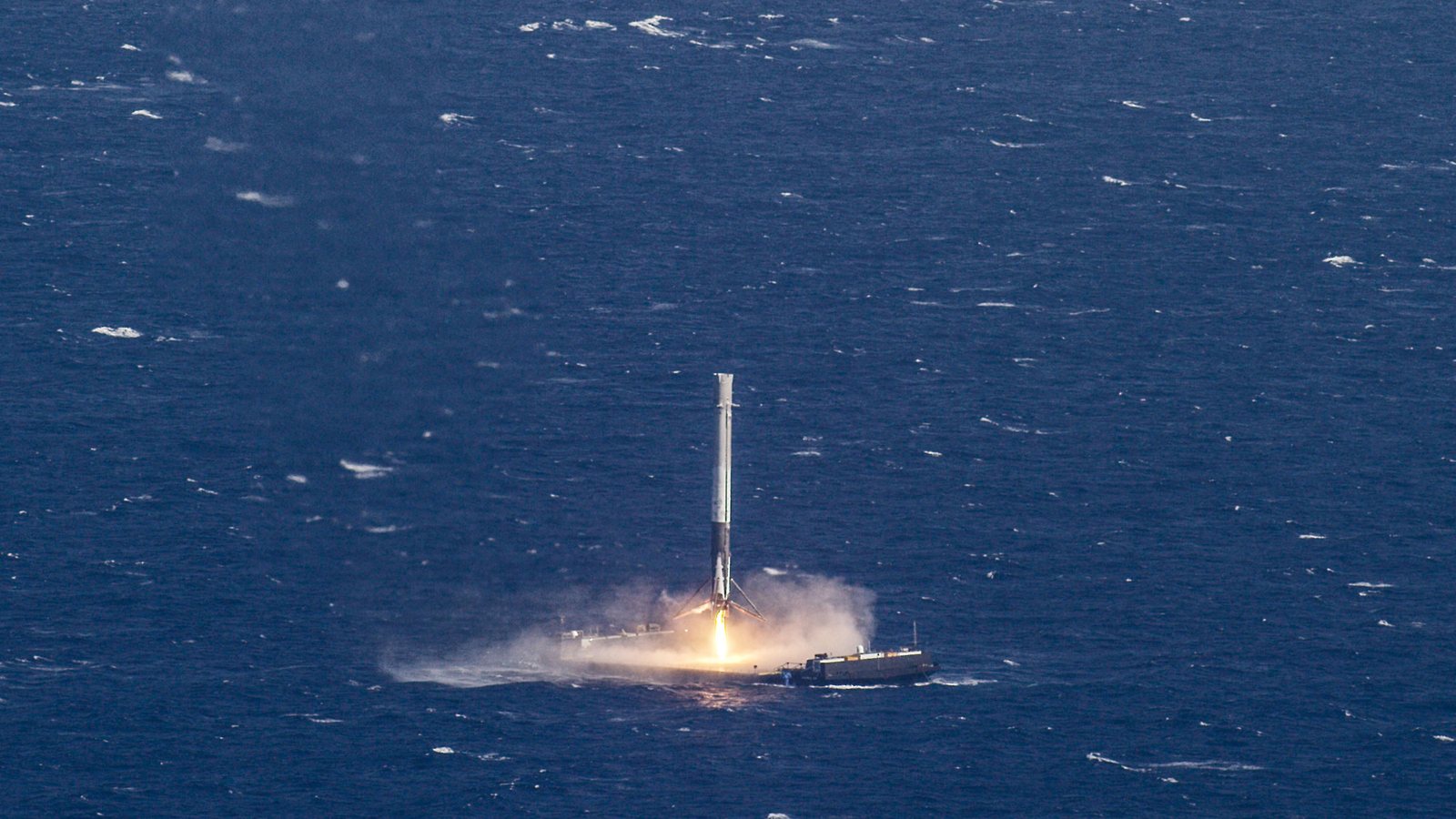
Cowboy plans to reuse the first stage. An animation Bhatt showed had it landing on a ship at sea, the way Falcon 9 boosters do.
The new idea is the upper stage. Instead of dropping a satellite and being thrown away, it becomes the satellite.
“The idea is that you have a two-stage rocket where the upper stage of the rocket itself transforms into the satellite,” Bhatt said. He called it “a fundamentally novel approach to rocketry in the modern era, in our opinion.”
Cowboy wants each part to do two jobs. According to the company, the rocket’s skin doubles as the radiator that sheds heat from the chips. The ammonia propellant serves as coolant, and the nitrogen that pressurizes the stage also unfolds the solar wings. Once deployed, each satellite would measure 132 by 73 meters and carry five racks of Nvidia Vera Rubin GPUs.
COO Joseph Yaffe put it plainly to Payload: “you’re paying for that same metal twice to lift it into space.”
The math of 20,000 launches
The constellation, called Stampede, is where the plan gets very large. Cowboy asked the Federal Communications Commission in May to approve up to 20,000 satellites.
The company asked the FCC to waive its usual deployment deadlines, Via Satellite reported. It said service could start with a single satellite. SatNews reported that Cowboy also told the agency its satellite design isn’t finished.
Because each Big Iron carries one satellite, building Stampede takes 20,000 launches. Space.com estimated it would likely take several thousand more every year to keep the fleet at that size.
The company intends to launch multiple times a day from sites it calls Trailheads, Space.com reported. Bhatt said each site will likely have four launch mounts. Cowboy hasn’t said where they will go.
Our arithmetic shows the scale. Even at three launches a day, every day of the year, 20,000 launches would take more than 18 years. At 1 megawatt each, a full Stampede would carry about 20 gigawatts of computing payload. That assumes every satellite works as designed.
Bhatt argues the design will pay for itself. “Our design puts us on a path to cost parity with terrestrial data centers,” he said in the release. The company has not published a price for launch or for computing time.
Why AI companies are looking up
The pitch rests on power. Cowboy’s website says new data centers in big US markets can wait five to seven years for a grid hookup. That bottleneck is already reshaping towns on the ground, as with xAI’s power plant fight in Southaven, Mississippi.
Cowboy’s answer is to put the chips where the sunlight is, in dawn-dusk orbits, and skip the grid entirely. Space brings its own problems, though.
“Dissipating one megawatt of thermal load in vacuum is not a trivial engineering exercise,” wrote SatNews editor Nick David. He added that the optical-only design “mitigates but does not eliminate” the debris risk of a 20,000-satellite shell.
Cowboy isn’t alone. SpaceX has asked for authority for up to 1 million orbital data center satellites, Via Satellite reported. Starcloud has asked for up to 88,000.
Bhatt compared Big Iron with Starmind, SpaceX’s planned data center spacecraft. Space.com said each Starmind would carry about 250 kilowatts of compute payload. Google plans to test the concept with prototype satellites under its Project Suncatcher.
What Cowboy has actually flown
So far, one satellite. Reason-1 launched on SpaceX’s Transporter-18 rideshare on October 1 to test laser power beaming from orbit to the ground. Yaffe told Payload the first beaming attempt will likely come in the next few weeks.
A second satellite, Reason-2, is due in 2027 to run GPUs in orbit, Payload reported. One planned customer is a NOAA effort to process weather data in space.
The engine work is just starting. Cowboy tested part of a Clydesdale engine at NASA’s Stennis Space Center the week before the unveiling, according to Payload. Yaffe said the company is “almost a year ahead of schedule.” He also said, “We just still have a lot of executing to do.”
The company is also opening Big Iron to outside customers through a program it calls Big Iron Express. Yaffe told Payload that government buyers “want to see a completed rocket” first.
Bhatt didn’t promise the December 2028 date. “Now, a lot of things have to go right for that to happen; it’s not a guarantee,” he said. The next checkpoints come sooner: Reason-1’s first power-beaming attempt in the coming weeks, and an FCC decision on Stampede.