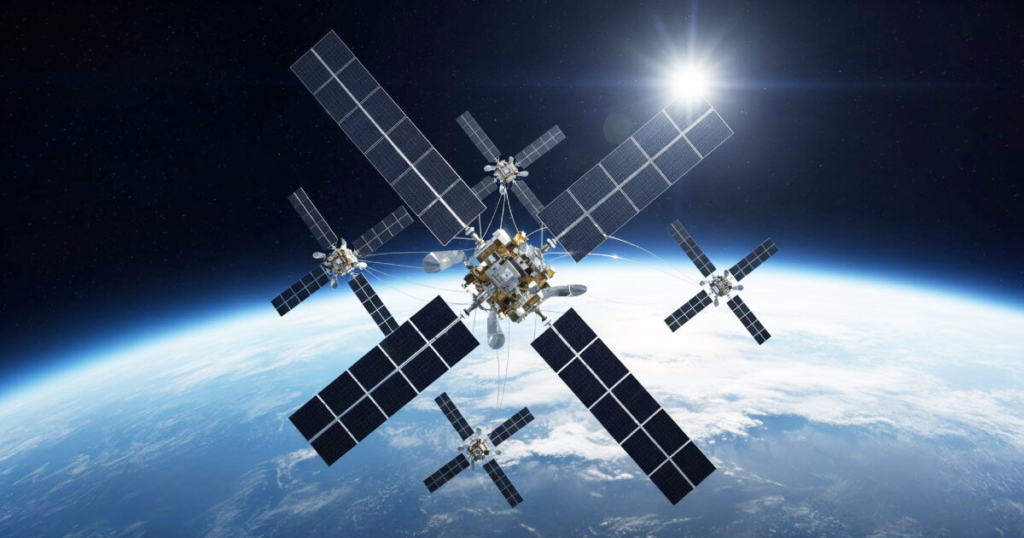
Google is preparing to test a radical idea for artificial intelligence infrastructure: putting data centers in space.
The company plans to launch a refrigerator-sized satellite carrying computing power equivalent to a single server as part of Project Suncatcher, an experimental effort exploring whether AI computing could eventually operate in orbit. The satellite is expected to launch aboard a SpaceX Falcon 9 on October 1, according to The New York Times.
The experiment puts Google alongside other technology and space companies exploring the possibility of orbital computing. Elon Musk’s SpaceX and Jeff Bezos’ Amazon have also discussed using satellite networks to support computing and AI workloads in space.
The concept could offer access to near-continuous sunlight and reduce some of the constraints facing terrestrial data centers. But the technology remains experimental, and major questions remain about cost, cooling, radiation, maintenance, orbital debris and the environmental consequences of putting enormous computing infrastructure above Earth.
What is Google’s Project Suncatcher?
Project Suncatcher is Google’s research effort to investigate whether AI computing could eventually be moved from Earth into orbit.
The basic idea is straightforward: instead of building increasingly large data centers on the ground, companies could deploy networks of computing satellites powered primarily by solar energy.
Google’s planned test satellite is expected to carry computing hardware roughly equivalent to one server. The spacecraft will be used to test how such systems perform under actual orbital conditions rather than only in laboratory simulations.
The satellite is reportedly designed to remain in orbit for as long as six years before re-entering Earth’s atmosphere.
Google senior vice president for research James Manyika told The New York Times that the company does not expect the technology to become usefully operational within the next few years.
That makes the upcoming launch a technology demonstration rather than the beginning of an operational space-based data center network.
Why does Google want data centers in space?
The biggest attraction is energy.
AI data centers require enormous amounts of electricity, particularly as companies deploy increasingly powerful chips to train and operate large AI models.
On Earth, operators must secure electricity, land, cooling systems, water and grid connections. Building new facilities can also take years and requires extensive infrastructure.
A satellite in orbit has access to sunlight without the interruption caused by night.
That could allow solar panels to generate electricity for much longer periods than conventional solar installations on Earth’s surface.
Project Suncatcher is essentially testing whether that advantage can outweigh the enormous technical and financial costs of operating computing infrastructure in space.
How would an orbital AI data center work?
A future orbital computing system would likely combine several components:
- Solar panels to generate electricity.
- Computing hardware to run AI workloads.
- Radiators to remove heat from the electronics.
- Communications systems to send data between satellites and Earth.
- Propulsion and navigation systems to maintain the satellites’ orbits.
- Multiple spacecraft working together as an orbital computing network.
The concept sounds similar to a terrestrial cloud data center, but with one crucial difference: every component must operate in an environment where physical repair is extremely difficult.
That creates a fundamental engineering trade-off.
On Earth, a failed server can often be replaced by a technician. In orbit, replacing a failed component could require another spacecraft, a robotic servicing mission or an entirely new satellite.
What is the advantage of constant sunlight?
Solar power is one of the strongest arguments for orbital computing.
Spacecraft in certain orbits can receive sunlight for much longer periods than solar farms on Earth. A sufficiently large solar array could therefore provide substantial power without relying on the terrestrial electricity grid.
For AI companies, that could eventually mean building computing capacity without competing directly for scarce electricity-generation and transmission infrastructure on Earth.
But sunlight is only one part of the equation.
Turning sunlight into electricity produces heat, and computer chips also generate heat. In space, there is no atmosphere to carry heat away through conventional air cooling.
That makes thermal management one of the major challenges facing orbital data centers.
Why is cooling so difficult in space?
Computers produce heat whenever they operate.
On Earth, data centers commonly use air, chilled water or other cooling systems to move that heat away from servers. Space offers no surrounding atmosphere for ordinary air cooling.
Instead, spacecraft must radiate heat into space.
That requires carefully designed thermal systems and radiators. As computing power increases, the amount of heat that must be removed also increases.
This creates a potentially important limitation for orbital AI.
A future satellite may have abundant solar energy but still struggle to convert that energy into useful computing capacity if it cannot efficiently dispose of the resulting heat.
Could space data centers solve the environmental problems of AI?
Possibly in some areas, but they would not make AI infrastructure impact-free.
Large terrestrial data centers consume significant amounts of electricity and, depending on their cooling systems and location, can also require substantial quantities of water.
Moving computing hardware into orbit could reduce the need for some terrestrial land and water resources.
But the environmental calculation would also have to include rocket launches, satellite manufacturing, communications infrastructure and eventual atmospheric re-entry.
A large orbital computing network would require many launches and enormous quantities of hardware.
That means the environmental cost would not simply disappear. Some impacts would move from data-center construction and electricity generation toward spacecraft production and launch operations.
What happens if an orbital data center breaks?
This is one of the biggest differences between terrestrial and space-based computing.
A conventional data center is designed around physical access. Engineers can replace servers, repair cooling systems and upgrade hardware.
A satellite is much harder to service.
A serious hardware failure could render an individual spacecraft partially or completely unusable. If orbital servicing is not economically practical, operators may have to replace the entire satellite.
That creates another question for Project Suncatcher: Can space-based computing hardware be made reliable enough to justify the cost of launching it?
The answer will depend partly on how quickly computing technology becomes obsolete.
AI hardware develops rapidly. A server that is competitive today may be considerably less efficient than newer hardware several years later.
An orbital data center therefore faces an unusual problem: it must survive in space while remaining economically useful as computing technology changes.
What about space junk?
Orbital debris is another major concern.
Earth’s orbital environment contains thousands of tracked objects and many smaller pieces of debris. Even a relatively small piece of material traveling at orbital velocity can seriously damage a spacecraft.
For a terrestrial data center, a hardware failure is generally an operational problem.
For a satellite, a collision could destroy the entire computing platform.
A future constellation containing hundreds or thousands of computing satellites would therefore need sophisticated collision-avoidance systems and careful orbital management.
Could radiation damage AI chips?
Yes.
Spacecraft outside Earth’s protective atmosphere and magnetic environment are exposed to higher levels of radiation than electronics operating on the ground.
High-energy particles can cause errors in electronic systems and, over time, contribute to degradation of components.
Space missions therefore use hardware and engineering techniques designed to withstand radiation.
For orbital AI, the challenge becomes more complicated because advanced computing chips are extremely dense and sophisticated. A system designed for high-performance AI may not automatically be optimized for long-term operation in a radiation-heavy environment.
Google’s experiment should help researchers collect real-world data on how computing hardware performs under those conditions.
Why large satellite constellations could be controversial
One experimental satellite is very different from a future orbital data center network.
If the technology works, companies could eventually envision deploying large numbers of computing satellites.
That could create new concerns about:
- Orbital congestion
- Collision risks
- Space debris
- Rocket-launch emissions
- Satellite re-entry
- Astronomical observations
- Radio-frequency interference
- Manufacturing and disposal of spacecraft
The scale would ultimately determine the environmental and operational impact.
A handful of experimental satellites would have a very different footprint from a constellation containing thousands or potentially far more spacecraft.
Claims about extremely large future constellations should therefore be treated separately from Google’s current test mission.
Is SpaceX also planning space-based data centers?
SpaceX has explored the idea of putting computing infrastructure into orbit alongside its Starlink satellite network.
Elon Musk has discussed the possibility of using satellite constellations to support AI computing in space, while Amazon founder Jeff Bezos has separately promoted the idea of moving certain industrial activities and infrastructure away from Earth.
These proposals reflect a broader shift in thinking about where computing infrastructure could operate.
However, discussions about future mega-constellations are not the same as demonstrated operational systems. The economics, hardware requirements and regulatory framework for orbital data centers remain unresolved.
When could data centers actually move into space?
Not anytime soon, based on Google’s own description of Project Suncatcher.
The upcoming satellite is an experiment designed to answer basic technical questions.
Researchers first need to establish whether computing hardware can operate reliably in orbit, whether solar generation and thermal management work as expected, whether data can be transmitted efficiently and whether the economics make sense.
Only after those questions are answered would it make sense to consider scaling the concept.
That could take years.
And even if the technology works technically, an orbital data center would still have to compete economically with increasingly efficient terrestrial facilities.
The bigger question: Can AI computing leave Earth?
Project Suncatcher is testing more than a new type of satellite.
It is testing an increasingly important question for the AI industry: where should the world’s future computing infrastructure be built?
AI companies are already looking for enormous quantities of electricity and suitable locations for new data centers. Space offers an intriguing alternative because of its access to sunlight and the absence of some terrestrial constraints.
But space replaces those problems with a different set of challenges.
Hardware cannot be easily repaired. Heat must be radiated away. Radiation can damage electronics. Launches are expensive. Orbital debris creates collision risks, and large constellations could introduce new environmental and regulatory concerns.
For now, Google’s satellite will provide a much more modest answer.
It will test whether a single server can function in orbit.
Whether that experiment can eventually lead to a space-based AI data center is a much bigger question—and one Google itself does not expect to answer in the immediate future.
TL;DR
- Google is preparing to test Project Suncatcher, an effort to explore AI computing in space.
- A refrigerator-sized satellite carrying computing power equivalent to a single server is expected to launch aboard a SpaceX Falcon 9.
- The spacecraft is designed to test orbital computing and could remain in orbit for up to six years.
- Constant access to sunlight could provide an advantage for solar-powered computing.
- Major challenges include cooling, radiation, orbital debris, maintenance, launch costs and communications.
- Moving data centers into space could reduce some terrestrial resource demands but would introduce new environmental impacts.
- Google’s current mission is an experiment, not an operational orbital data center.