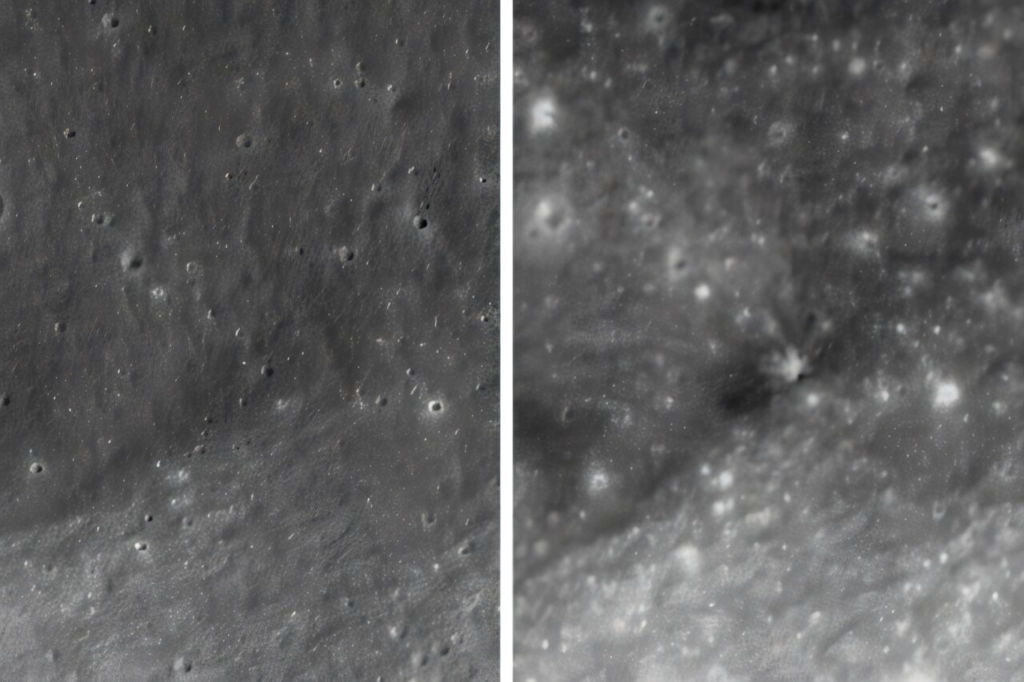
A discarded SpaceX Falcon 9 rocket upper stage has slammed into the Moon at roughly 5,400 mph, creating a fresh impact crater that scientists estimate could be as wide as 27 meters. The unusual collision gave researchers something they rarely get with lunar impacts: images of the same patch of the Moon both before and after the strike.
South Korea’s Danuri lunar orbiter captured the site shortly before and after the impact, allowing scientists to identify changes in the surface and traces of material thrown outward by the collision.
The event was not a planned lunar experiment. The Falcon 9 stage had been left in space after completing its mission in 2025 and gradually ended up on a collision course with the Moon.
What happened to the SpaceX rocket?
The object that hit the Moon was the upper stage of a SpaceX Falcon 9 rocket launched from Florida in January 2025.
The mission carried Firefly Aerospace’s Blue Ghost and ispace’s Resilience lunar landers toward the Moon. After completing its role in the mission, the upper stage remained in space rather than returning to Earth.
Over time, its trajectory changed under the influence of the Moon’s gravity and other factors, including solar activity. Eventually, astronomers determined that the rocket stage was heading toward the lunar surface.
The roughly 12-meter-long stage weighed an estimated 4,000 to 4,500 kilograms. It ultimately struck the Moon at about 8,700 kilometers per hour, or roughly 5,400 mph.
Researchers estimate the collision released energy equivalent to about three tons of TNT.
How big is the crater from the SpaceX rocket crash?
Scientists estimate that the impact created a crater up to about 27 meters wide and roughly five meters deep.
The exact dimensions will require additional observations because crater size depends on several factors, including the object’s mass, speed, impact angle and the physical properties of the lunar surface.
The impact also excavated lunar material, creating a plume of dust and debris around the newly formed crater.
The resulting mark is expected to look different from many natural lunar craters because researchers have unusually detailed information about the object that created it.
How did South Korea’s Danuri spacecraft capture the Moon before and after the impact?
The Korea Aerospace Research Institute’s Danuri spacecraft was in an unusually useful position to document the event.
Danuri began observing the region approximately 30 minutes before the collision and carried out eight imaging sessions. Its observations provide researchers with a baseline image of the lunar terrain before the impact and subsequent images showing what changed.
KARI said the observations revealed changes in the terrain around the impact site as well as traces of ejecta, the material thrown outward when the rocket struck the surface.
That before-and-after record is particularly valuable because scientists normally have to study lunar impacts using images taken after the event and then work backward to estimate what happened.
Why are before-and-after images so important?
Natural meteoroid impacts happen frequently on the Moon, but scientists usually do not know precisely what caused a newly discovered crater.
A meteoroid may be detected before impact, but in many cases researchers cannot determine its exact mass, composition, shape or impact trajectory. That makes it difficult to connect the characteristics of the impactor with the crater it creates.
The Falcon 9 stage changes that equation.
Scientists have estimates for:
- The rocket stage’s mass
- Its approximate dimensions
- Its trajectory
- Its impact speed
- The location of the collision
- The resulting surface changes
That makes the event a useful natural laboratory for studying lunar impacts.
Researchers can compare computer models of the collision with what actually happened on the Moon. If those models accurately reproduce the crater and debris pattern, they can potentially improve scientists’ understanding of other lunar impacts.
Was the SpaceX rocket supposed to hit the Moon?
No. The collision was not part of the original mission plan.
The rocket stage was left in space after delivering its payload toward the Moon. Its subsequent trajectory eventually brought it into contact with the lunar surface.
This is an important distinction because spacecraft are sometimes intentionally sent into the Moon at the end of their missions. In those cases, scientists can prepare instruments to observe the collision.
Here, the impact was effectively an unintended experiment.
The incident also highlights a broader issue in lunar exploration: as more spacecraft and launch vehicles operate around the Moon, mission planners increasingly have to consider where discarded hardware will eventually go.
Did astronomers see the impact happen?
Researchers in Spain say they captured evidence of the impact through telescopic observations.
The actual flash from the collision was reportedly hidden behind the Moon’s limb from their viewing position. However, astronomers said they may have recorded the plume of dust and debris produced by the impact.
Jose Maria Madiedo of Spain’s Institute of Astrophysics of Andalusia shared preliminary footage showing the evolution of material ejected from the lunar surface.
Further analysis will be needed to determine exactly what the observations reveal.3
What will NASA’s Lunar Reconnaissance Orbiter do?
NASA’s Lunar Reconnaissance Orbiter is also expected to observe the impact location during a later pass.
Those observations could provide another layer of evidence about the crater’s dimensions and the distribution of debris.
Comparing Danuri’s images with later LRO observations could help scientists determine how much material was displaced and whether the impact produced secondary craters nearby.
The additional observations are important because the first images taken after an impact do not necessarily reveal the entire story. Dust can settle over time, while later high-resolution images may make the boundaries of the crater easier to identify.
Why does an accidental rocket crash matter for lunar science?
The collision provides scientists with a rare controlled-data problem.
Unlike an asteroid or meteoroid, the Falcon 9 stage was a known human-made object. Researchers can estimate its mass and speed with far greater confidence than they can for an unknown space rock.
That makes it possible to test theories about how impact energy is converted into:
- Crater formation
- Excavation of lunar soil
- Ejecta plumes
- Surface deformation
- Debris distribution
The results could eventually help researchers interpret craters created by natural impacts elsewhere on the Moon.
Has spacecraft been deliberately crashed into the Moon before?
Yes. Space agencies have deliberately impacted spacecraft on the Moon for scientific purposes.
One notable example was the European Space Agency’s SMART-1 mission. After completing its lunar mission, SMART-1 was intentionally directed into the Moon in 2006.
Scientists observed the impact to study the resulting plume and learn more about the lunar surface.
The Falcon 9 collision differs because it was not planned as a scientific experiment, but researchers can still extract useful information from it after the fact.
What does the crash mean for future lunar missions?
The incident comes as lunar activity is increasing, with government agencies and private companies planning more missions to the Moon.
More spacecraft operating in lunar orbit means more hardware will eventually need to be disposed of, parked or redirected. Mission designers therefore have to consider not only how spacecraft reach the Moon but also where they end up afterward.
That could make trajectory planning and end-of-mission disposal increasingly important parts of lunar exploration.
The Moon has no atmosphere capable of burning up objects the way Earth’s atmosphere does. A spacecraft left on the wrong trajectory can remain in space for a long time before gravity eventually sends it toward the lunar surface or elsewhere.
What scientists can learn from the impact
The SpaceX rocket crash is dramatic, but its greatest value may be scientific rather than visual.
Researchers now have an opportunity to compare a known impactor with the crater and debris it produced. Danuri’s before-and-after images make that opportunity even more valuable.
The next steps will involve determining the crater’s exact dimensions, studying the ejecta pattern and comparing observations from Danuri, NASA’s Lunar Reconnaissance Orbiter and Earth-based telescopes.
For scientists studying the Moon, an accidental collision has effectively become a data-rich experiment. It also offers a reminder that as humanity sends more hardware into lunar space, every mission has a second chapter: what happens to the spacecraft after its job is finished.