What makes this discovery so significant?
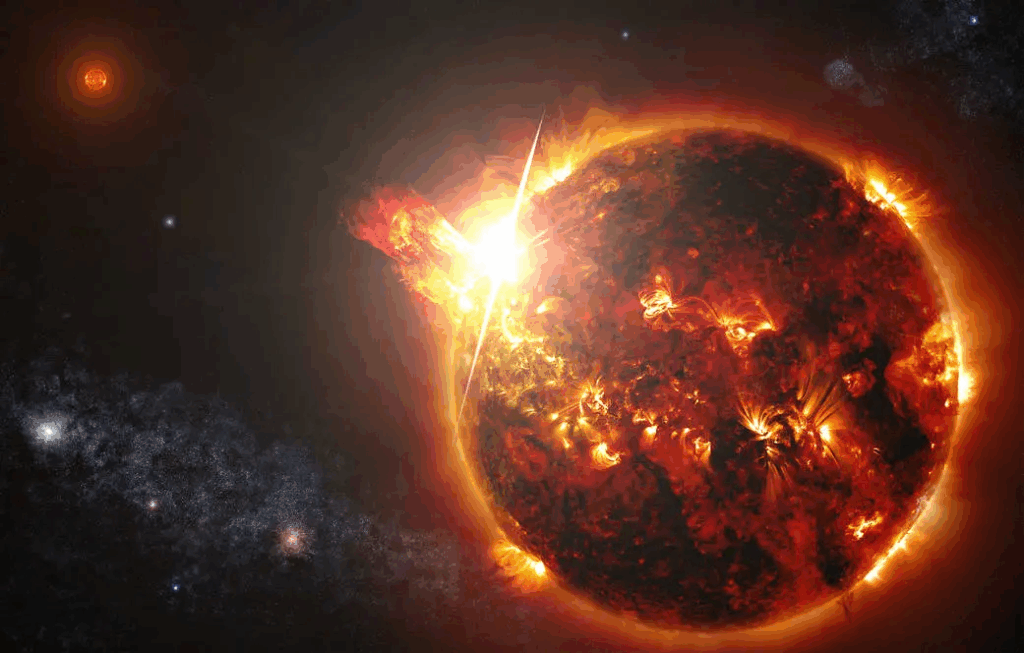
Astronomers have observed something never seen before: a coronal mass ejection, or CME, erupting from a star beyond our Sun. This extraordinary event was spotted on StKM 1-1262, a red dwarf located roughly 133 light-years away. For decades, scientists have studied solar storms from our Sun, but detecting such a storm on another star marks a major milestone in stellar physics and space weather research.
The CME on StKM 1-1262 was extreme by any measure. It blasted off at an estimated 2,400 km/s, carrying more than 10,000 times the energy typical of CMEs from our Sun. Such violent stellar outbursts had long been theorized, but until now, direct observational evidence was missing. This detection provides a crucial piece of the puzzle in understanding how stars behave across the galaxy.
The event also expands our view of what stellar systems experience over time. If CMEs on red dwarfs are this powerful and frequent, it could reshape how astronomers evaluate the environments around these stars, which make up the majority of stars in the Milky Way.
How astronomers captured the coronal storm
The breakthrough was made possible by the LOFAR (Low-Frequency Array) radio telescope, one of the most sensitive radio observatories in the world. Using LOFAR’s advanced capabilities, researchers were able to detect the shockwave of the CME as it burst from the star’s outer magnetic boundary during an eight-hour observation window.
Radio emissions from shockwaves are key indicators of CMEs. On Earth, similar signatures help space-weather specialists track solar storms heading toward our planet. Detecting the same kind of signal from another star required a telescope with both enormous sensitivity and wide-field monitoring, making LOFAR uniquely suitable.
StKM 1-1262 itself proved to be an ideal target. Classified as a rapidly rotating red dwarf, it spins about 20 times faster than the Sun. This fast rotation supercharges the star’s magnetic field, amplifying magnetic reconnection events that lead to flares and CMEs. Such stars are known to produce intense space weather, but this is the first time a CME has been actually observed instead of inferred.
This single detection also demonstrates that future radio telescopes—especially the upcoming Square Kilometre Array (SKA)—will be able to study stellar eruptions with unprecedented clarity. It opens a new observational window into stellar magnetism across the cosmos.
- How a CME forms on a star
- LOFAR’s radio detection method
- A comparison of CME speeds on the Sun vs StKM 1-1262
What this means for red dwarf systems
Red dwarfs are the most common type of star in our galaxy, and they frequently host compact planetary systems. Many exoplanets discovered to date, including several in potentially habitable zones, orbit red dwarfs. However, these stars are also known for intense magnetic activity, raising long-standing concerns about whether they can support life.
The new CME detection adds an important dimension to this debate. For a planet to remain warm enough for liquid water, it must orbit relatively close to a red dwarf. But this proximity makes the planet especially vulnerable to stellar storms. If the storms are as powerful as the one observed on StKM 1-1262, the implications are severe.
How coronal storms affect atmospheres
A CME that strong can strip away a planet’s atmosphere over time, even if the planet initially has Earth-like protection. Without an atmosphere, a planet loses its ability to regulate temperature, shield life from harmful radiation, and sustain surface water.
This creates a paradox: red dwarfs offer long lifespans and stable radiation output over billions of years, which are ideal conditions for life. Yet their extreme magnetic outbursts may prevent any atmosphere from surviving long enough for life to develop.
What this means for the search for life
Current models of habitability must now incorporate the possibility that powerful CMEs are not rare in red dwarf systems but potentially common. This could mean:
- Planets around quiet, slowly rotating red dwarfs are more promising candidates for life.
- Planets with strong magnetic fields may be better protected but still face atmospheric loss over geological timescales.
- The definition of a “habitable zone” may need refinement to include space weather conditions, not just temperature and stellar flux.
While this discovery does not eliminate red dwarfs as potential hosts for life, it underscores the need for a more detailed understanding of stellar activity in those systems.
How this discovery changes our understanding of space weather
CMEs are fundamental to understanding how stars interact with their surroundings. On Earth, solar storms can disrupt power grids, satellites, GPS systems, and communication networks. More intense storms from other stars could have even broader implications for their planetary systems.
This detection provides the first opportunity to:
- Compare the Sun’s magnetic behaviour with stars of different types
- Understand how stellar age, rotation speed, and magnetic field strength shape CME frequency
- Refine models predicting how stellar eruptions influence exoplanet evolution
It also gives astrophysicists a baseline to evaluate how common violent CMEs may be across the galaxy. Until now, most of what scientists knew about stellar weather came from solar analogs. This new data point from a rapidly rotating red dwarf expands the framework dramatically.
What scientists plan to study next
With this breakthrough, researchers are preparing for the next steps in stellar weather exploration.
Monitoring more red dwarfs
Astronomers plan to study other fast-spinning red dwarfs to see whether similarly powerful CMEs occur regularly. If so, red dwarf habitability models may need significant revision.
Using multi-wavelength observations
Radio telescopes detect shockwaves, but CMEs also produce X-ray and ultraviolet signatures. Coordinated observations across multiple wavelengths will provide a clearer picture of each storm’s full structure.
Leveraging upcoming telescopes
New facilities such as the SKA and space-based observatories will dramatically expand sensitivity and reach, enabling detection of smaller and more frequent CMEs.
These future studies will determine whether StKM 1-1262 is an extreme outlier or a representative example of red dwarf weather.
Why this discovery matters for the broader public
Understanding space weather isn’t just a scientific curiosity. It shapes the technological environment we live in. As humanity moves closer to establishing lunar bases, crewed Mars missions, and deep-space communication networks, the ability to understand and predict stellar storms becomes essential.
Moreover, as exoplanet research accelerates, questions about habitability and atmospheric survival become central to the search for life beyond Earth. This discovery gives scientists a crucial new tool for refining that search.