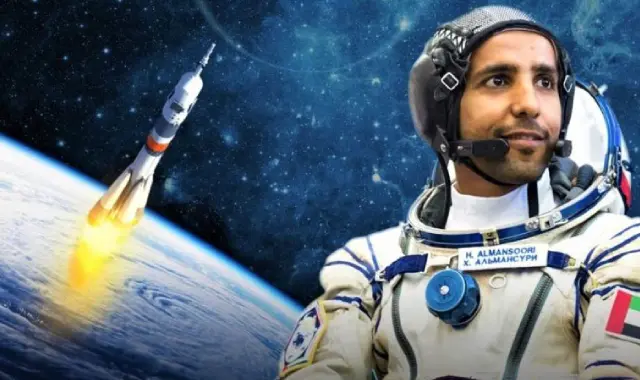
As India gears up to send Group Captain Shubhanshu Shukla to space aboard the Axiom 4 mission, NDTV spoke exclusively with Hazzaa Al Mansoori, the first Emirati astronaut, about his extraordinary journey aboard the International Space Station (ISS). His insights reveal the marvels and challenges of life in microgravity, international collaboration in space exploration, and the profound perspective shift that comes with viewing Earth from orbit.
“An amazing feeling”: The awe of spaceflight
Selected from over 4,000 applicants in 2017, Al Mansoori made history as the UAE’s first astronaut. Reflecting on his mission, he described the sensation of weightlessness as unparalleled.
“It’s something that I would say is amazing,” Al Mansoori said. “Just to have that feeling of floating, to know that humans are capable of achieving this type of machine up there… it was an amazing experience and amazing feeling.”
His selection marked a pivotal moment for the Arab world’s space ambitions. “Without hesitation, I applied,” he recalled. “It was a big thing, a big deal for us.”
Life aboard the ISS: A world without borders
The rhythm of space
Living on the ISS defies terrestrial norms. The station hurtles around Earth at 28,000 kilometers per hour, completing an orbit every 90 minutes, meaning astronauts witness 16 sunrises and sunsets each day.
“You’re floating, you’re watching Earth,” Al Mansoori explained. “You can see day and night every 45 minutes.”
Despite this, operations adhere to Greenwich Mean Time. “We are working with London time for our working activities, everything—the experiments, the exercises.”
A glowing planet below
One of his first acts upon arrival was locating Dubai from the Cupola, the ISS’s panoramic observation module. “Dubai was amazing,” he said. “Especially at night with the light cities… you can recognize places like the Palm Island. All astronauts want to see it.”
India, too, left a luminous impression. “The lights, you can see different places like New Delhi, Bombay. I remember just looking at different places and trying to take pictures.”
The harsh realities of space survival
Recycling everything—even urine
Life on the ISS demands meticulous resource management. Oxygen is machine-generated, and water is recycled, including urine.
“We say ‘coffee of today, is coffee of tomorrow,’ because everything is being collected and reused,” Al Mansoori said with a chuckle. “Even urine is recycled into drinking water.”
The contrast with Earth’s abundance is stark. “Here on the ground, oxygen is free, water is free. In space, everything is a resource you must manage carefully.”
Rigorous training across global space agencies
Al Mansoori’s preparation spanned the world’s leading space institutions: Russia’s Star City, NASA’s Johnson Space Center, JAXA in Japan, the Canadian Space Agency, and ESA in Europe.
“Each agency has a different perspective and flavour in their training, but all are very professional,” he noted.
He served as backup for Sultan Al Neyadi, the UAE’s second astronaut, emphasizing the importance of international collaboration. “We worked with instructors and scientists from different agencies. It was a great experience.”
Science in microgravity: Astronauts as “guinea pigs”
During his eight-day mission, Al Mansoori conducted experiments on time perception, tested floating robots for JAXA, and participated in Russian-led studies on space’s physiological effects.
“We are like guinea pigs,” he acknowledged. “We’re the subjects of experiments to help understand how humans can live and work in space.”
India’s rising star: Shubhanshu Shukla’s upcoming mission
Al Mansoori praised Group Captain Shukla, India’s Axiom 4 astronaut, whom he met during training.
“He’s an amazing person,” Al Mansoori said. “I walked with him during one of his training sessions. He’s the pilot for the Crew Dragon, and I have no doubt he can do it.”
He commended Shukla’s professionalism: “He’s very much grounded, very professional… He’s ready and he’s going to represent India in a very, very professional way.”
UAE and India: A growing partnership in space
Al Mansoori highlighted deepening ties between the two nations, from satellite development to human spaceflight.
“We have a long relationship, and we see it in daily life in both countries,” he said, echoing Prime Minister Narendra Modi’s vision: “He said we have to dream together, walk together, and think together. And we can achieve amazing things if we do them together.”
The brutal return to Earth
Re-entry was physically grueling. “Your body becomes weaker in microgravity,” he explained. “When you land, you feel the G-forces intensely. You can’t walk for a few days because your vestibular system needs to readapt.”
Full recovery took about a week, but the experience cemented his commitment to spaceflight. “I’m still active as a fighter pilot, but I’m fully committed to human spaceflight now.”
Inspiring the next generation
Al Mansoori’s mission has reshaped ambitions in the UAE. “Seven years ago, if you asked a child in the UAE if they wanted to be an astronaut, they’d say it’s impossible,” he noted. “Now, every kid wants to be one.”
With four Emirati astronauts now in the pipeline, including a woman training for a future mission, the UAE’s cosmic ambitions are soaring. “We’re looking forward to working with everyone, including India, to achieve great things in human spaceflight.”