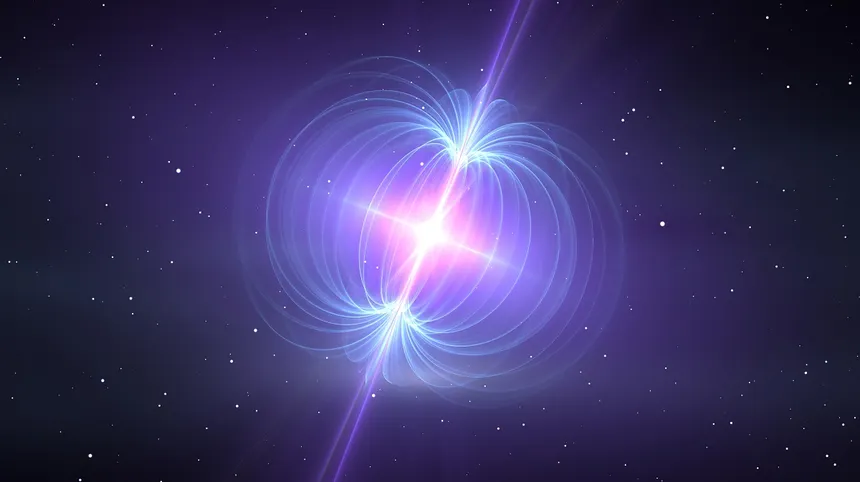
Every 22 minutes, like clockwork, something deep in the Milky Way sends a radio pulse toward Earth. It has been doing so since at least 1988. The object, known as GPM J1839-10, sits roughly 15,000 light-years away and behaves in a way that challenges long-standing theories about pulsars and neutron stars.
For astronomers, this is not just a curiosity. It is a crack in the rulebook.
What is GPM J1839-10?
GPM J1839-10 is a repeating radio source located in the constellation Scutum. It emits a powerful radio pulse approximately every 1,000 seconds, or 22 minutes.
That interval is the mystery.
Most repeating radio bursts in our galaxy come from pulsars, which are rapidly spinning neutron stars. Pulsars rotate multiple times per second, sending out lighthouse-like beams of radiation that sweep past Earth at regular intervals.
GPM J1839-10 does not follow that pattern. Its pulses can last between 30 seconds and five minutes. Then it falls silent until the next cycle.
Why is a 22-minute radio pulse so unusual?
Pulsars are the dense remnants of massive stars that exploded as supernovae. They are compact, extremely magnetic, and spin at astonishing speeds. Most known pulsars complete a rotation in milliseconds to a few seconds.
A 22-minute rotation period suggests something dramatically slower.
Under conventional astrophysics, a neutron star spinning that slowly should no longer produce strong radio emissions. There is a theoretical boundary known as the “death line,” beyond which pulsars are expected to fall silent because they can no longer generate the electric fields needed to power radio beams.
GPM J1839-10 appears to sit near or beyond that line, yet it keeps broadcasting.
This tension between theory and observation is what makes the object so compelling.
How was GPM J1839-10 discovered?
The signal was first identified in 2022 by researchers at Curtin University using the Murchison Widefield Array in Australia. After its discovery, astronomers dug into archival data.
Observations from the Giant Metrewave Radio Telescope in India and the Very Large Array in the United States revealed something remarkable. The signal had been present in data sets dating back to 1988.
Giant Metrewave Radio Telescope and Very Large Array had unknowingly recorded this cosmic metronome decades earlier.
That means Earth has been receiving these pulses for 38 years without fully recognizing their significance.
What could be producing the signal?
Scientists are considering several possibilities.
Ultra-long-period magnetar
One leading theory is that GPM J1839-10 could be an ultra-long-period magnetar. Magnetars are neutron stars with extraordinarily strong magnetic fields. They can produce powerful bursts of radiation.
If this object is a magnetar spinning once every 22 minutes, it would represent a new class of slow-spinning neutron stars capable of sustained radio emission.
White dwarf pulsar
Another possibility is a white dwarf pulsar. White dwarfs are the remnants of smaller stars and are much less dense than neutron stars. A highly magnetized white dwarf could, in theory, produce periodic radio bursts.
However, no confirmed white dwarf pulsar has yet matched the strength and stability of this signal.
A new category of long-period radio transient
GPM J1839-10 may belong to an emerging group of objects called long-period radio transients. In recent years, astronomers have identified a handful of slow, repeating radio sources that defy standard pulsar models.
If confirmed, this object could expand that category and force revisions to pulsar emission theory.
Does this mean we misunderstand pulsars?
Possibly.
For decades, pulsar theory has been grounded in the relationship between spin rate, magnetic field strength, and radio emission. The assumption was straightforward: as neutron stars slow down, their radio emissions weaken and eventually stop.
GPM J1839-10 complicates that picture.
It suggests that either:
• Some neutron stars can emit radio waves at much slower spin rates than predicted.
• Our understanding of the “death line” is incomplete.
• Or a different type of stellar remnant is responsible.
In science, anomalies are often more valuable than confirmations. They highlight where models need refinement.
Is it dangerous?
No evidence suggests that GPM J1839-10 poses any threat to Earth. At 15,000 light-years away, it is safely distant within our galaxy.
Its radio waves are detectable only by sensitive instruments. By the time they reach us, they are extraordinarily faint.
The object is scientifically disruptive, not physically dangerous.
Why does this discovery matter?
Discoveries like this reshape how astronomers think about stellar evolution.
If slow-spinning neutron stars can continue emitting radio pulses, then:
• The population of detectable neutron stars may be larger than expected.
• Surveys might need to adjust search strategies to detect long-period signals.
• Models of magnetic field decay in stellar remnants may require revision.
It also underscores the importance of archival data. The signal was hiding in plain sight for decades, waiting for researchers to connect the dots.
TL;DR
GPM J1839-10 has been sending a radio pulse to Earth every 22 minutes since at least 1988.
Located 15,000 light-years away in the constellation Scutum, it defies conventional pulsar theory.
Scientists believe it could be an ultra-long-period magnetar, a white dwarf pulsar, or part of a new class of long-period radio transients.
The discovery challenges existing models of how neutron stars emit radiation.