June 21, 2026, will mark the longest day of the year for people across the Northern Hemisphere, including India, the United States, Canada, and most of Europe. The annual event, known as the summer solstice, is more than just a date on the calendar. It is a reminder of how Earth’s position in space shapes everyday life, from the length of our days to seasonal weather patterns.
While many people notice the extra daylight, the science behind the phenomenon is rooted in the way our planet moves around the Sun.
What is the summer solstice?
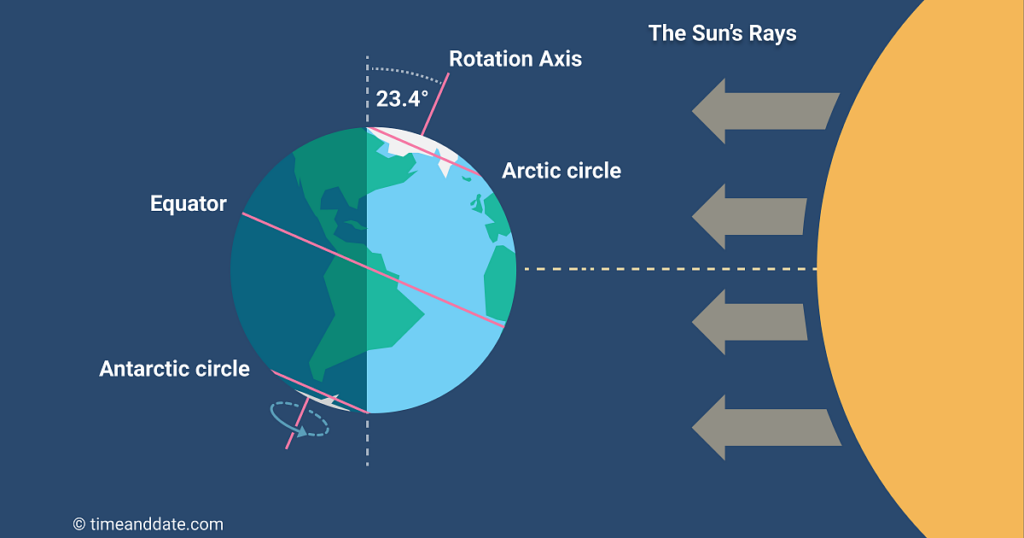
The summer solstice occurs when one hemisphere of Earth is tilted most directly toward the Sun during its yearly orbit.
On June 21, the Northern Hemisphere reaches this point, resulting in the maximum number of daylight hours and the shortest night of the year.
The word “solstice” comes from Latin and roughly translates to “Sun standing still.” Around this time, the Sun appears to pause in its northward movement across the sky before gradually beginning its journey southward.
For millions of people, this means earlier sunrises, later sunsets, and more daylight than any other day of the year.
Why does Earth’s tilt matter?
Earth does not orbit the Sun while standing perfectly upright. Instead, it is tilted at an angle of approximately 23.5 degrees.
This tilt is responsible for the changing seasons.
As Earth travels around the Sun, different parts of the planet receive varying amounts of sunlight. During June, the Northern Hemisphere leans toward the Sun, allowing sunlight to strike more directly and remain visible for longer periods each day.
Without this tilt:
- There would be no distinct seasons.
- Day and night would remain nearly equal throughout the year.
- The dramatic differences between summer and winter would not exist.
The summer solstice represents the moment when this tilt produces the greatest daylight advantage for the Northern Hemisphere.
How much daylight will people experience?
The exact number of daylight hours depends on location.
Cities closer to the equator experience relatively small seasonal changes, while locations farther north see dramatic differences.
For example:
- New Delhi receives nearly 14 hours of daylight.
- New York experiences around 15 hours.
- London gets more than 16 hours.
- Regions near the Arctic Circle can see nearly 24 hours of continuous sunlight.
The farther north you travel, the more noticeable the effect becomes.
The phenomenon known as the “Midnight Sun”
One of the most fascinating consequences of the summer solstice is the Midnight Sun.
In areas near and above the Arctic Circle, the Sun does not fully set for days, weeks, or even months, depending on the location.
Instead of darkness, residents experience continuous daylight, with the Sun remaining visible near the horizon even at midnight.
Places in northern Norway, Sweden, Finland, Greenland, and parts of Alaska are famous for this phenomenon, which attracts tourists from around the world.
Why June 21 is important beyond astronomy
The summer solstice has cultural and historical significance that stretches back thousands of years.
Ancient civilizations carefully tracked the movement of the Sun and built monuments aligned with solstice events.
Some notable examples include:
- Stonehenge in England
- Chichén Itzá in Mexico
- Ancient solar observatories across Asia and South America
Many cultures viewed the solstice as a symbol of abundance, fertility, and renewal.
Today, festivals, outdoor celebrations, and cultural gatherings continue to mark the occasion in various parts of the world.
What happens after the solstice?
Although June 21 is the longest day of the year, it does not mean summer is ending.
In fact, astronomical summer officially begins with the solstice.
However, from the following day onward, daylight hours gradually start decreasing in the Northern Hemisphere.
The change is subtle at first, often amounting to only seconds per day. Over the coming months, the reduction becomes more noticeable until the autumnal equinox in September, when day and night become nearly equal again.
Does the solstice make June 21 the hottest day of the year?
Not necessarily.
Many people assume the longest day must also be the hottest, but temperatures usually continue rising for several weeks after the solstice.
This happens because Earth’s land masses and oceans absorb and store heat over time.
Meteorologists refer to this delay as “seasonal lag.”
As a result:
- July is often hotter than June in many regions.
- Peak summer temperatures can occur weeks after the longest day.
- The atmosphere continues warming even as daylight hours begin to shorten.
Why the longest day matters in a changing world
The summer solstice offers a simple yet powerful reminder of the mechanics that govern life on Earth.
From agriculture and ecosystems to human activity and energy consumption, seasonal sunlight plays a major role in how societies function.
For scientists, solstices provide important reference points for studying climate patterns, solar radiation, and environmental changes. For everyone else, they serve as a visible reminder that our planet’s journey through space influences daily life in ways that often go unnoticed.
TL;DR
- June 21, 2026, is the summer solstice and the longest day of the year in the Northern Hemisphere.
- Earth’s 23.5-degree tilt causes longer daylight hours and shorter nights.
- Areas closer to the Arctic Circle can experience nearly 24 hours of daylight, known as the Midnight Sun.
- The solstice marks the start of astronomical summer.
- The longest day is not necessarily the hottest day because of seasonal lag.
- The event has scientific, cultural, and historical significance across the world.