
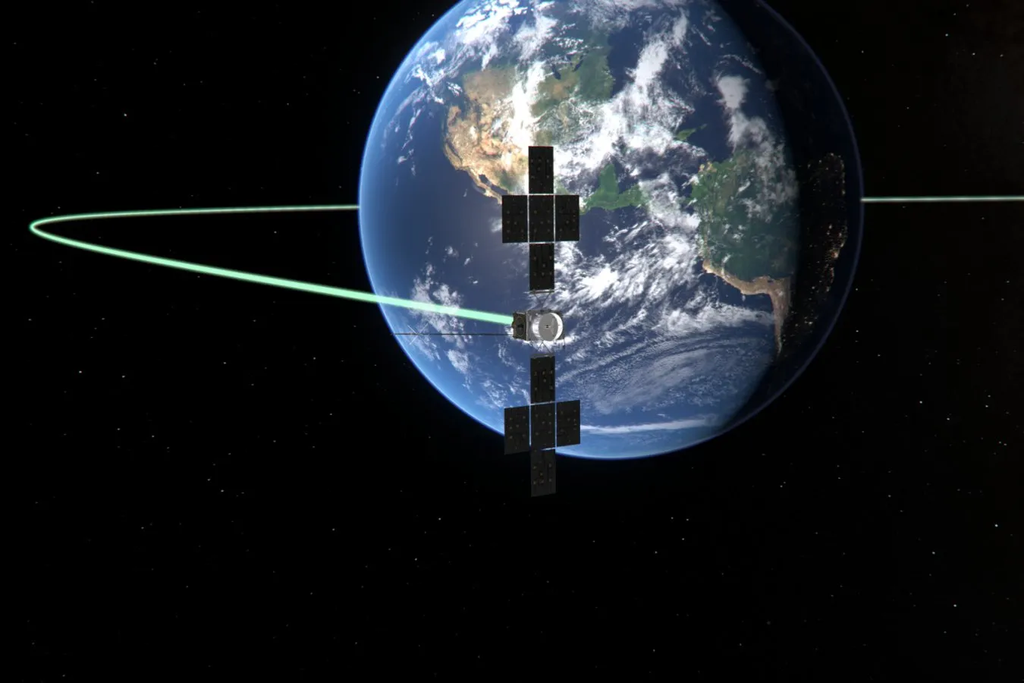
A spacecraft on a billion-kilometre journey to Jupiter has just borrowed energy from Earth to get closer to its destination.
The European Space Agency’s Jupiter Icy Moons Explorer, better known as JUICE, successfully completed a crucial Earth gravity-assist maneuver on September 28, 2026, using Earth’s gravity to alter its trajectory and increase its speed without burning a large amount of fuel.
During the close approach, JUICE passed about 8,640 kilometers above the Indian Ocean.
The maneuver increased the spacecraft’s velocity by approximately 3.5 kilometers per second, equivalent to about 12,600 km/h. ESA says the flyby also bent JUICE’s trajectory by around 20 degrees, placing it on a new path toward another Earth encounter in 2029 and, ultimately, Jupiter in 2031.
On paper, the spacecraft simply flew past its home planet.
In mission terms, it was a carefully choreographed piece of orbital mechanics that effectively gave JUICE a major change in speed and direction while using very little of its onboard propellant.
Why did JUICE need Earth’s gravity?
Getting to Jupiter is not simply a matter of pointing a spacecraft toward the largest planet in the Solar System and firing its engines.
Jupiter orbits roughly five times farther from the Sun than Earth does. Reaching that region of the Solar System at the required speed and then slowing down enough to enter orbit around Jupiter would demand an enormous amount of fuel if a spacecraft attempted to do everything with its own engines.
JUICE was therefore designed around a series of gravity assists.
The basic principle is elegant.
A spacecraft passes close to a planet or moon and uses the body’s gravity to change its velocity and direction relative to the Sun. The spacecraft does not receive energy from nowhere. Instead, it exchanges a minuscule amount of momentum with the moving planet while taking advantage of the planet’s enormous mass and orbital motion.
The result can be a substantial change in the spacecraft’s trajectory without a comparable expenditure of rocket fuel.
For a mission that must eventually slow down enough to enter Jupiter’s orbit and later maneuver around Ganymede, conserving propellant is critical.
ESA describes the technique as allowing JUICE to pick up speed and reshape its path “almost entirely for free” in terms of fuel.
JUICE has already used the Moon, Earth and Venus
The September 28 encounter was not JUICE’s first gravity assist.
The spacecraft launched in April 2023 from Europe’s Spaceport in French Guiana aboard an Ariane 5 rocket.
Its first major gravity-assist sequence came in August 2024, when it performed the world’s first combined lunar-Earth flyby of its kind.
JUICE first passed the Moon and then Earth, using the encounter to reduce its orbital energy and redirect itself toward Venus.
That was followed by a Venus flyby in August 2025.
The current Earth encounter was therefore JUICE’s third gravity-assist maneuver.
But the journey still has another planetary assist to come.
ESA has planned a final Earth flyby for January 2029. That encounter will place JUICE on the trajectory needed to intercept Jupiter in July 2031.
What happened during the September 28 flyby?
The timing had to be extraordinarily precise.
JUICE’s navigation campaign began on August 17, more than a month before the flyby. ESA had six opportunities available to make small trajectory corrections in the weeks leading up to the encounter.
Only one of those correction opportunities was ultimately needed.
ESA says the maneuver made four weeks before the flyby was small but highly effective, putting the spacecraft on the correct approach trajectory.
At closest approach, JUICE passed just 8,640 kilometers above the Indian Ocean at 13:45 CEST, or 11:45 UTC.
The spacecraft was not diving toward Earth’s atmosphere. Instead, it skimmed the planet at a distance carefully chosen to produce the desired change in its velocity and trajectory.
The result was a roughly 20-degree deflection of its path and a 3.5 km/s increase in velocity.
That works out to approximately 12,600 km/h of additional velocity.
The figure is striking because JUICE achieved that change without needing to use its main propulsion system for a comparable acceleration maneuver.
The spacecraft came close enough to photograph Earth
The flyby was not only about navigation.
ESA also used the opportunity to operate JUICE’s scientific and monitoring instruments while the spacecraft was relatively close to Earth and the Moon.
The mission’s 10 science instruments were switched on between September 23 and October 3 to collect observations of Earth and the Moon.
JUICE’s navigation camera also used the encounter to test techniques that could eventually improve optical navigation around Jupiter’s moons.
The spacecraft’s monitoring cameras captured images during the flyby as well.
One image taken by JUICE’s navigation camera just two minutes after closest approach showed part of Madagascar. ESA said the image was taken at 13:47 CEST on September 28, shortly after the spacecraft had passed its closest point to Earth.
ESA later released another view of Earth showing large portions of Africa, Madagascar and parts of the Arabian Peninsula.
These cameras were not originally designed as dedicated planetary-imaging instruments. Their primary purpose is monitoring spacecraft structures such as antennas and booms.
The flyby gave mission scientists an opportunity to repurpose them for additional observations.
Why the 12,600 km/h boost matters
A speed increase of approximately 3.5 km/s might sound modest compared with the enormous distances involved in interplanetary travel.
It is not.
At spacecraft scale, changing velocity by several kilometers per second can substantially alter where a probe will be years later.
The goal is not simply to make JUICE arrive at Jupiter faster.
Its trajectory must also be shaped so that the spacecraft arrives at the right place, with the right velocity, at the right time.
Arriving at Jupiter too quickly could be just as problematic as arriving too slowly.
The spacecraft needs enough energy to reach Jupiter, but it also needs enough remaining propellant and the correct trajectory to slow down and enter the planet’s gravitational environment.
That is why gravity assists are so valuable.
They allow mission planners to trade time and route complexity for fuel efficiency.
Another Earth flyby is coming in 2029
The September maneuver was not the end of JUICE’s gravitational detours.
ESA’s mission plan calls for another Earth flyby on January 17, 2029.
The current trajectory data place that encounter at roughly 4,635 kilometers above Earth, considerably closer than the September 2026 pass.
That flyby will provide the final major gravitational adjustment before JUICE heads toward Jupiter.
Afterward, the spacecraft will continue outward through the Solar System and is expected to reach the Jupiter system in July 2031.
The final destination, however, is not simply Jupiter itself.
JUICE is designed primarily to study Jupiter’s icy moons, with Ganymede as its principal target.
Ganymede is the mission’s ultimate destination
Jupiter has dozens of known moons, but JUICE is particularly interested in Ganymede, Europa and Callisto.
These worlds are important because scientists have strong evidence that several of Jupiter’s icy moons contain subsurface oceans.
Ganymede is especially intriguing because it is the largest moon in the Solar System and has its own magnetic field.
JUICE will study the structure of Ganymede’s ice shell and possible subsurface ocean, its magnetic environment and the relationship between its surface and interior.
Reaching that final stage requires an elaborate sequence of additional maneuvers after JUICE arrives in the Jupiter system.
ESA’s plan includes multiple flybys of Jupiter’s moons before JUICE eventually moves into orbit around Ganymede.
The spacecraft is expected to begin its dedicated Ganymede orbital investigations in late 2034.
The journey is a long game of orbital geometry
JUICE’s mission illustrates an important fact about interplanetary exploration.
Spacecraft do not always take the fastest-looking route.
Instead, engineers search for trajectories that balance fuel consumption, travel time, orbital mechanics, spacecraft limitations and scientific objectives.
A direct trip might sound simpler.
It could also require vastly more fuel.
JUICE’s route through the Earth-Moon system, Venus and future Earth encounters is therefore not a scenic detour.
It is the mission.
Every flyby is intended to reshape the spacecraft’s path so that its limited onboard propellant can be preserved for the tasks that gravity cannot accomplish alone.
What happens after the 2026 Earth flyby?
For now, JUICE continues outward on its revised trajectory.
ESA says the September encounter successfully redirected the spacecraft toward its next major milestone, the January 2029 Earth flyby. Mission operators will continue closely monitoring the spacecraft after the maneuver, with heightened tracking extending into early October.
The September flyby also gives mission scientists a useful opportunity to test instruments and navigation techniques long before the spacecraft reaches Jupiter.
That is an important feature of deep-space missions.
Every stage can double as preparation for a later and more difficult one.
Earth is relatively easy to observe and navigate around compared with a distant Jovian moon.
So the spacecraft can use this relatively nearby encounter as a rehearsal.
The spacecraft just received something no fuel tank can provide
The easiest way to describe the maneuver is also the most revealing.
JUICE did not simply fly past Earth.
It used Earth to change its future.
The planet’s gravity bent the spacecraft’s trajectory by about 20 degrees and increased its velocity by roughly 3.5 km/s, or about 12,600 km/h. The maneuver consumed very little fuel compared with what a comparable engine-driven change would require.
That borrowed momentum will help carry JUICE onward to its next Earth encounter in 2029 and eventually to Jupiter in 2031.
From there, the mission gets even more ambitious.
The spacecraft will enter the Jupiter system, study its major icy moons and ultimately head toward Ganymede, where it is expected to become the first spacecraft to orbit a moon other than Earth’s.
For now, however, the spacecraft has one more task accomplished.
Earth has given JUICE a push.
The long road to Jupiter continues.