
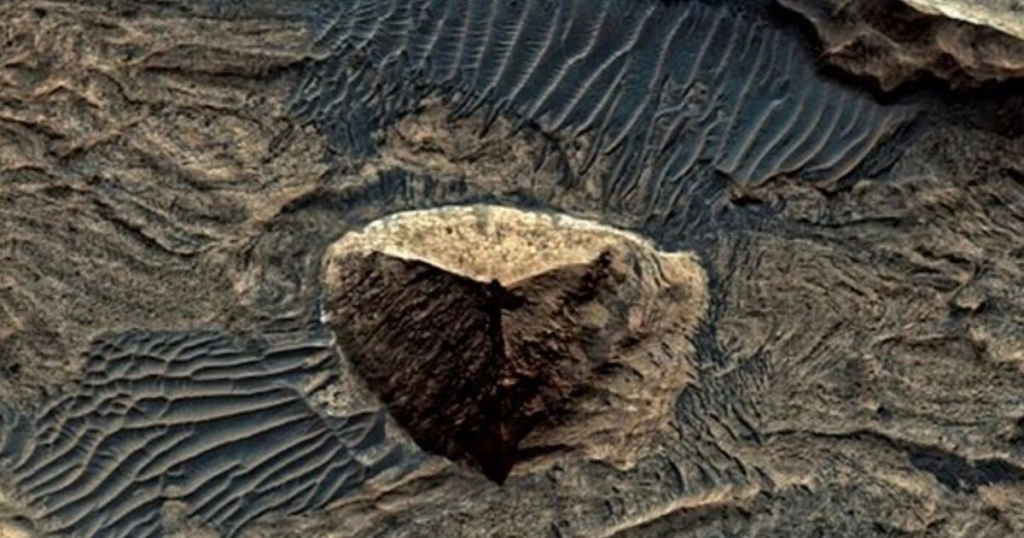
Three-sided pyramid on Mars: natural formation or ancient structure?
A striking image from NASA archives is once again lighting up the internet. The photo shows what appears to be a three-sided, pyramid-like structure on Mars, prompting a familiar question: Are we looking at geology or something far more extraordinary?
The image isn’t new. It dates back to 2001. But like a cosmic boomerang, it keeps returning, each time with sharper debate and louder speculation.
What is the “pyramid on Mars,” and where is it located?
The structure sits in Candor Chasma, part of the vast Valles Marineris canyon system. To put that into perspective, Valles Marineris stretches over 4,000 kilometers, making it one of the largest canyon networks in the solar system.
The feature itself has been imaged multiple times by:
- Mars Global Surveyor (early 2000s)
- Mars Reconnaissance Orbiter (2007 onward)
Across different years, lighting conditions, and resolutions, the formation appears consistently triangular, with three distinct edges that look unusually straight.
Why this image stands out
Unlike random rock formations, this one has:
- A clear three-sided geometry
- Sharp, defined edges
- Symmetry that remains visible across multiple images
That combination is what keeps pulling it back into public conversation.
Why are people calling it a pyramid?
The comparison to Egypt’s pyramids didn’t come out of nowhere.
The visual trigger
Some observers, including researcher Keith Laney and filmmaker Brian Dobbs, argue that the structure resembles a scaled version of the Great Pyramid of Giza.
Their reasoning hinges on:
- Straight lines that appear too precise
- Symmetry that looks engineered rather than accidental
- Consistency across multiple imaging passes
One researcher even suggested that if such a structure were found on Earth, it would immediately become an archaeological site.
That statement captures the intrigue but also the leap.
Could this be evidence of ancient life on Mars?
Short answer: There is no scientific evidence supporting that claim.
Longer answer: the idea persists because humans are wired to find patterns, especially familiar ones.
The psychology behind the excitement
This phenomenon is known as pareidolia, the brain’s tendency to see meaningful shapes in random data. It’s the same reason people spot faces in clouds or animals in constellations.
On Mars, where images are often grainy and shadow-heavy, this effect gets amplified.
What NASA says
NASA has consistently explained that Mars is shaped by:
- Erosion
- Landslides
- Wind activity
- Geological fracturing
In a place like Candour Chasma, where cliffs collapse and reshape terrain, geometric formations are not just possible, they’re expected.
Why does the structure look so precise?
The illusion of precision often comes down to lighting and perspective.
The role of sunlight and shadows
Early images from 2001 showed only one illuminated face of the structure. Later images revealed more sides, but shadows still played tricks on perception.
Depending on the angle of sunlight:
- Edges can appear sharper than they are
- Slopes can look flat
- Depth can be misinterpreted as symmetry
Resolution matters
Higher-resolution images from the Mars Reconnaissance Orbiter revealed more surface irregularities, suggesting the structure is less “perfect” than it first appears.
In other words, the closer you look, the more it behaves like a natural formation.
What about claims of CIA experiments and ancient civilisations?
This is where the story drifts from science into speculation.
The “Project Stargate” angle
Some reports reference declassified CIA documents related to “Project Stargate,” a Cold War-era program exploring psychic phenomena like remote viewing.
According to these accounts, a participant described pyramids and structures on ancient Mars.
However:
- These descriptions are not scientific evidence
- The program itself was discontinued due to a lack of reliable results
- No physical data support these claims
Treat this as a cultural footnote, not a scientific lead.
Elon Musk and the Mars narrative
Elon Musk has popularised the idea of Mars as humanity’s future home, but he has not endorsed claims of ancient Martian civilizations tied to this structure.
His focus remains on colonisation, not archaeology.
Natural vs artificial: what does the evidence suggest?
Let’s weigh both sides clearly.
Arguments for artificial origin
- Symmetrical appearance
- Straight ხაზ-like edges
- Repeated visibility across images
Arguments for natural origin (scientific consensus)
- Known geological processes can create նման shapes
- High-resolution images show irregularities
- No supporting evidence of tools, materials, or civilisation
Right now, the second column is doing all the heavy lifting.
Why does this debate keep coming back
This isn’t just about Mars. It’s about how humans interpret the unknown.
The bigger picture
Space imagery sits at a strange intersection:
- Scientific data
- Public imagination
- Internet amplification
A single compelling image can travel faster than the context needed to understand it.
And once it does, the debate becomes less about evidence and more about possibility.
What should readers take away?
The “pyramid on Mars” is a fascinating visual. It deserves attention, but not exaggeration.
Here’s the grounded takeaway:
- The structure is real
- The pyramid interpretation is subjective
- There is no credible evidence of artificial construction
Mars remains a world of mysteries, but this one likely belongs to geology, not history.
TL;DR
- A pyramid-like structure in Valles Marineris has resurfaced online
- Images from NASA missions show consistent triangular features
- Some claim artificial origins, but evidence is lacking
- Scientists attribute the shape to natural geological processes
- The debate persists due to human pattern recognition and viral imagery