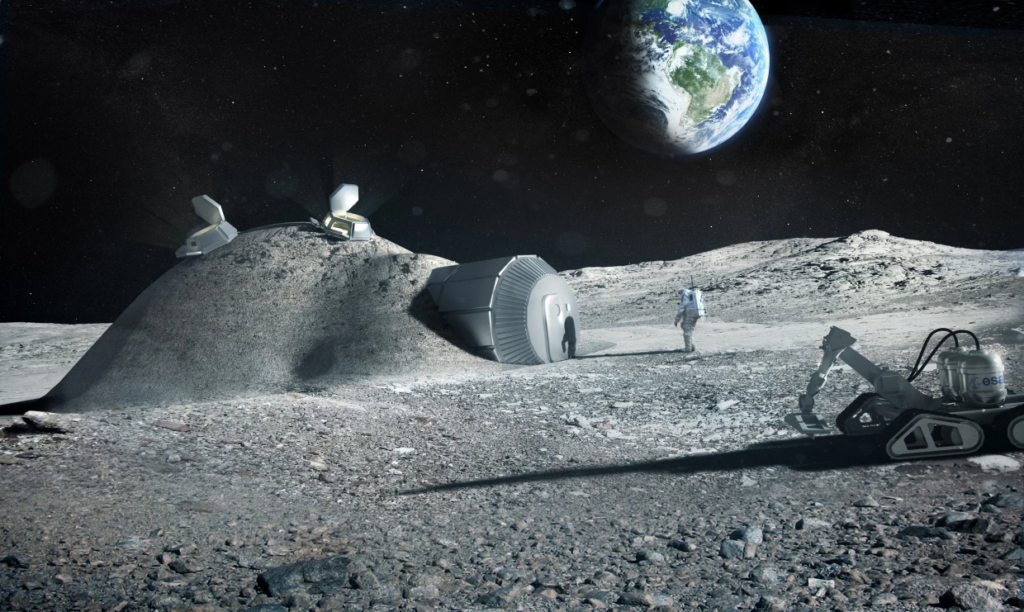
NASA has unveiled an ambitious long-term strategy to build a permanent human presence on the Moon, marking one of the agency’s boldest space exploration goals since the Apollo era. The proposed “Moon Base” project is designed to create a sustained settlement near the lunar South Pole, where astronauts would live, conduct scientific research, test advanced technologies, and prepare for future crewed missions to Mars.
If successful, the effort would transform the Moon from a destination humans briefly visit into a continuously occupied frontier outpost.
That is a profound shift in space exploration philosophy. Apollo planted flags. Artemis aims to build infrastructure.
What is NASA’s Moon Base project?
A permanent settlement near the Moon’s South Pole
The Moon Base initiative forms a central pillar of NASA’s broader Artemis Program, which seeks to return astronauts to the Moon for the first time since 1972.
Unlike the Apollo missions, which focused on short-term exploration, Artemis is built around sustainability.
NASA’s plan envisions:
- Continuous lunar operations
- Long-duration astronaut stays
- Scientific laboratories
- Cargo delivery systems
- Infrastructure for future deep-space missions
The lunar South Pole was chosen because scientists believe the region may contain water ice trapped inside permanently shadowed craters. That resource could eventually support drinking water, oxygen production, and even rocket fuel manufacturing.
How will NASA build the Moon Base?
The project will unfold in three major phases
NASA says the lunar habitat will be developed gradually through a multi-phase strategy spanning years of missions, infrastructure expansion, and technology testing.
The approach resembles constructing a remote Antarctic research station, except on a world with no atmosphere, brutal temperature swings, and nights lasting two Earth weeks.
Phase 1: Testing technologies and scouting locations
NASA will begin with demonstrations and early missions
The first phase focuses on reaching the lunar surface consistently while testing technologies needed for long-term habitation.
NASA plans:
- 25 launches
- 21 Moon landings
- Delivery of roughly 4,000 kilograms of cargo
This stage will include:
- Technology demonstrations
- Surface mobility testing
- Habitat experiments
- Landing site identification
- Early infrastructure systems
NASA also expects this phase to include the first crewed Moon Base mission.
The agency is essentially building the lunar equivalent of a campsite before attempting a full settlement.
Why this stage matters
Long-term survival on the Moon depends on solving dozens of engineering problems first:
- Radiation protection
- Dust contamination
- Energy generation
- Communications
- Life-support reliability
- Surface mobility
Unlike Earth, the Moon offers no atmosphere to soften conditions. Lunar dust is sharp, clingy, and notoriously destructive to equipment. Temperatures can swing from blistering heat to extreme cold.
In short: the Moon is beautiful from afar and deeply hostile up close.
Phase 2: Expanding lunar infrastructure
Crewed missions will become more frequent
The second phase shifts from experimentation toward construction and operational growth.
NASA plans:
- 27 launches
- 24 landings
- Nearly 60,000 kilograms of payload delivery
This stage would establish the Moon’s first meaningful operational infrastructure.
Key goals include:
- Semi-annual crewed missions
- Site preparation
- Regolith manipulation
- Expanded power systems
- Surface transportation capabilities
- Larger habitation modules
What is “regolith manipulation”?
Regolith is the loose dusty material covering the Moon’s surface.
NASA hopes astronauts and robotic systems will eventually use lunar regolith to:
- Build landing pads
- Shield habitats from radiation
- Create roads
- Produce construction materials
That concept, known as “in-situ resource utilization,” is central to making the base sustainable.
Transporting every brick from Earth would be wildly expensive. Using Moon materials instead could dramatically reduce mission costs.
Phase 3: A continuously inhabited Moon Base
NASA wants a permanent human presence
The final phase represents the agency’s most ambitious vision: a fully operational lunar settlement supporting continuous human activity.
NASA projects:
- 29 launches
- 28 landings
- Nearly 150,000 kilograms of delivered cargo
At this stage, the Moon Base would function less like a temporary outpost and more like a permanent scientific frontier station.
The plan includes:
- Continuous astronaut rotations
- Advanced research facilities
- Large-scale cargo systems
- Expanded habitat networks
- Uncrewed cargo return missions
NASA also aims to increase Commercial Lunar Payload Services capability to eight metric tons.
That would mark a dramatic leap in lunar logistics.
Why the Moon’s South Pole is both exciting and dangerous
The environment is harsher than Apollo landing zones
NASA says the lunar South Pole presents unique engineering challenges never faced during the Apollo era.
Apollo astronauts landed near the Moon’s equator, where sunlight conditions were more predictable.
The South Pole is very different.
Challenges include:
- Long shadows
- Extreme cold
- Extended darkness
- Permanently shadowed craters
- Difficult terrain
- Limited solar exposure
Some regions may never receive sunlight at all.
That creates a paradox:
The same craters likely holding valuable water ice are also among the harshest environments in the solar system.
Long lunar nights are a major problem
A lunar night lasts roughly 14 Earth days.
During that time:
- Temperatures plunge dramatically
- Solar power generation becomes difficult
- Equipment must survive extreme cold
Future habitats will likely require:
- Nuclear power systems
- Advanced thermal controls
- Energy storage technologies
- Redundant life-support systems
The Moon is not just far away. It is operationally unforgiving.
Why NASA sees the Moon as a gateway to Mars
Artemis is about more than the Moon itself
NASA increasingly frames lunar exploration as preparation for future Mars missions.
The Moon offers a nearby testing ground where astronauts can learn how to:
- Live off Earth for long periods
- Operate in hostile environments
- Use local resources
- Build remote infrastructure
- Manage deep-space logistics
In effect, the Moon becomes a dress rehearsal for Mars.
The difference is distance.
If something goes wrong on the Moon, astronauts are days from Earth. On Mars, help could be months away.
That makes lunar experience strategically valuable before attempting interplanetary settlement.
The geopolitical race back to the Moon is accelerating
NASA is not the only player
The Moon Base announcement also reflects intensifying global competition in space exploration.
Countries and organizations pursuing lunar ambitions include:
- China National Space Administration
- European Space Agency
- SpaceX
- Indian Space Research Organisation
China, in particular, has outlined plans for an International Lunar Research Station later this decade.
That means the next lunar era may involve not just exploration, but geopolitical influence, resource competition, and commercial development.
The 21st-century Moon race looks less like Apollo and more like the early stages of a new frontier economy.
Can NASA actually pull this off?
The vision is ambitious, expensive, and technically difficult
Building a permanent Moon settlement will require:
- Massive funding
- International partnerships
- Reliable heavy-launch systems
- Long-term political support
- Breakthrough engineering
NASA’s timeline will almost certainly evolve as budgets, technologies, and administrations change.
Still, the broader direction is becoming increasingly clear:
Humanity is preparing to move from short space visits toward sustained off-world presence.
The Moon Base concept may sound futuristic today, but so did the International Space Station decades ago.
Now astronauts treat orbit like a workplace.
NASA hopes one day the Moon will feel similarly ordinary, a strange sentence that somehow captures the scale of the ambition.
TL;DR
- NASA plans to build a permanent Moon Base near the lunar South Pole.
- The project is part of the Artemis Program aimed at sustainable lunar exploration.
- The plan includes three phases ranging from technology tests to continuous human habitation.
- NASA hopes the Moon Base will help prepare astronauts for future Mars missions.
- The South Pole offers potential water ice resources but presents severe environmental challenges.