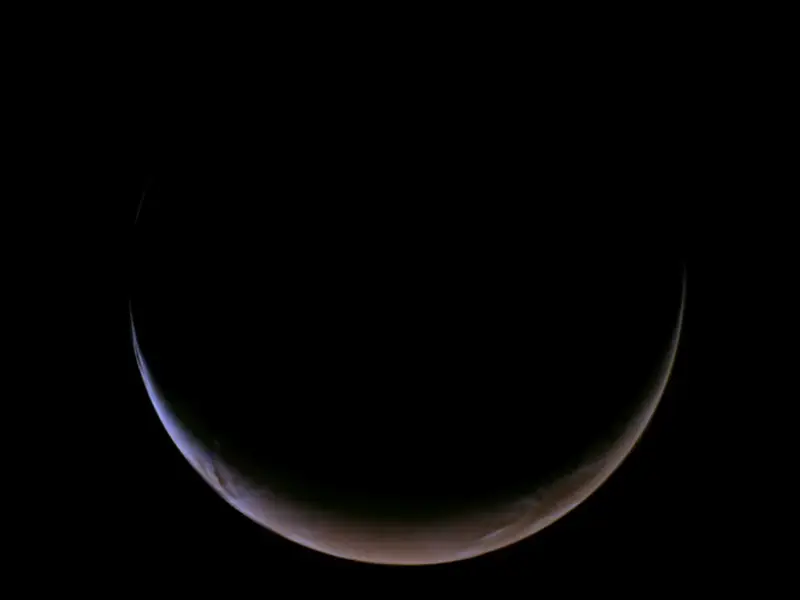
NASA’s Psyche mission has delivered a striking new look at Mars while on its long journey toward the metal-rich asteroid 16 Psyche.
The spacecraft recently snapped images of the Red Planet from an angle humans rarely get to see: a glowing crescent hanging against the darkness of space. The photos were taken during a carefully planned Mars flyby that used the planet’s gravity to redirect the spacecraft deeper into the solar system.
The images are more than just eye-catching. They mark a key milestone for one of NASA’s most ambitious asteroid missions — a six-year, 3.6-billion-kilometre trek to investigate what scientists believe could be the exposed metallic core of an ancient failed planet.
What Is the Psyche Mission?
Launched in October 2023, the Psyche mission is headed toward one of the most unusual objects in the asteroid belt.
Unlike most asteroids, which are primarily rocky or icy, 16 Psyche appears to contain large amounts of metal. Radar observations suggest its surface reflects light in a way consistent with iron and nickel — the same materials found in Earth’s core.
Scientists suspect the asteroid may be the leftover center of an early planetary body that never fully formed.
Why Scientists Care About 16 Psyche
If that theory proves correct, the asteroid could offer something impossible on Earth: a direct look at a planetary core.
Earth’s metallic core lies thousands of miles beneath the surface, unreachable even with modern drilling technology. But 16 Psyche may expose similar material in open space.
That makes the mission important for understanding:
- How rocky planets form
- What happens during violent collisions in the early solar system
- How planetary interiors evolve over billions of years
- Why some planetary bodies survive while others fail to become planets
The Mars Flyby Was More Than a Scenic Detour
The recent Mars encounter was a gravity assist maneuver — a common but highly precise spaceflight technique.
As the spacecraft passed near Mars, the planet’s gravity effectively “slingshotted” the probe forward, changing both its speed and direction without requiring massive fuel consumption.
NASA says the spacecraft came within roughly 4,609 kilometers (2,864 miles) of the Martian surface.
According to Don Han, Psyche’s navigation lead at NASA’s Jet Propulsion Laboratory, the flyby boosted the spacecraft’s speed by about 1,000 miles per hour while also shifting its orbital plane slightly relative to the Sun.
That adjustment is critical for steering the spacecraft toward the outer region of the main asteroid belt between Mars and Jupiter.
Why Gravity Assists Matter in Deep Space Missions
Gravity assists are one of the most efficient tools in interplanetary travel. Instead of carrying enormous amounts of fuel, spacecraft borrow momentum from planets.
NASA and other space agencies have used the technique for decades, including on missions such as:
- Voyager program
- Cassini–Huygens
- New Horizons
For Psyche, the Mars flyby shaved years and fuel costs off the mission profile.
The Crescent Mars Images Offer a Rare Perspective
Most public images of Mars come from orbiters circling the planet or telescopes viewing it from Earth.
Psyche captured something different.
Approaching the planet from above, the spacecraft photographed Mars as a thin illuminated crescent — similar to the phases seen on the Moon or Venus from Earth. After the flyby, it also captured a nearly fully lit version of the planet.
The dramatic shift highlights how perspective changes in space depending on a spacecraft’s position relative to the Sun.
Why the Images Matter Beyond Aesthetics
The photos were not taken solely for public outreach.
NASA engineers and scientists also used the flyby to test and calibrate the spacecraft’s imaging systems under real mission conditions.
Jim Bell, the mission’s imaging lead at Arizona State University, said the varying lighting conditions provided ideal calibration opportunities for the onboard camera systems.
That matters because the spacecraft will rely heavily on those instruments once it reaches 16 Psyche in 2029.
A good place for a side-by-side visual would be:
- Crescent Mars image during approach
- Near-full Mars image after flyby
- Artist rendering of the Psyche spacecraft trajectory
Why the Psyche Mission Could Change Planetary Science
Planetary scientists often study worlds indirectly. They analyze meteorites, seismic data, or gravitational measurements to infer what lies beneath planetary surfaces.
The Psyche mission may change that.
If the asteroid truly represents an exposed planetary core, scientists could directly examine:
- Metal composition
- Magnetic properties
- Surface geology
- Impact history
The findings may help answer longstanding questions about how planets like Earth formed in the chaotic early solar system roughly 4.5 billion years ago.
Could 16 Psyche Really Be Worth Trillions?
The asteroid has occasionally drawn headlines for its supposed financial value because of its metal content.
But scientists caution against framing the mission as a mining expedition.
The goal is scientific discovery, not resource extraction. In practical terms, mining an asteroid millions of kilometers away remains far beyond current economic and technological capabilities.
Still, the public fascination reflects how unusual the asteroid is compared to most known space rocks.
What Happens Next for the Psyche Spacecraft?
After the Mars gravity assist, the spacecraft will continue its long cruise toward the asteroid belt.
NASA expects the probe to arrive at 16 Psyche in 2029, where it will spend about two years orbiting and studying the asteroid from different altitudes.
The mission’s instruments include:
- Multispectral imagers
- Gamma ray and neutron spectrometers
- Magnetometers
- Communications systems capable of testing deep-space laser communication technology
By the end of the mission, scientists hope to build the clearest picture yet of what lies inside rocky worlds.
TL;DR
- NASA’s Psyche mission captured rare crescent images of Mars during a close flyby.
- The maneuver gave the spacecraft a gravity boost toward 16 Psyche.
- Scientists believe the asteroid may be the exposed metal core of an ancient failed planet.
- The mission could reveal new insights into how planets form and evolve.
- Psyche is expected to arrive at the asteroid in 2029.