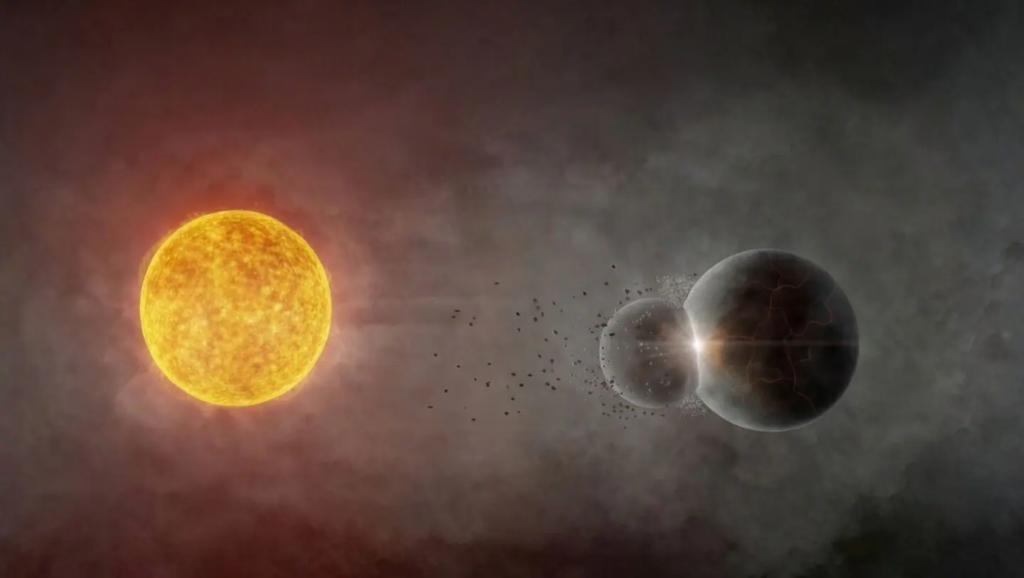
Astronomers have witnessed a dramatic planetary collision near the distant star Gaia20ehk, providing one of the clearest real-time views of two planets smashing together. The rare cosmic event is helping scientists understand how planetary systems evolve and may even shed light on the ancient impact believed to have formed Earth’s Moon.
The collision occurred about 11,000 light-years from Earth near the constellation Puppis. Researchers say the event produced massive heat, glowing debris, and a chaotic cloud of dust that temporarily dimmed the host star.
The findings were published on March 11 in The Astrophysical Journal Letters, adding to the extremely small number of confirmed planetary collisions ever observed by astronomers.
What scientists observed around the star Gaia20ehk
Astronomers noticed unusual activity around Gaia20ehk after comparing observations taken years apart.
In 2016, the star appeared stable and behaved like a typical Sun-like star. But by 2021, researchers saw something strange: the star’s brightness had dropped dramatically, and its behavior became erratic.
According to Anastasios Tzanidakis, the study’s lead author, the star “went completely bonkers,” displaying dramatic fluctuations in brightness that normal stellar physics could not easily explain.
These changes triggered further observations using multiple telescopes worldwide, which began tracking the system closely.
Key observations astronomers recorded
Scientists noticed several unusual signals around the star:
- The star’s brightness dropped to roughly one-third of its earlier level.
- Large amounts of debris appeared to pass repeatedly in front of the star.
- Infrared emissions surged dramatically.
- Extremely hot dust surrounded the system.
Together, these signals pointed to a violent event unfolding in the planetary system.
How astronomers confirmed a planetary collision
Seeing planets collide is extremely rare. Although planetary crashes were common during the early formation of solar systems, catching one in action from Earth requires precise alignment.
For telescopes to detect such events, debris from the collision must pass directly in front of the host star. When that happens, the dust cloud blocks some of the star’s light.
Researchers detected these changes through both visible light and infrared observations.
Visible light revealed dimming
Astronomers first noticed the phenomenon when the star’s brightness began fading.
This suggested something large was orbiting or moving across the star’s line of sight.
Infrared observations revealed extreme heat
Further analysis showed something even more surprising. While the star’s visible light dimmed, its infrared emissions increased dramatically.
This meant the material surrounding the star was extremely hot.
Such a signal strongly suggests freshly created debris. When two planets collide, they release enormous energy that melts rock and vaporizes material, producing a glowing cloud of superheated dust.
The rising infrared signal therefore provided a key clue that a planetary collision had occurred.
Why scientists believe two planets smashed together
The researchers concluded that the most likely explanation was a collision between two large planets orbiting Gaia20ehk.
The data suggest the event unfolded in stages rather than a single catastrophic impact.
Step 1: a grazing encounter
Scientists believe the planets first brushed past each other.
This initial interaction would have knocked large amounts of dust and rock into space, explaining the early dimming of the star’s light.
Step 2: the catastrophic collision
Eventually, the planets collided more directly.
This produced the intense heat detected in infrared wavelengths as molten rock and vaporized material formed a massive debris cloud.
The debris now orbits the star at roughly one astronomical unit, which is nearly the same distance that Earth orbits the Sun.
Why this collision resembles the birth of the Moon
One of the most fascinating aspects of the discovery is how closely it mirrors a major event in our own solar system’s history.
Scientists widely believe that Earth’s Moon formed when a Mars-sized body slammed into the early Earth about 4.5 billion years ago.
This hypothesis, known as the Giant Impact Hypothesis, suggests that the impact ejected enormous amounts of debris into orbit. Over time, that material combined to form the Moon.
Similarities scientists noticed
The collision around Gaia20ehk shares several features with the giant impact scenario:
- A large debris cloud surrounds the star
- Material orbiting roughly one astronomical unit away
- Extremely hot dust and rock
- Evidence of a multi-stage collision
Because of these similarities, the event offers a rare opportunity to watch a process that may have shaped our own planet billions of years ago.
Why planetary collisions are common but rarely observed
Planetary collisions are actually a normal part of how solar systems form.
Young star systems begin as chaotic disks of gas, dust, and rocky fragments. Over millions of years, these pieces crash together and gradually assemble into planets.
However, witnessing these impacts directly is incredibly difficult.
Several factors must align perfectly:
- The collision must occur in a system visible from Earth.
- Debris must pass in front of the host star.
- Telescopes must be observing at the right time.
- The debris cloud must produce detectable light changes.
Because of these challenges, astronomers have recorded only a handful of planetary collision events.
The detection around Gaia20ehk therefore, represents a rare scientific opportunity.
How space telescopes helped detect the event
The discovery began when Anastasios Tzanidakis analyzed data from NASA missions.
One key dataset came from SPHEREx, which surveys the sky for infrared signals that can reveal hidden cosmic processes.
Infrared observations are particularly useful for detecting hot dust and debris created by violent events like planetary collisions.
Once the unusual signals were spotted, astronomers coordinated follow-up observations using several ground-based telescopes around the world.
What scientists hope to learn next
The debris cloud surrounding Gaia20ehk will likely remain observable for years.
As the dust spreads and cools, scientists can study how the debris evolves.
Future observations may reveal:
- How quickly the debris disk expands
- Whether new moons or smaller bodies begin forming
- How planetary systems stabilize after catastrophic impacts
Each of these clues could help researchers refine models explaining how planets, moons, and entire solar systems form.
TL;DR
- Astronomers observed a rare planetary collision near Gaia20ehk.
- The event occurred about 11,000 light-years away in the constellation Puppis.
- The collision produced a cloud of hot debris that dimmed the star and emitted strong infrared radiation.
- Scientists say the event closely resembles the impact believed to have created the Moon.
- Observing such collisions in real time is extremely rare and provides valuable insights into planetary formation.