
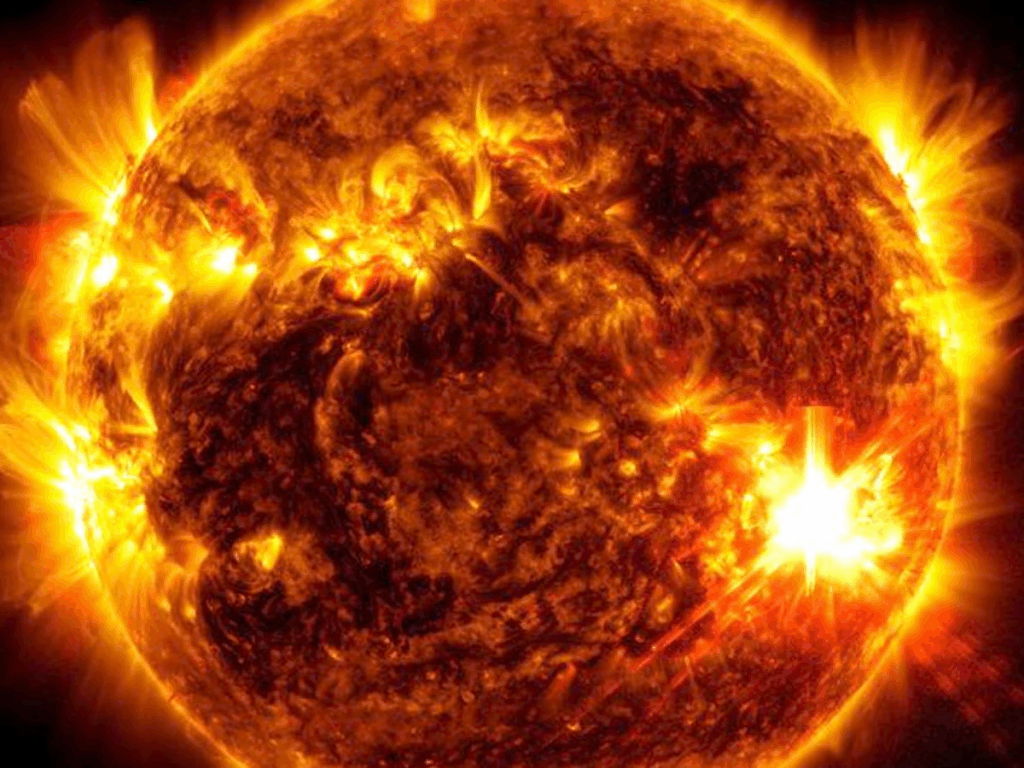
The possibility of a major solar storm disrupting aviation, satellites, and global communication networks is once again under focus after scientists detected an unusually strong burst of radiation in Earth’s upper atmosphere. A new study from the Surrey Space Centre (SSC) shows that the November 11 solar flare raised radiation levels at altitudes used by aircraft to as much as ten times the normal range, marking the strongest ground-level solar event recorded in nearly 20 years.
With the Sun approaching the peak of its 11-year solar cycle, researchers caution that an even more powerful geomagnetic storm could strike in the near future. And if that happens, the consequences for aviation safety and global technological infrastructure could be severe.
This article breaks down how the recent solar storm unfolded, what the new study reveals, and why scientists say the world must prepare.
What triggered the recent radiation surge?
On November 11, the Sun released a series of powerful X-class solar flares, the strongest category of solar eruptions. These flares launch intense bursts of electromagnetic energy and charged particles toward Earth.
A rare storm powerful enough to be detected from the ground
The event was so strong that radiation levels rose deep into the atmosphere, reaching altitudes normally used by aircraft such as:
- Business jets
- High-altitude research aircraft
- Supersonic transport planes flying near 40,000 ft
According to the SSC’s analysis, the storm caused a radiation spike that was measurable even from the ground. This phenomenon, known as a ground-level enhancement (GLE), is extremely rare.
Clive Dyer, a climate scientist at the University of Surrey, describes it as a once-in-two-decades event.
First ground-detection event since 2006
The study notes this was the strongest ground-level solar radiation event since December 2006. That earlier storm was itself among the most intense ever recorded during the age of modern instrumentation.
How scientists measured the spike across UK airspace
To capture real-time data, the UK Met Office and Dutch researchers launched rapid-response weather balloons. These flew directly through the radiation-affected zone at altitudes near 40,000 ft.
Results from the balloon sensors
The sensors recorded:
- A tenfold increase in radiation exposure
- The highest readings seen in two decades
- A clear three-dimensional picture of how radiation spread across the region
Keith Ryden, head of the Surrey Space Centre, said this was the first real-world test of their new rapid-reaction instrumentation. The system, he noted, worked “very well,” providing a detailed map of how the storm affected aviation altitudes.
Why a major solar storm could threaten aircraft safety
Risks to onboard electronics
Aircraft rely on sensitive electronic systems for:
- Flight control
- Navigation
- Communication
- Data coordination
A severe solar storm could overwhelm these systems with charged particles, potentially causing:
- Temporary malfunctions
- Data corruption
- Navigation disruptions
- Increased radiation exposure to crew and passengers
Commercial aircraft typically avoid regions of high solar activity, but sudden, extreme radiation spikes—like the one observed on November 11—can pose unpredictable risks.
Radiation dose concerns
Although short-term exposure at ten times the normal level is still below emergency thresholds, longer exposure or a stronger storm could create serious health concerns for frequent flyers, pilots, and high-altitude crew.
Why scientists believe a bigger storm could hit Earth
Historical records show that the Sun is capable of unleashing solar storms far more powerful than anything seen in the modern technological age.
As the Sun approaches its solar maximum, expected between 2024 and 2025, the frequency of:
- Solar flares
- Sunspots
- Coronal mass ejections (CMEs)
is increasing dramatically.
Clive Dyer warns that “significantly bigger events are possible,” adding that global systems “need to be ready.”
The Carrington Event: a reminder of what a superstorm looks like
The most powerful solar storm in recorded history occurred in 1859. Known as the Carrington Event, it produced auroras so bright they woke sleeping gold miners in the Rocky Mountains. The storm also:
- Set telegraph systems on fire
- Delivered electric shocks to operators
- Disrupted global communications
- Was visible across Europe, North America, and even near the equator
Scientists estimate that if a storm of similar magnitude were to hit today, the effects would be catastrophic, potentially disabling:
- GPS systems
- Aviation networks
- Power grids
- Internet cables
- Satellites
- Radio communication
Modern society’s heavy dependence on electrical and digital systems makes a repeat of the Carrington Event a far greater threat today than in 1859.
How the aviation industry can prepare for future solar storms
While solar storms cannot be prevented, aviation authorities and researchers are working to mitigate risk.
Key readiness measures include:
- Installing radiation monitors on aircraft
- Developing real-time solar weather alerts for pilots
- Rerouting high-altitude flights during solar storms
- Strengthening electronic shielding in critical systems
- Using independent backup navigation systems (beyond GPS)
Why readiness matters now more than ever
The November 11 flare was a warning shot. With the solar cycle peaking, the likelihood of more intense events is increasing.
Whether the next major storm mirrors the 2006 event or reaches Carrington-level strength, experts agree: global aviation systems must prepare as solar activity intensifies.
TL;DR
- A November 11 solar flare caused a radiation spike ten times above normal levels at aircraft cruising altitudes.
- Scientists say it was the strongest ground-level event since 2006.
- The Sun is near its solar maximum, raising the risk of larger geomagnetic storms.
- A severe storm could disrupt aircraft electronics, navigation, and safety systems.
- Experts warn the world must prepare for potentially larger solar events in the near future.