
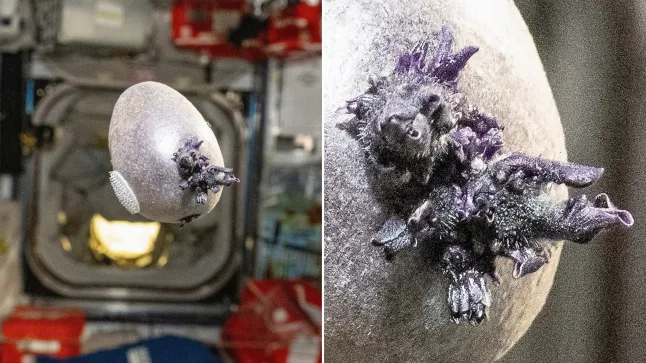
A bizarre, tentacled object called Spudnik-1 is floating inside the International Space Station, which recently sparked curiosity, and a fair bit of internet panic. The black, egg-like form looked almost alien, with root-like strands stretching outward in all directions.
But the truth is far less sci-fi.
According to NASA astronaut Don Pettit, the mysterious object is simply a potato growing in space.
What was the “strange object” seen on the ISS?
The viral image shows what appears to be:
- A dark, oval-shaped object
- Thin, tentacle-like structures extending outward
- A floating, almost alien appearance
In reality, those “tentacles” are sprouting roots and shoots from a potato.
Pettit humorously dubbed it “Spudnik-1,” a playful nod to Sputnik, the first artificial satellite.
Why does a potato look so strange in space?
The unusual appearance of Spudnik -1 comes down to one key factor: microgravity.
How plants behave differently in space
On Earth, gravity guides plant growth:
- Roots grow downward
- Shoots grow upward toward light
In space, that directional cue disappears.
What happens in microgravity
- Roots grow in all directions instead of downward
- Shoots don’t follow a fixed upward path
- Growth appears chaotic and tangled
This creates the eerie, tentacle-like look seen in the image.
Why was the potato growing on the ISS?
This wasn’t a random experiment—it’s part of a broader effort to understand space agriculture.
What Pettit was doing
- Conducting informal plant growth experiments during Expedition 72
- Using an improvised setup with Velcro and grow lights
- Testing how potatoes develop in orbit
NASA has long been interested in growing food in space, especially for future missions to the Moon and Mars.
Why potatoes are important for space missions
Potatoes may not sound exciting, but they’re incredibly valuable for astronauts.
Key advantages
- High nutritional value
- Efficient growth relative to plant mass
- Versatile and easy to store
Pettit himself noted that potatoes are one of the most efficient foods in terms of edible yield vs. total plant size.
The “Martian” connection
The experiment also draws inspiration from The Martian.
In the story (and its film adaptation), an astronaut survives on Mars by growing potatoes in extreme conditions.
Why this matters in real life
- Long-duration missions require self-sustaining food sources
- Resupply from Earth is limited or impossible
- Crops like potatoes could become lifelines for astronauts
This makes even small experiments like “Spudnik-1” scientifically meaningful.
Has NASA grown food in space before?
Yes—this is part of a growing field of research.
Crops successfully grown in space
- Lettuce
- Radishes
- Tomatoes (in experimental phases)
- Peppers
NASA facilities like Kennedy Space Center are actively working on expanding the range of crops that can be grown in orbit.
Why do plants grow slowler in space?
According to Pettit, plant growth in space is noticeably slower than on Earth.
Possible reasons
- Lack of gravity affects nutrient distribution
- Water behaves differently in microgravity
- Artificial lighting conditions are less optimal
Understanding these limitations is key to improving future space farming systems.
What does this mean for the future of space exploration?
Experiments like this are small steps toward a much bigger goal: sustainable life beyond Earth.
Future implications
- Growing food on long missions (Mars, Moon)
- Reducing dependence on Earth-based supplies
- Building closed-loop life support systems
As missions become longer and more distant, the ability to grow food in space will shift from a novelty to a necessity.
What about the ISS itself?
The International Space Station is expected to be retired around 2030.
NASA and its partners are already planning:
- New space stations
- Commercial orbital platforms
- Expanded research into space agriculture
So experiments like this are laying the groundwork for the next generation of space habitats.
TL;DR
- The “alien-looking” object on the ISS is just a potato
- Its strange appearance is due to microgravity affecting root growth
- The experiment highlights efforts to grow food in space
- Potatoes could play a key role in future missions to Mars
- Even simple experiments help solve complex challenges in space exploration