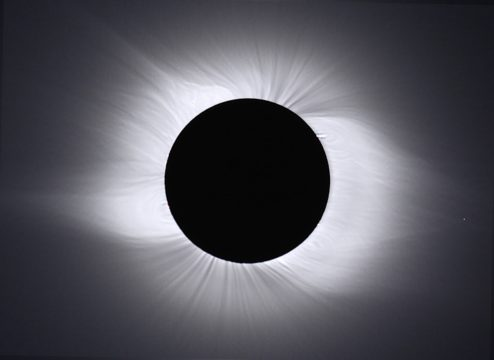
The August 12, 2026, total solar eclipse will give skywatchers a fleeting look at something that can never be exactly reproduced: the Sun’s corona at one particular moment in its constantly changing magnetic cycle.
As the Moon completely covers the Sun’s bright surface, the normally invisible outer atmosphere will suddenly become visible as a delicate halo of plasma, with streamers and tendrils extending into space. The basic phenomenon occurs during every total solar eclipse, but the precise shape of the corona is never the same twice.
That makes the 2026 eclipse particularly interesting for scientists. Solar Cycle 25 has already passed its peak, but the Sun remains considerably more active than it will be near solar minimum. The result should be a corona that reflects a transitional stage in the Sun’s roughly 11-year activity cycle.
What is special about the August 12, 2026 solar eclipse?
The unusual feature of this eclipse is not a newly discovered object or a permanent structure on the Sun. It is the temporary arrangement of the corona’s streamers and magnetic structures.
The corona consists of extremely hot, electrically charged plasma. Its appearance is governed by the Sun’s magnetic field, which changes as solar activity rises and falls.
During periods of high solar activity, the corona tends to display streamers extending in many directions. Near solar minimum, the structure generally becomes more concentrated around the Sun’s equatorial regions.
The 2026 eclipse arrives during the decline from Solar Cycle 25’s peak, creating an intermediate phase that scientists are particularly interested in observing.
According to NASA, the cycle reached its maximum around October 2024. By August 2026, solar activity will be declining, but the Sun will not yet have reached the quieter conditions associated with solar minimum.
Why will the Sun’s corona look different in 2026?
The Sun is not magnetically static.
Its magnetic field constantly shifts, and those changes influence the movement and shape of plasma in the corona. That means an eclipse effectively freezes one moment of this constantly changing environment for observers on Earth.
During totality, the Moon acts like a natural coronagraph, blocking the brilliant photosphere and allowing the much fainter corona to emerge.
The visible corona can appear as:
- Long white streamers stretching outward
- Narrow spikes and rays
- Loops associated with magnetic activity
- Bright prominences along the edge of the Moon
- More pronounced structures around active regions
No future eclipse will reproduce precisely the same arrangement because the Sun’s magnetic configuration will have changed.
This is why describing the 2026 corona as a “one-of-a-kind” structure is best understood as describing a unique snapshot rather than a never-before-seen physical feature.
Where will the total solar eclipse be visible?
The path of totality will cross a relatively narrow portion of the Northern Hemisphere.
NASA says totality will be visible across parts of:
- Greenland
- Iceland
- Northern Russia
- Spain
- A small part of Portugal
- The Atlantic Ocean
A much larger area will experience a partial eclipse, including parts of North America, Canada, Europe and northwestern Africa.
Northern Spain is expected to be one of the major viewing locations because totality will occur relatively late in the day, with the Sun low in the sky.
In Reykjavík, Iceland, NASA lists totality beginning at 5:48 p.m. local time and ending at 5:49 p.m. In León, Spain, totality is expected to begin at 8:28 p.m. and last about two minutes.
How long will totality last?
The total eclipse will be brief.
NASA says totality will last less than two and a half minutes even near the central portions of the eclipse path. For most observers, the period will be shorter.
That short window is also why scientists are using aircraft to extend their observing time.
NASA’s WB-57 research jet will fly at approximately 50,000 feet and chase the Moon’s shadow at around 460 mph. By moving with the eclipse, researchers expect to observe the corona for nearly three minutes—longer than observers standing on the ground can experience it.
Why are NASA scientists chasing the eclipse?
A total solar eclipse provides an opportunity that instruments on Earth cannot easily reproduce.
The bright surface of the Sun normally overwhelms the faint corona. When the Moon blocks that surface, researchers can examine the corona with far less interference.
NASA scientists will use high-altitude aircraft equipped with specialized cameras to study the corona during the eclipse.
The WB-57’s instruments will also observe infrared wavelengths that are difficult to study from the ground because Earth’s atmosphere absorbs some of that radiation.
NASA is also supporting balloon experiments in Iceland and Spain to study how the sudden transition from daylight to darkness affects Earth’s atmosphere.
What else could observers see during totality?
The corona will be the main attraction, but the brief darkness can reveal other celestial phenomena.
Depending on viewing conditions and location, observers may be able to see bright planets and stars around the eclipsed Sun.
The Perseid meteor shower also reaches its annual peak around this period, although spotting meteors during the short darkness of totality would be difficult and highly dependent on conditions.
Another spectacular phenomenon is the appearance of solar prominences—bright structures of plasma that can become visible along the edge of the Moon during totality.
Is it safe to look at the eclipse?
Yes—but only during the brief period of totality and only when the Moon completely covers the Sun.
During the partial phases, looking directly at the Sun without appropriate protection can cause serious eye injury.
NASA recommends certified solar-viewing glasses or appropriate solar filters. Ordinary sunglasses are not sufficient.
Anyone using a camera, telescope or binoculars must also use a properly designed solar filter attached to the front of the optical equipment. Wearing eclipse glasses while looking through unfiltered optical equipment does not make it safe.
Once the Sun begins to reappear at the end of totality, viewers must immediately put their eye protection back on.
Why this eclipse matters to solar science
The 2026 eclipse is more than a spectacular sky show.
Scientists can use observations of the corona to improve their understanding of how the Sun’s magnetic field shapes its outer atmosphere and how solar activity changes over time.
That matters because powerful solar eruptions can send charged particles toward Earth, potentially affecting satellites, radio communications, navigation systems and electrical infrastructure.
Observing the corona during different stages of the solar cycle gives researchers another piece of the long-term picture of how our star behaves.
The August 12 eclipse therefore offers something that photographs from previous eclipses cannot: a new measurement of the Sun at a particular point in Solar Cycle 25.
The “one-of-a-kind” structure won’t last
The most important distinction is that scientists are not expecting a permanent structure to suddenly emerge from the Sun.
Instead, the eclipse will reveal a configuration of the corona that exists for only that moment.
The Sun’s magnetic field will continue changing after August 12. Its streamers will shift, active regions will evolve and the corona will gradually take on a different appearance.
That makes every total solar eclipse a kind of natural time capsule.
The 2026 eclipse will capture the Sun in a transitional phase—after the peak of Solar Cycle 25 but before the much quieter conditions of solar minimum. For a few minutes, observers inside the path of totality will see that changing magnetic environment with their own eyes.
And once the Moon moves away, that exact view will be gone.