
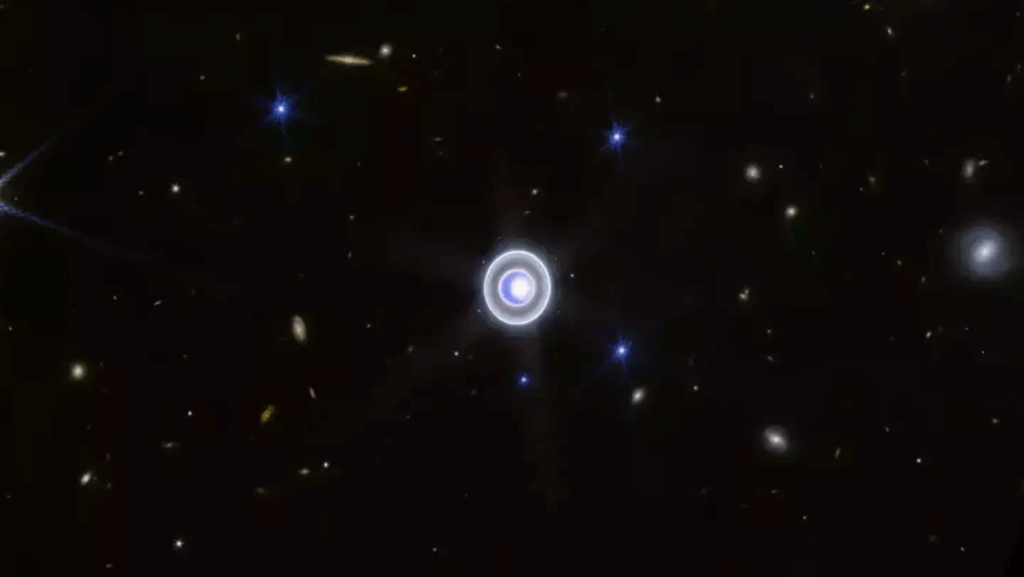
Uranus, the seventh planet from the Sun, is famous for its sideways rotation and the jokes its name inspires. But few know that “Uranus” wasn’t its original name. The planet’s first title triggered an unexpected controversy in the astronomy community, eventually prompting a complete renaming.
This article explores why Uranus’ first name caused an uproar, how the planet finally got its mythological identity, and why naming conventions matter for modern astronomy.
What was Uranus’ original name, and why was it controversial?
When William Herschel discovered Uranus in 1781, he changed our understanding of the solar system. Until then, no new planet had been identified since ancient times. Herschel used the most advanced telescope of his era, the 40-foot Newtonian reflector. King George III had funded the instrument, so Herschel chose a name that reflected his gratitude.
Herschel proposed “the Georgium Sidus”
Herschel initially named the planet “the Georgium Sidus,” meaning “George’s Star” in Latin, in honor of King George III. The name sparked immediate criticism for several reasons:
- It broke the tradition of naming planets after Roman or Greek deities.
- It inserted overt politics into scientific discovery.
- It incorrectly used the word “star,” even though the object was a planet.
- It would have created an awkward precedent since no other planet was named after a reigning monarch.
Space enthusiasts and astronomers across Europe resisted adopting the royal title. Many argued that a planet—an object belonging to all humankind—should not be used as a tribute to one king.
How did Uranus get its modern name?
Johann Elert Bode proposed “Uranus”
German astronomer Johann Elert Bode advocated a name that aligned with longstanding mythological conventions. He suggested “Uranus,” after the ancient Greek sky deity and father of Saturn.
Bode’s reasoning aligned neatly with existing naming logic:
- Jupiter is the son of Saturn
- Saturn is the son of Uranus
- Therefore, placing “Uranus” beyond Saturn preserved a mythological family tree
This argument quickly gained traction among astronomers who wanted to move away from nationalistic naming.
The name took decades to become standard
Even with growing support, the name Uranus did not become standard until around 1850. It took nearly 70 years after its discovery for scientists worldwide to formally adopt the mythological name.
Today, the International Astronomical Union (IAU) oversees the naming of all planets, moons, stars, and exoplanets. If Uranus were discovered now, it would follow a structured approval process rather than political preference.
What makes Uranus scientifically unique?
Even without its naming controversy, Uranus stands out as one of the strangest planets in our solar system.
Uranus rotates on its side
Unlike any other world in the solar system, Uranus spins almost completely sideways with an axial tilt of about 98 degrees. Scientists believe this tilt resulted from a violent collision early in its history.
This extreme orientation causes unusual seasonal patterns:
- Each pole receives about 42 years of continuous sunlight
- Followed by 42 years of complete darkness
- A full Uranian year lasts 84 Earth years
Uranus is an ice giant with rings and dozens of moons
Uranus is composed largely of icy materials like methane and water. Its signature blue-green glow comes from methane’s absorption of red light.
Key characteristics:
- Classification: Ice giant
- Moons: At least 27, many named after Shakespearean characters
- Rings: 13 faint, narrow rings
- Temperature: Among the coldest planets, averaging around −224°C
Why the naming of Uranus matters today
Planetary naming might sound trivial, but it shapes how future generations learn about space. A planet’s name influences:
- Scientific communication
- Cultural perceptions
- Educational clarity
- Global consensus in astronomy
If Herschel’s original name had remained, astronomy textbooks would depict a solar system with one planet named after a king and all others named after mythological gods—an inconsistency that could confuse scientific lineage and cultural continuity.
The legacy of the Uranus naming debate
The controversy surrounding Uranus’ original name helped strengthen the case for consistent, mythology-based naming. Today, astronomy strives for neutrality and universality over nationalism. The shift away from “Georgium Sidus” was more than a cosmetic change—it reinforced a standard that still governs space science today.
TL;DR
- Uranus was originally named “the Georgium Sidus” by William Herschel.
- The name honored King George III but broke mythological tradition and sparked backlash.
- German astronomer Johann Elert Bode proposed “Uranus,” fitting the mythological lineage of Saturn and Jupiter.
- The name became widely accepted only by 1850.
- Uranus is unique for its sideways rotation, 42-year seasons, blue-green ice-giant composition, and collection of moons and rings.
- The debate shaped the modern naming rules used by the International Astronomical Union.