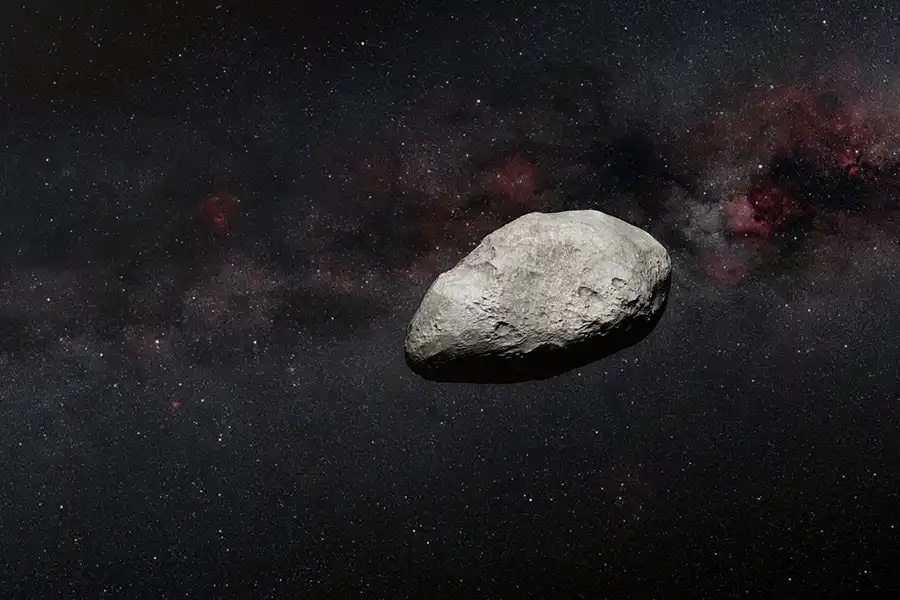
An asteroid spinning once every 1.88 minutes should not exist in one piece. Yet that is exactly what astronomers are observing in the main asteroid belt, following new detections by the Vera C. Rubin Observatory. The object, named 2025 MN45, is forcing scientists to re-evaluate long-standing ideas about how asteroids are formed, how strong they are, and what keeps them from tearing themselves apart in space.
At roughly 2,300 feet across, this is no minor space rock. It is one of the largest asteroids ever seen rotating at such an extreme speed. According to existing models, the centrifugal force alone should have caused it to fracture long ago. Instead, it remains intact, and that contradiction has left researchers searching for answers.
What exactly did scientists discover?
Using early observations from Rubin’s powerful telescope system in Chile, astronomers identified 19 unusually fast-spinning asteroids in the belt between Mars and Jupiter. The findings were detailed in a study published in The Astrophysical Journal Letters.
The group includes 76 asteroids examined in total. Sixteen of them fall into the category of super-fast rotators, completing one spin every 13 minutes to 2.2 hours. Three are classified as ultra-fast rotators, spinning once every five minutes or less.
All 19 of the fastest objects are at least 300 feet long, with some exceeding 3,000 feet in diameter. Among them, 2025 MN45 stands out as the fastest-spinning asteroid ever observed among objects measuring 500 meters or more.
Why is a 1.88-minute rotation such a problem?
Asteroids are not expected to survive such speeds unless they are either very small or made of exceptionally strong material. Most known asteroids do not meet either condition.
For decades, scientists have believed that the majority of asteroids are rubble piles. These are loosely bound collections of rocks and debris held together mainly by gravity. At extreme rotation speeds, gravity should lose its grip, causing material to fly off the surface or the entire body to break apart.
That is what makes 2025 MN45 so puzzling. Despite spinning at a rate that should destroy it, the asteroid shows no sign of structural failure.
Is this asteroid made differently?
The discovery raises uncomfortable questions about what this asteroid is actually made of. According to lead author Sarah Greenstreet, the asteroid must have internal strength comparable to solid rock in order to survive.
This is surprising because most asteroids in the main belt are thought to be fragments left behind after ancient collisions. If 2025 MN45 is not a rubble pile, it could mean one of several things. It may be a rare remnant from the early Solar System that never shattered. It could have undergone processes that fused it more tightly over time. Or it may suggest that scientists have underestimated the strength of some asteroids altogether.
How could an asteroid start spinning this fast?
Researchers are still debating how an object this large could reach such an extreme rotation rate without falling apart. Several possibilities are under consideration.
One explanation involves ancient collisions that transferred angular momentum, effectively spinning the asteroid up. Another possibility is the YORP effect, a phenomenon in which uneven heating from sunlight slowly changes an asteroid’s rotation over millions of years. A third theory suggests the asteroid may have formed as a largely solid body rather than assembling from debris.
None of these explanations fully resolves the mystery on its own, which is why the object continues to draw intense interest.
A well-placed visual here could compare asteroid size versus rotation speed, showing how dramatically 2025 MN45 stands apart from known objects.
Why the Vera Rubin Observatory is central to this discovery
This finding is also an early demonstration of what the Rubin Observatory is capable of. Equipped with the world’s largest digital camera for astronomy, the facility is designed to repeatedly scan the sky and capture changes over time.
Its capabilities allow scientists to detect smaller, fainter, and faster-moving asteroids that older surveys often missed. It also enables long-term tracking of rotation rates, brightness changes, and orbital behavior.
Rubin’s Legacy Survey of Space and Time is expected to dramatically expand the catalog of known asteroids and uncover many more unusual objects like 2025 MN45.
Why this discovery matters beyond astronomy
Understanding how strong asteroids really are has practical implications. In planetary defense, knowing whether an asteroid is solid or loosely bound determines how effective any deflection strategy might be. For future space mining efforts, internal structure dictates whether extraction is possible or safe. Scientifically, these objects act as time capsules that preserve clues about how the Solar System formed.
If more large, fast-spinning asteroids turn out to be stronger than expected, scientists may need to revise decades of assumptions that guide both research and mission planning.
An internal link to a detailed explainer on asteroid impact risks or planetary defense strategies would add useful context here.
What scientists will look for next
Researchers plan to continue monitoring 2025 MN45 to see whether its rotation changes over time or if it begins shedding material. They also want to compare it with other ultra-fast rotators to determine whether it is a rare anomaly or part of a previously hidden population.
As Rubin’s survey ramps up, astronomers expect to find more objects that challenge existing theories, potentially reshaping how we understand asteroid evolution.
Credible external sources to reference include official releases from NOIRLab, NASA’s Planetary Defense Coordination Office, and peer-reviewed research from major astronomy journals.
TL;DR
An asteroid named 2025 MN45 is spinning once every 1.88 minutes, a speed that should have torn it apart. Instead, it remains intact, challenging the idea that most asteroids are weak rubble piles. Detected by the Vera Rubin Observatory, the object may force scientists to rethink asteroid strength, formation, and even how Earth might one day defend itself from a potential impact.