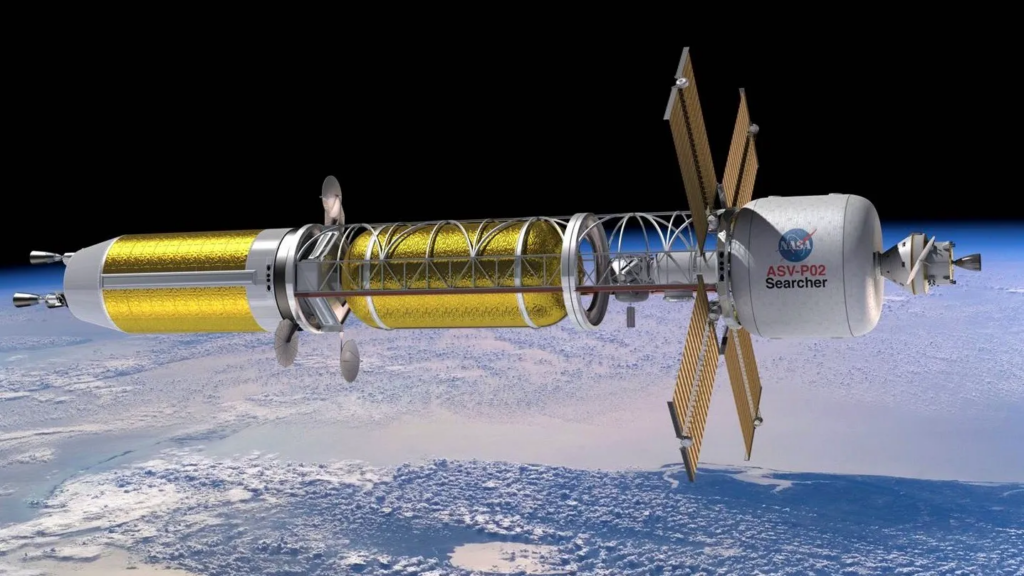
The idea sounds like science fiction, but it is edging closer to reality. Space agencies are preparing to test nuclear-powered rockets engines in orbit, with the first in-space demonstration of nuclear thermal propulsion (NTP) currently planned for early 2026. If successful, the test could reshape how humanity travels beyond Earth orbit, especially to Mars.
At the same time, the technology carries undeniable risks, from radiation exposure to fears of nuclear material accidents. As momentum builds, the debate around nuclear engines in space is intensifying.
What Is Nuclear Thermal Propulsion (NTP)?
Nuclear thermal propulsion replaces chemical combustion with nuclear fission to generate thrust. Instead of burning fuel and oxidizer, an NTP engine pumps liquid hydrogen through a compact nuclear reactor built into the rocket.
Inside the reactor, uranium atoms split in a controlled fission process, releasing enormous heat. That heat rapidly raises the temperature of the hydrogen, which is then expelled through a nozzle to produce thrust. The physics is straightforward, but the engineering is anything but.
NTP is not a new concept. The United States tested nuclear thermal engines on the ground during the Cold War, but none were ever flown in space. Today’s renewed interest is driven by modern materials, improved reactor designs, and ambitious plans for human deep-space exploration.
Why NTP Is Seen as a Game-Changer
The main appeal of nuclear thermal propulsion lies in efficiency. NTP engines can be roughly twice as efficient as the best chemical rockets currently in use. In practical terms, that means spacecraft can travel farther using less propellant or carry heavier payloads without increasing fuel mass.
Hydrogen plays a key role here. Because it is extremely light, it accelerates more easily than the heavier exhaust products of chemical rockets, such as water vapor. The result is higher exhaust velocity and better overall performance.
For mission planners, this efficiency opens doors that chemical rockets struggle to unlock.
How NTP Engines Would Be Used Safely
Nuclear thermal engines are not designed for liftoff from Earth. Instead, missions would follow a two-step approach. A conventional chemical rocket would first launch the spacecraft into orbit. Only after reaching space would the nuclear engine be activated.
This strategy significantly reduces the risks associated with launching nuclear material from Earth. In theory, the reactor would remain inactive and subcritical during launch, minimizing the chance of radioactive release even in the event of a launch failure.
Why Mars Missions Are Driving Interest
Mars is the primary target behind the renewed push for nuclear propulsion. With NTP, travel time to Mars could be reduced by up to 25 percent, depending on mission design.
Shorter journeys matter for human spaceflight. Reduced travel time means lower exposure to cosmic radiation and fewer health risks from prolonged weightlessness. NTP systems also allow for wider launch windows, making missions less dependent on rare planetary alignments.
Another advantage is flexibility. Higher-performance propulsion could make abort scenarios more feasible, giving crews more options if something goes wrong en route.
What NASA Is Doing Right Now
The most advanced nuclear rocket effort today is a joint program between NASA and DARPA, known as DRACO—short for Demonstration Rocket for Agile Cislunar Operations.
DRACO aims to conduct the first-ever in-space test of a nuclear thermal rocket engine. Current plans call for activating the engine in Earth orbit in early 2026, although officials acknowledge the schedule could slip into 2027.
Lockheed Martin is developing the spacecraft, while BWX Technologies is responsible for the reactor and nuclear fuel. The test will not carry a crew and is designed purely as a technology demonstration.
What About India and Other Countries?
India is watching developments closely. ISRO is working on nuclear power systems and foundational technologies that could support nuclear propulsion in the long term, but a full nuclear thermal rocket program is likely still years away.
Elsewhere, private companies are also exploring nuclear propulsion concepts. In the UK, Pulsar Fusion is researching nuclear fusion-based rocket engines. Fusion propulsion promises far higher performance than fission-based NTP, but the technology remains far less mature and is unlikely to see practical use anytime soon.
The Risks of Nuclear-Powered Rockets
Despite its promise, nuclear propulsion comes with serious concerns. The use of uranium as rocket fuel raises safety, security, and proliferation issues. To address this, NASA and the US Department of Energy are working to use low-enriched uranium instead of highly enriched fuel, reducing both security risks and political sensitivity.
Radiation is another major challenge. Engineers plan to shield sensitive spacecraft components and orient reactors away from crew areas to minimize exposure. Ground tests suggest modern fuel designs can withstand extreme temperatures and radiation without significant degradation.
Launch accidents remain one of the most sensitive issues. Even with inactive reactors, fears persist about nuclear material dispersal in the event of a catastrophic failure. To mitigate this, engineers are developing robust fuel forms designed to remain intact under severe accident conditions.
Engineering and Political Hurdles Ahead
NTP reactors operate at extraordinarily high temperatures, pushing materials to their physical limits. Managing liquid hydrogen in space for long durations also remains technically difficult, especially for deep-space missions.
Beyond engineering, nuclear propulsion faces regulatory and political challenges. International treaties, environmental concerns, and public perception all play a role in determining how, and whether, nuclear rockets become mainstream.
What the 2026 Test Could Decide
The planned in-space test in early 2026 will be a turning point. Success would validate decades of theory and laboratory work, potentially paving the way for operational nuclear-powered missions in the late 2020s and 2030s. Failure, or major setbacks, could delay the technology for years.
Nuclear thermal propulsion offers enormous potential for deep-space exploration, but it also demands careful handling of technical, safety, and political risks. The upcoming test will help determine whether nuclear engines move from promise to practice—or remain a powerful idea waiting for its moment.
TL;DR
Nuclear thermal propulsion could power faster, more capable space missions, especially to Mars. NASA and DARPA plan the first in-space test of a nuclear rocket engine in early 2026. While the technology promises major benefits, it also raises serious safety, engineering, and political concerns. The upcoming test will likely shape the future of nuclear-powered spaceflight.