
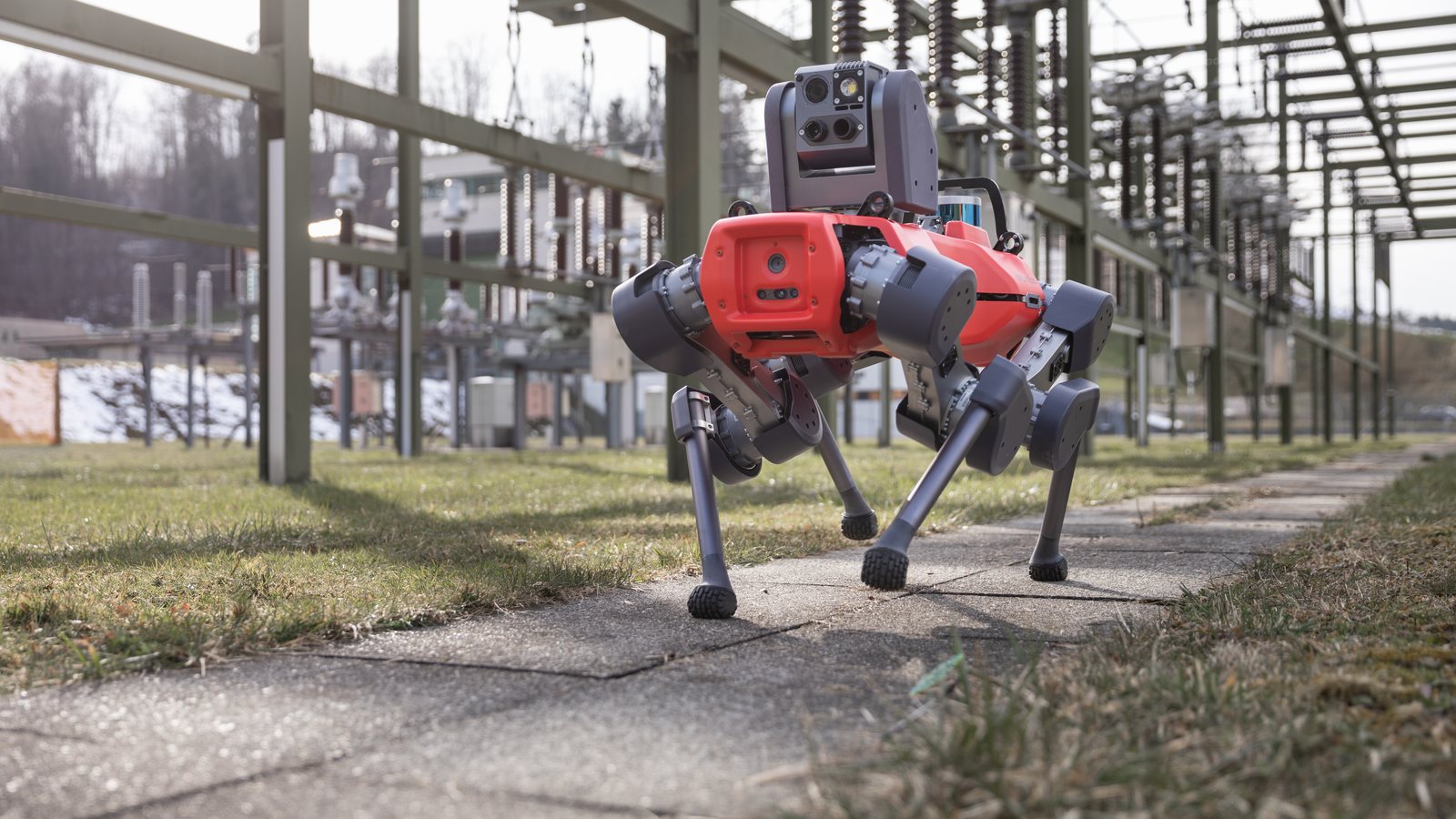

A robot dog at ETH Zurich has solved a giant Rubik’s Cube using only its feet. It did it three times, with no human help. Each solve of the 40-centimeter, 4.6-kilogram cube took the four-legged ANYmal D robot 8 to 9 minutes, according to the team’s preprint, posted Oct. 17.
Nobody needs a robot to solve Rubik’s Cubes this slowly. What the cube tests is whether a walking robot can handle an object precisely, over and over, with the legs it already has. That matters because the legged robots now working in power plants and mines carry sensors, not hands.
Who built it, and what the paper claims
The work comes from ETH Zurich’s Robotic Systems Lab, led by Marco Hutter. Lukas Amiet and Gabriel Sánchez-Blanco Repgen are joint first authors on the seven-person paper. One co-author, Mayank Mittal, also lists an affiliation with NVIDIA. The paper credits funding from the Luxembourg National Research Fund and the Swiss National Science Foundation.
It is an arXiv preprint, which means it hasn’t been through peer review yet. The team has posted video and a summary on its project page. The paper doesn’t claim a world first, and no Guinness record is involved. For scale, Guinness credits a Mitsubishi Electric machine with the fastest robot solve, at 0.305 seconds in 2024.
The robot itself isn’t new. ANYmal is built by ANYbotics, a Swiss company that sells it for industrial inspection at power, mining, oil and gas, and chemical sites. The ETH team used a standard ANYmal D and taught it new skills.
How a robot dog solves a cube with its feet
The solve has three stages. First the robot walks a 270-degree arc around the cube and flips it once. That lets its onboard camera see all six faces. The paper reports the color reading was 100% accurate indoors and 98.7% outdoors.
Then a standard solver, Kociemba’s two-phase algorithm, works out the moves. The team converts each move into one of a few robot skills.
The hard part is doing it.
To flip the cube, the robot presses one foot against it and tips it 90 degrees toward or away from itself. To turn a layer, the right front foot pins the bottom layer. The left front foot then pushes the top two layers a quarter turn.
Between moves, the robot walks around the cube to bring the right face into position.
Each solve took about 30 of these flips, turns and walking steps. One sequence shown in the paper had 25. A single slip that turns the wrong layer ruins every move that follows. The authors call the task “a demanding test of precise, repeatable pedipulation.”
What ‘pedipulation’ means, and how the robot learned it
Pedipulation is the lab’s word for manipulating objects with a legged robot’s feet. The paper says it “extends a legged robot’s capability to interact with its environment without an additional arm.”
The skills were trained by reinforcement learning, a trial-and-error method, in NVIDIA’s Isaac Lab simulator. The team first trained “teacher” policies that could see the simulator’s exact data. Then it distilled them into “student” policies that run on what the real robot senses: depth cameras and its own joint readings.
The paper’s own tests show why the cameras matter. With the depth cameras removed in simulation, the success rate for one cube rotation fell from 99% to about 77%.
Where the robot still struggles
The three full solves worked, but the individual skills weren’t flawless on real hardware. In 15 tries each, both flips succeeded every time. The counterclockwise layer turn worked 13 times, and the clockwise turn only 10, mostly because the robot turned the layer too far.
The authors list other limits. Outdoors, the cube sometimes slid on low-friction ground, and only three of five outdoor scans finished. Rotations are sensitive to friction and to where the cube sits. Once the robot commits to a press, a late shove can still cause an incomplete flip or a fall.
In other words, the three clean solves are a lab result. We think the more telling number is 10 out of 15. It shows how much precision is still missing for routine work.
Why feet matter for search, inspection and rescue
Most legged robots in the field today look and listen. ANYbotics markets ANYmal for thermal readings, gas-leak detection and acoustic checks, and lists no arm on its product page. Adding an arm brings weight, cost and another thing to break. A robot that can use its own legs to push, hold and turn things doesn’t need one for simple jobs.
The lab has worked toward this for years. Its 2024 Pedipulate paper had an ANYmal open doors, collect samples and push obstacles with one leg. The new paper lists button pressing, ball dribbling and door opening as earlier pedipulation results.
Rescue and exploration are where ANYmal first made its name. In September 2021, Team CERBERUS, which included ETH Zurich researchers, won DARPA’s Subterranean Challenge and $2 million with four ANYmal C robots and drones. That contest sent robots into tunnels, caves and urban underground spaces with no GPS. Robotics 24/7 tied those settings to “active combat operations or disaster response.” In those settings, a robot that can shove a door or move debris without an arm could reach places a heavier robot couldn’t.
The Rubik’s Cube demo doesn’t show that yet. It shows two feet working together on one object for minutes at a time. The lab’s earlier one-leg work didn’t attempt that.
Viral robot clips often promise more than they show, as with Unitree’s “bodyguard” robot video. This one comes with a paper that spells out the failures.
The next test is everyday equipment
The authors say the same skill could let a robot hold a toolbox steady while closing its lid, or brace a collapsible crate while folding its sides. In each case one foot holds while the other moves a part. They write that extending this across objects “would give legged robots practical ways to handle everyday equipment using their existing limbs.”
The paper doesn’t give a timeline, and ANYbotics hasn’t said whether any of this will reach its commercial robots. Like Tesla’s plan to add owners’ cars to its robotaxi fleet, it’s a promise to judge by deployments, not demos. The next sign will be peer review and whether the lab shows the skills on objects other than a cube.