A 400-year-old grave in Poland has given archaeologists an unusually detailed glimpse into the fears and superstitions that surrounded death in 17th-century Europe.
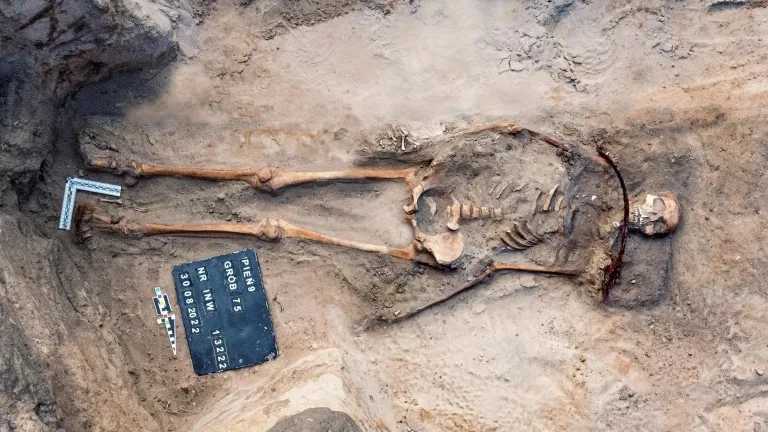
When researchers excavated the grave in 2022, they found the remains of a young woman buried with an iron sickle positioned across her neck and a triangular iron padlock attached to the big toe of her left foot. The arrangement suggested that the people who buried her were taking deliberate steps to prevent her from returning from the dead.
The discovery, known as Grave 75 at a cemetery in Pień, was recently examined in a multidisciplinary study published in the Journal of Archaeological Science: Reports. Researchers from Nicolaus Copernicus University and other institutions combined archaeological, DNA, isotope and materials analysis to reconstruct what they could about the woman and the circumstances surrounding her unusual burial.
The researchers do not claim that the woman was actually a vampire. Instead, they interpret the burial as evidence of anti-demonic practices — rituals intended to prevent a dangerous deceased person from returning to harm the living.
What did archaeologists find in the Polish ‘vampire’ grave?
The burial contained a young woman who was probably between 17 and 19 years old when she died, sometime between approximately 1620 and 1674.
What made the grave extraordinary was the combination of two objects.
A curved iron sickle had been placed directly across her neck, with its blade pointing toward her throat. An iron padlock had been attached to the big toe of her left foot. According to the researchers, the combination is unique in the published archaeological record.
The sickle appears to have served a very practical purpose within the logic of the ritual: if the woman somehow attempted to rise from the grave, the blade would have made it difficult to do so without injuring or severing her head.
The padlock carried a different symbolic message. It represented closure — physically and metaphorically preventing the deceased from crossing back into the world of the living.
The Nicolaus Copernicus University team has previously cautioned against simply calling the woman a “vampire.” The term is useful for describing the popular interpretation of the discovery, but the archaeological evidence points more broadly to fears of a dangerous or demonic return from the grave.
Why was a sickle placed across her throat?
The position of the sickle is one of the strongest clues to the burial’s purpose.
Sickles have been found in other unusual burials in Central and Eastern Europe, but their meaning can vary depending on their position and archaeological context.
In this case, the blade was deliberately positioned across the woman’s neck rather than simply placed beside the body.
Researchers interpret this as an attempt to physically restrain the corpse. If the dead woman were believed capable of rising, the sickle would act as a barrier.
Similar anti-vampire or anti-demonic practices have been documented elsewhere in Poland. Archaeologists have found burials involving decapitation, stones placed over bodies, bodies positioned face-down and other measures apparently intended to prevent the dead from returning.
Why was the grave disturbed after burial?
The archaeological evidence suggests the story did not end when the woman was initially buried.
Researchers found that the soil inside the grave had been disturbed and mixed. The arrangement of the skeleton indicated that the grave had apparently been reopened before the body had completely decomposed.
The woman’s arm had been repositioned toward the northeast, and the sickle appears to have been added during this secondary intervention.
This raises an intriguing possibility: the community may initially have buried her with one protective measure — the padlock — but later became sufficiently concerned about her return that they reopened the grave and added the sickle.
The study interprets the secondary deposition as an attempt to re-secure the grave.
It is impossible to know exactly what prompted the reopening. Archaeologists can identify the physical sequence of events, but not the thoughts or conversations of the people who carried them out.
Who was the young woman buried as a ‘vampire’?
The evidence suggests she may have come from a relatively wealthy family, making the circumstances of her burial even more striking.
Researchers found fragments of decorative textile near her skull containing fine metallic threads made from silver and gold-gilded wire. The materials were associated with an elaborate silk head covering and would have been expensive in the 17th century.
That suggests she was not necessarily a marginalized person of low social standing.
Her skeleton also provided clues about her health.
Stable isotope and osteological analyses indicate periods of nutritional stress, while researchers continue to investigate signs of disease and the possible circumstances of her death. The study says the cause of death remains unknown.
This is important because popular accounts of the grave can easily turn the woman into a supernatural character. The archaeological evidence instead points to a real young person whose community appears to have developed an extraordinary fear of what might happen after her death.
What does the padlock on her toe mean?
The padlock is perhaps the strangest object in the grave because it appears to have been used as a symbolic restraint.
Historical beliefs across parts of Central and Eastern Europe included the idea that certain dead people could return to the world of the living and cause illness, death or other misfortune.
A lock offered a simple symbolic solution: close the dead person’s connection to the living world.
The Nicolaus Copernicus University researchers interpret the padlock as part of a broader anti-demonic ritual intended to prevent the deceased from returning.
The sickle and padlock therefore appear to have worked together — one providing a physical obstacle and the other symbolizing closure.
Why might the community have feared her?
The precise reason is unknown.
The researchers suggest that people in the 17th-century Polish-Lithuanian Commonwealth could attribute devastating events such as disease and famine to recently deceased individuals believed to possess dangerous supernatural qualities.
In communities with limited understanding of infectious disease and other natural phenomena, unexplained deaths and disasters could be interpreted through supernatural beliefs.
That does not mean the woman was necessarily accused of being a vampire while alive.
The archaeological evidence only establishes that someone took unusual measures to prevent her from returning after death. Researchers therefore avoid claiming that the community definitively identified her as a vampire in the modern sense. (ScienceDirect)
What does DNA reveal about the woman?
The researchers also conducted genetic analysis to learn more about the woman’s ancestry.
Her mitochondrial DNA — genetic material passed through the maternal line — belonged to a relatively rare lineage that is now uncommon in modern Slavic populations.
DNA and isotope evidence can help archaeologists determine whether an individual was local to the area or came from elsewhere, while also providing clues about population movements and ancestry.
In this case, the findings contribute to the picture of a woman who may have had a non-local background despite being buried in the Pień cemetery. The study’s multidisciplinary approach was specifically intended to examine her biological origins alongside the unusual cultural treatment of her body.
What does the grave tell us about 17th-century Poland?
The burial offers more than a gruesome archaeological story.
It provides evidence of how people in early modern Europe understood the boundary between life and death.
The 17th century was marked by wars, epidemics, famine and widespread social instability. In such an environment, fears about the dead could become part of community life.
Anti-demonic burials were not simply random acts of violence against corpses. They followed recognizable patterns.
Archaeologists have documented practices including:
- Placing sickles or other iron objects near the body.
- Attaching padlocks to corpses.
- Decapitating suspected revenants.
- Placing heavy stones on bodies.
- Burying people face-down.
- Using other restraints intended to prevent the dead from rising.
The Pień burial is particularly valuable because several of these ideas appear to converge in one grave.
Was she really a vampire?
There is no archaeological evidence that the woman was a supernatural being.
The word “vampire” comes from later cultural traditions and has become a convenient label for unusual burials associated with fears of the returning dead.
The researchers’ preferred interpretation is more precise: the grave shows anti-demonic or anti-vampire practices intended to protect the living.
That distinction matters.
The discovery does not prove that vampires existed. It demonstrates something historically more revealing: people believed that certain dead individuals might return, and they took physical steps to stop it from happening.
The grave therefore tells us more about the fears of the living than about the woman herself.
Why is this discovery important?
The Pień grave is unusual because archaeologists can reconstruct not only how the woman was buried but also evidence that her grave was later reopened and modified.
The combination of:
- a young woman,
- an apparently high-status burial,
- expensive textile materials,
- a padlock on the toe,
- a sickle across the neck, and
- evidence of secondary disturbance
creates an unusually detailed record of how one community responded to a feared death.
The recently published study adds scientific evidence to what was initially a sensational archaeological discovery. Rather than simply presenting a “400-year-old vampire,” researchers have been able to investigate the woman’s ancestry, diet, health, burial treatment and the cultural meaning of the objects placed around her.
A particularly useful companion graphic would compare the modern vampire myth with documented historical anti-vampire burial practices, making clear which elements are supported by archaeology and which belong to later folklore.
What happened to the ‘vampire’ woman after archaeologists found her?
The discovery attracted international attention after the grave was excavated in 2022.
The woman was later given the informal name Zosia, and forensic artist Oscar Nilsson reconstructed her face using a replica of her skull, DNA information and anatomical modeling. The reconstruction was intended to present her as a real young woman rather than reinforce the supernatural image attached to the burial.
That reconstruction adds an important human dimension to the archaeological evidence.
Four centuries after her death, the objects buried with her still tell us that someone was afraid of her. But the science also reveals that she was a young person who lived, suffered illness or nutritional stress and belonged, at least in some respects, to a society with complex social and cultural traditions.
The sickle and padlock may have been intended to keep her from returning.
Instead, they ensured that her story survived.
TL;DR
A 17th-century grave in Pień, Poland, contained the remains of a young woman buried with an iron sickle across her neck and a padlock attached to her left big toe.
Archaeologists believe the objects were part of an anti-demonic burial ritual, designed to prevent her from returning from the dead. The grave appears to have been reopened after the initial burial, with the sickle added later.
Scientific analysis suggests the woman may have come from a relatively wealthy family, while DNA indicates a rare maternal lineage. Researchers have not established why she was feared or what caused her death.
The discovery does not prove that vampires existed. Instead, it offers a rare look at how seriously some 17th-century communities in Poland took fears of the dead returning to harm the living.