
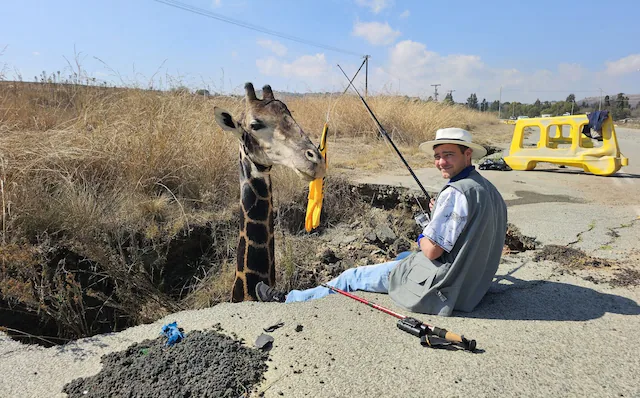
A political stunt intended to highlight South Africa’s deteriorating roads has taken an unexpected turn after wildlife rescuers rushed to what they believed was a genuine emergency involving a giraffe trapped in a sinkhole.
The Democratic Alliance (DA), South Africa’s main opposition party, placed a stuffed giraffe head in a large road hole in Mogale City, northwest of Johannesburg, and shared footage of the stunt online. The accompanying message joked that the hole was “so deep a giraffe can stand in it.”
The joke, however, prompted concerned members of the public to contact the Owl Rescue Centre, a wildlife rescue organisation. Rescuers interrupted another operation and travelled to the location, only to discover that the apparent giraffe was not alive.
Instead, it was a stuffed head belonging to a dead giraffe.
Why Did the Political Party Put a Giraffe in a Sinkhole?
The stunt was intended to draw attention to the condition of roads and sinkholes in Mogale City.
Evert Du Plessis, the DA’s shadow member for roads and logistics, shared images of the scene and argued that the road problem had been ignored despite previous visits to the area.
The visual was deliberately exaggerated: a giraffe’s long neck and head emerging from a large hole made the depth of the road damage immediately obvious.
The DA’s broader argument was that residents and businesses continue to face safety risks and disruption because of deteriorating infrastructure.
The underlying road-safety concern, however, became overshadowed by the decision to use actual animal remains as part of the stunt.
How Did Wildlife Rescuers Get Involved?
The situation became serious when members of the public saw the images and believed an animal might genuinely be trapped.
Several concerned people contacted the Owl Rescue Centre, prompting rescuers to investigate.
Because wildlife rescuers cannot assume that an animal in danger is merely a publicity stunt, the team responded as they would to a real emergency.
They ultimately discovered that there was no live giraffe in the hole.
The organisation later said the team had spent valuable time and fuel responding to an emergency that did not exist.
Why Did the Rescue Centre Criticise the Stunt?
The Owl Rescue Centre said it understood the DA’s attempt to draw attention to dangerous roads but objected strongly to the way the message was delivered.
The organisation argued that wildlife rescuers have to respond whenever there is a possibility that an animal is in danger.
That means even an apparently absurd report can require a real investigation.
The rescue centre also objected to the use of an actual dead animal as a political prop, arguing that it was disrespectful to wildlife and biodiversity.
The criticism was not simply about the humour of the stunt. For the rescuers, the practical problem was that their team could have been responding to a genuine animal emergency elsewhere while investigating the fake one.
What Did the DA Say It Was Trying to Highlight?
The political party’s focus was the deteriorating condition of local roads.
The DA said the stunt was intended to demonstrate how deep and serious the area’s pothole and sinkhole problems had become. The party also pointed to the fact that the location had reportedly been visited in February 2025, with little apparent progress afterward.
The stunt therefore had two very different messages depending on who viewed it.
For the DA, the giraffe was a visual metaphor for the severity of the road problem.
For wildlife rescuers, it created a false emergency and used the remains of an animal to make a political point.
Why Did the Giraffe Stunt Backfire?
The incident illustrates a basic problem with attention-grabbing political campaigns: the visual can become more memorable than the issue it was intended to promote.
The image of a giraffe appearing to stand inside a massive sinkhole was designed to make people notice the road.
Instead, the immediate public reaction focused on whether a real animal was trapped.
That led to:
- Emergency calls to a wildlife rescue organization.
- A diversion of rescuers from another operation.
- Additional fuel and operational costs.
- Criticism over the use of animal remains.
- A broader debate over the ethics of political stunts.
The road problem itself became secondary to the controversy surrounding the stunt.
What Does the Incident Say About South Africa’s Pothole Problem?
Behind the unusual story is a serious infrastructure issue.
Poorly maintained roads and potholes have become recurring political issues in South Africa, where local authorities face pressure to repair aging infrastructure and maintain public roads.
The DA’s stunt was specifically designed to turn an otherwise ordinary road defect into a striking political image.
That strategy worked in one sense: the stunt generated attention.
But the backlash demonstrates the risks of using increasingly elaborate or provocative imagery to communicate political messages.
Why the Rescue Team’s Response Was Still Necessary
The rescue centre’s reaction also highlights an important point about wildlife emergencies.
Rescuers cannot reliably determine from a photograph whether an animal is alive, injured, trapped, or already dead.
If a report suggests that a wild animal may be in immediate danger, failing to respond could have serious consequences.
The team therefore had little choice but to investigate the report before determining that the giraffe was a prop.
That is precisely why the centre argued that the stunt was problematic: a fake emergency can consume the same resources as a real one.
A Political Message Lost in the Joke
The DA succeeded in creating an image that was difficult to ignore. A giraffe appearing to stand inside a road hole is certainly more visually striking than a conventional photograph of a pothole.
But the controversy shows the downside of the approach.
Instead of leaving the public focused on dangerous roads, the stunt left many people debating whether it was appropriate to use a dead animal for political messaging and whether a wildlife rescue operation had been unnecessarily diverted.
The incident has effectively turned a campaign about potholes into a debate about political communication, animal ethics and the responsibilities that come with public stunts.
The underlying road problem may be serious, but the giraffe appears to have stolen the story.