
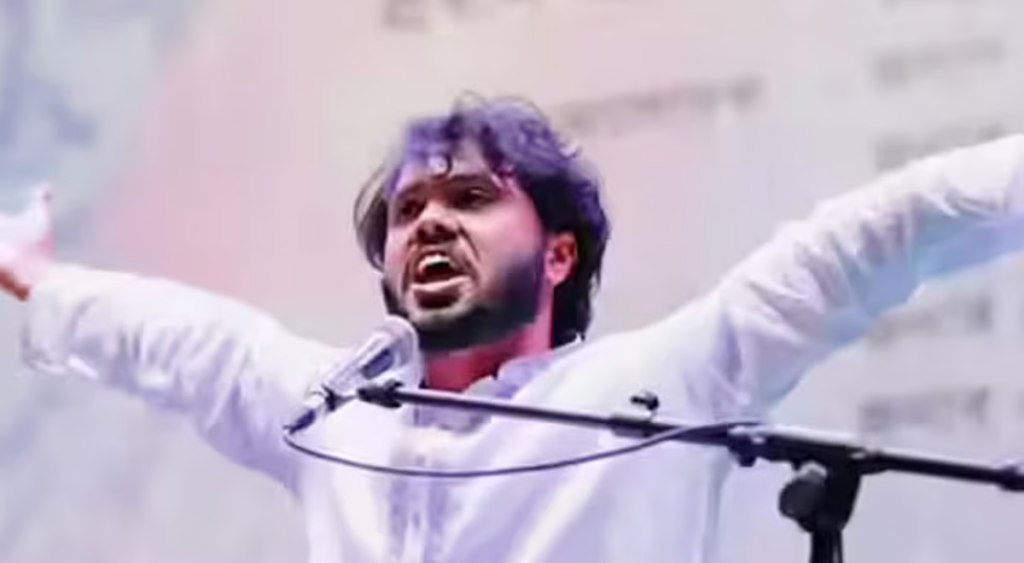
Bangladesh is once again staring at a period of dangerous uncertainty after the death of Sharif Osman Hadi, a prominent face of the July Uprising, who succumbed to gunshot injuries while undergoing treatment in Singapore. His death has reignited protests across the country, reopening political wounds that never fully healed after last year’s upheaval.
What began as grief has rapidly morphed into unrest, raising urgent questions about political violence, accountability, and whether Bangladesh’s fragile calm can hold.
Who was Sharif Osman Hadi?
Sharif Osman Hadi emerged as a key leader during the July Uprising, a student-led movement that shook Bangladesh’s political establishment and forced sweeping changes. Charismatic and outspoken, Hadi became a symbol of resistance for young protesters frustrated by corruption, repression, and lack of political space.
A voice of a restless generation
- Hadi was widely seen as part of a new generation of political actors, unaligned with traditional party structures.
- He gained prominence for mobilizing students and urban youth during the July protests.
- Supporters viewed him as fearless; critics saw him as disruptive. Either way, his influence was undeniable.
By late 2025, Hadi was no longer just a protest leader. He was increasingly perceived as a political figure with ambitions beyond the streets—making him both influential and vulnerable.
What happened to Sharif Osman Hadi?
The shooting and medical treatment
Hadi was shot last week in what supporters described as a targeted attack. He was initially treated in Bangladesh before being airlifted to Singapore for advanced medical care. Despite intensive treatment, he died in the hospital, news that spread rapidly back home.
Authorities have yet to publicly identify the attackers or confirm a motive.
Why is his death so explosive?
Political assassinations and attempted killings have a long and painful history in Bangladesh. In that context, Hadi’s shooting immediately triggered suspicions of political violence, regardless of who ultimately ordered the attack.
For many protesters, his death is not an isolated crime but part of a broader pattern of silencing dissent.
Protests erupt across Bangladesh
Streets fill with anger and grief
As news of Hadi’s death broke, protests erupted in Dhaka and other major cities. Demonstrators poured into the streets, chanting slogans, blocking roads, and demanding justice.
What started as memorial gatherings quickly escalated.
Violence and escalation
Reports indicate that protests turned violent in several areas:
- Clashes between demonstrators and security forces
- Vandalism and arson targeting public and private property
- Attacks on media offices accused by protesters of bias or silence
The unrest has forced authorities to increase security in sensitive areas, while universities—historically flashpoints for political agitation—remain on high alert.
Why Bangladesh is “teetering on the brink”
A country still recovering from upheaval
Bangladesh has not fully stabilized since the July Uprising. Institutions remain under strain, public trust is low, and political polarization runs deep. Hadi’s death has acted as a spark in an already volatile environment.
Key fault lines include:
- Distrust between protesters and state institutions
- Fear of renewed authoritarian crackdowns
- Deep frustration among students and young voters
In this climate, even a single high-profile killing can tip the balance.
The symbolism of Hadi’s death
For supporters, Hadi represents a movement that promised change but delivered uncertainty. His killing—still unexplained—feeds a narrative that dissent is punished, not debated.
That perception may matter as much as the facts.
Government response so far
Condemnation and calls for calm
Authorities have condemned the killing and appealed for restraint. Officials have promised investigations and accountability, though specifics remain limited.
The government faces a delicate balancing act:
- Crack down too hard, and risk inflaming protests
- Move too slowly, and appear complicit or weak
Experience suggests neither option is politically cost-free.
The credibility problem
In Bangladesh, promises of investigations are often met with skepticism. Without visible progress—arrests, transparent inquiries, or independent oversight—public anger is unlikely to subside.
Why this matters beyond Bangladesh
Regional stability at stake
Bangladesh is a key player in South Asia, with close economic and political ties to India, China, and Southeast Asia. Prolonged instability could affect:
- Regional trade routes
- Cross-border migration
- Diplomatic relations
International observers are already watching closely for signs of escalation.
A warning sign for protest movements
Hadi’s death also resonates beyond borders. It highlights the risks faced by protest leaders who transition into formal politics—or challenge entrenched power structures without institutional protection.
For movements built on youth energy and street mobilization, the line between influence and exposure is thin.
What happens next?
Several developments will determine whether Bangladesh steps back from the edge, or slides further toward unrest:
- Transparency: Clear information about who shot Hadi and why
- Accountability: Visible legal action against those responsible
- Political dialogue: Genuine engagement with student groups and protest leaders
Absent these, protests are likely to continue, and the cycle of violence and repression may repeat.
TL;DR
- Sharif Osman Hadi, a key July Uprising leader, has died after being shot and treated in Singapore.
- His death has triggered widespread protests and renewed instability across Bangladesh.
- The unrest reflects deeper unresolved tensions following last year’s uprising.
- How authorities handle the investigation and protests could shape Bangladesh’s political future.