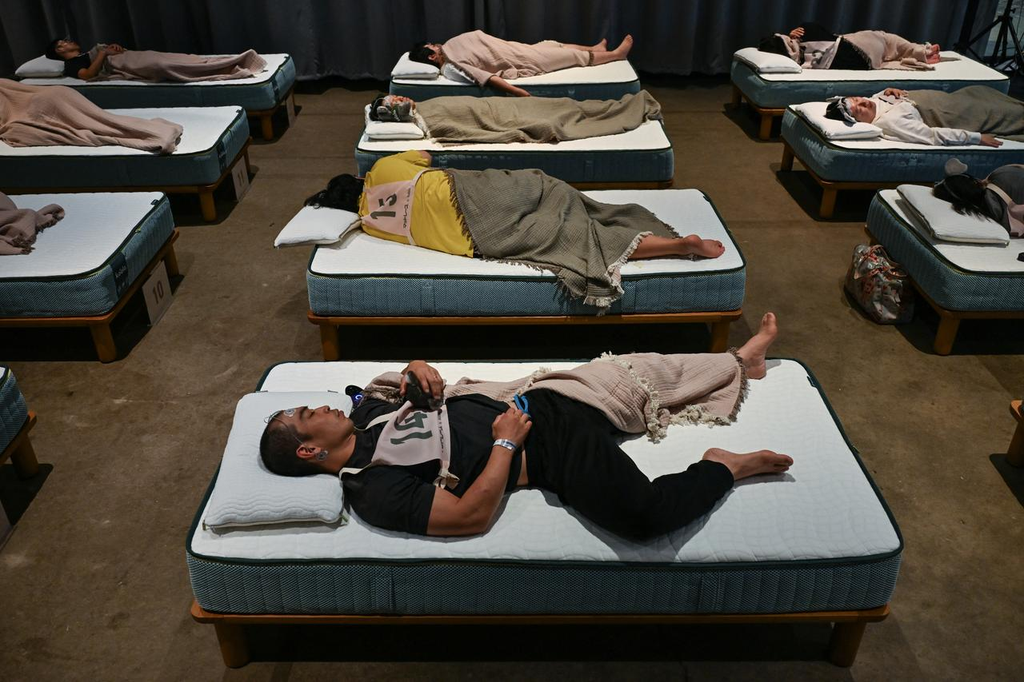
Tokyo recently hosted an unusual competition in which the goal was not to run faster, jump higher, or lift more, but to fall asleep.
Dozens of contestants took part in the “Matt Race by Koala,” a 90-minute sleep competition organised by mattress company Koala in Tokyo on October 5. Participants were asked to achieve the best possible sleep while wearing monitoring devices that tracked aspects of their rest.
The winner, identified only by the nickname Suimii, took home a prize of 2.22 million yen, worth roughly $14,000. The winner said the money would help with moving expenses and could also go toward buying a new bed.
How does a sleep competition work?
The concept sounds simple: lie down and sleep. The actual competition, however, involved more than simply seeing who could close their eyes first.
Participants rested on Koala mattresses for up to 90 minutes while wearing sleep-monitoring equipment. Their performance was assessed using measures related to how quickly they fell asleep, how deeply they slept, and how stable their sleep remained.
The event also included a pre-sleep routine designed to help contestants relax before the clock started. Organisers even introduced controlled distractions during the competition, adding another challenge for people trying to remain asleep.
The unusual format turned something normally associated with complete relaxation into a carefully monitored contest.
Why was the event held in Japan?
The competition was also designed to draw attention to sleep deprivation in Japan.
OECD data cited in reporting on the event showed that Japanese adults averaged about seven hours and 24 minutes of sleep per day in 2021, the lowest figure among the OECD countries included in that comparison.
Long working hours, commuting and Japan’s late-night entertainment economy are among the factors frequently associated with shorter sleep times.
However, the original report’s claim that Japanese people work between 180 and 200 hours a week is misleading. That figure cannot be used as a representative measure of normal working hours in Japan. The far more defensible point is that Japan has long faced concerns over excessive work and insufficient sleep.
Organizers appeared to use the competition as a way of turning that public-health concern into a light-hearted event that could get people talking about the importance of rest.
Who organized the Matt Race?
The competition was organized by Koala Sleep Japan, the Japanese business behind Koala mattresses. The company promoted the event as a new kind of “sleep competition” centered on sleep quality rather than physical endurance.
Ahead of the event, Koala said it received more than 45,000 applications, creating exceptionally high demand for a competition whose primary requirement was simply being able to sleep.
The company said the event was held at SHARE GREEN MINAMI AOYAMA in Tokyo and took place on October 5.
What made the competition different from an ordinary nap?
The contestants were not simply handed mattresses and told to take a nap.
The event incorporated sleep-tracking technology and a judging system intended to measure different dimensions of sleep performance. The competition concept also included a “sleep-in exercise” before the main event and planned disturbances intended to test how well participants could maintain their rest.
That made the challenge less about being the first person to drift off and more about achieving strong overall sleep performance during the allotted period.
The setup also produced a distinctly unusual scene. Participants lay side by side on mattresses, some wearing sleep masks or monitoring equipment and others holding stuffed toys as they attempted to get comfortable.
Who won the $14,000 sleep prize?
The competition was won by Suimii, who uses a nickname rather than a publicly disclosed full name.
After winning the grand prize, Suimii said the money would be used toward moving expenses. The winner also joked about wanting a “princess” bed and suggested that some of the prize money could go toward buying one.
The result gave the event an appropriately sleep-themed ending: the person who rested best walked away with enough money to make the nap considerably more lucrative than the average afternoon snooze.
Japan’s sleep problem goes beyond the competition
Behind the novelty of the contest is a serious issue.
Japan has spent years dealing with concerns over overwork, long commutes and inadequate rest. Sleep deprivation has implications well beyond feeling tired the next morning. Persistent lack of sleep can affect concentration, mood, productivity, and overall health.
That context helps explain why a mattress company would frame sleep as a competition. By turning rest into entertainment, organisers created a highly shareable event while also drawing attention to a problem that is normally discussed in much more serious terms.
The competition does not, of course, suggest that sleeping should become a performance sport. Its main message is that better sleep deserves greater attention.
Why the event attracted so much attention
The idea of competitive sleeping naturally stands out because it reverses the usual logic of sporting events.
Instead of exhausting themselves to win, contestants had to relax. Instead of speed being measured through physical movement, the challenge involved reaching and maintaining sleep. And rather than trophies or medals, the winner received a multimillion-yen cash prize.
The event’s novelty also helped it travel beyond Japan. The combination of sleep tracking, a large cash prize, and a national conversation about sleep deprivation made the Matt Race an unusual intersection of advertising, entertainment, and public awareness.
Ultimately, the Tokyo competition offered an amusing question with a serious undertone: in a country where many people struggle to get enough rest, could sleeping well itself become something worth competing for?