On Thursday morning, nearly every mobile phone in South Korea will buzz for about 10 seconds. The government is firing the emergency alert system it normally reserves for major earthquakes or war, for one reason: any phone smuggled into an exam hall will give itself away.
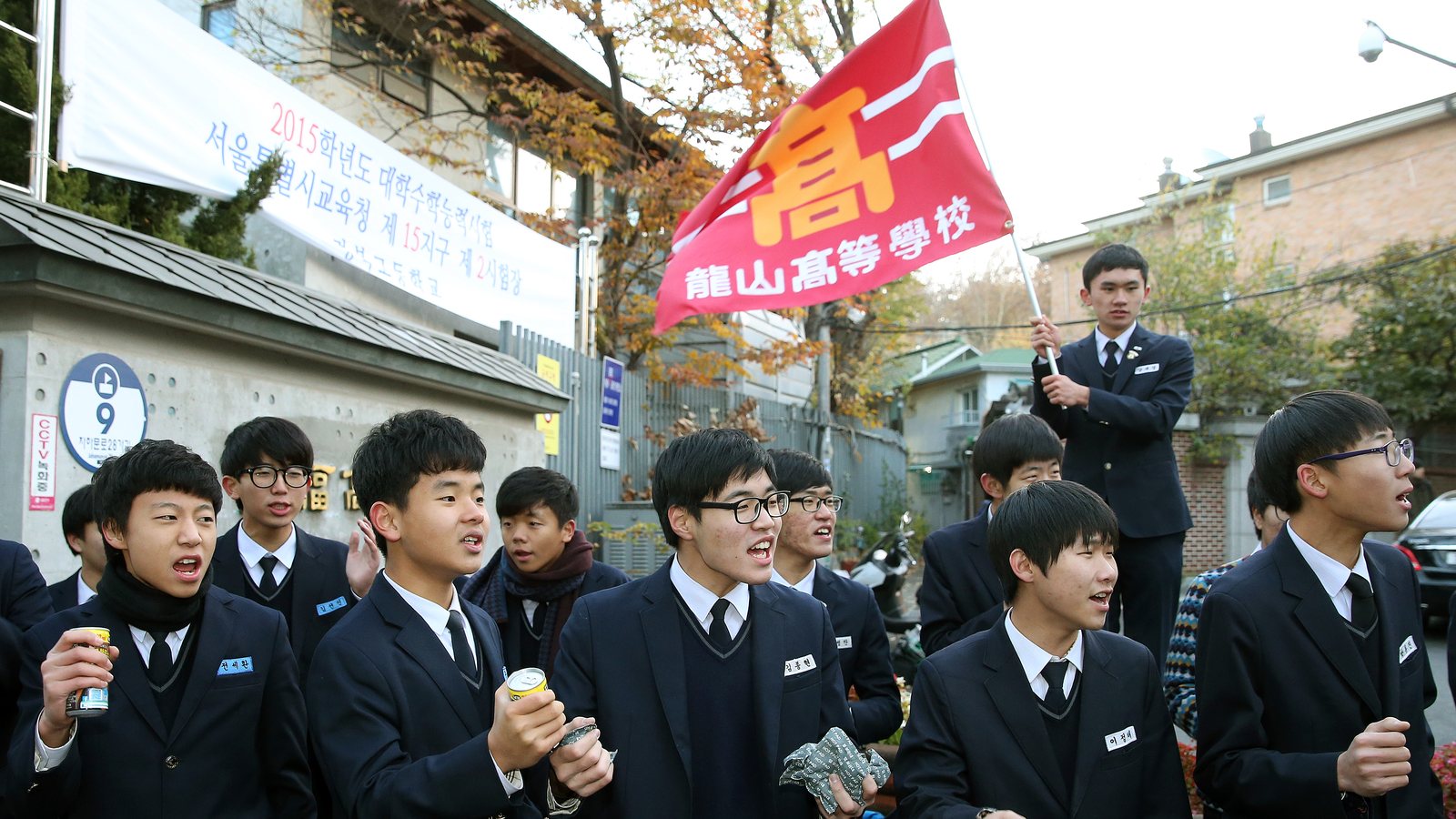
That is one of a set of measures Prime Minister Han Seong-sook announced in a televised briefing on Tuesday, the Associated Press reported. Proctors will also inspect every test-taker’s glasses and seal shirt buttons with stickers. More than 550,000 students sit the College Scholastic Ability Test, known at home as the Suneung, at about 1,300 centres.
South Korea is doing this because the top scorer in its certified tax accountant exam confessed on Sunday. He had photographed the questions with a hidden camera and run them through generative AI.
Glasses on the desk, stickers on the buttons
Students who wear glasses must take them off and put them on the desk before the first session. Proctors then check them and keep watching through the exam. Han advised candidates to avoid clothing with buttons altogether. Where there are buttons, stickers go over them, because a camera lens fits behind one.
Sleeves have to be rolled up, and collars get checked too. Proctors may use metal detectors on a candidate who behaves suspiciously. That is a reversal: at a briefing on Monday the Education Ministry had ruled metal-detector searches out, saying the legal basis was lacking, NocutNews reported.
Phones, smart glasses, smart watches and anything with a camera are banned. Handing them in is the rule, and failing to hand one in counts as cheating even if the student never switched it on. Authorities are deploying 8,400 extra supervisors on top of the usual force.
Global technology companies that run AI chatbots have agreed to help with investigations after the exam. That means checking for queries that contain photographs of exam pages. It is the first measure here aimed at catching a cheat rather than stopping one. Institutions elsewhere are drawing cruder lines: United Airlines this month simply banned AI agents from booking its flights.
Seoul decided a delay would cost more than it saved
Parents, students and several politicians asked for a postponement. A delay would only have run one or two weeks, Vice Education Minister Choi Eun-ok said, and “we judged that the confusion to test takers and disruptions to college admissions would be greater,” Yonhap reported via The Korea Times. Officials also noted that the ministry had already begun sending exam papers out to centres. The longer those papers sit there, the greater the risk of a leak.
Choi knows how the package looks. Failing to run the exam strictly and fairly would cause worse disruption than a disaster, she said, and “we believe we are in a situation where excessive measures are necessary.”
The Suneung has moved before. It slipped by a week in 2017 after an earthquake struck Pohang.
The scandal that set this off involved a camera, not smart glasses
The case behind all this is not a smart-glasses case. Han Won-seok, 34, topped the 63rd certified tax accountant exam with 397.5 out of 400 in April’s first round. He missed one of 160 questions. Other candidates said publicly that the score was impossible, and he denied cheating.
Then on Sunday, Nov. 15, he posted a video on his lawyer’s YouTube channel. “I cheated by using a miniature camera to photograph exam questions,” he said, and checked AI-generated answers on a smartphone, the Korea JoongAng Daily reported. His lawyer took a written confession to the Seoul Metropolitan Police Agency that night, with a laptop, a miniature camera and a phone. No AI glasses were in the bag.
Police questioned Han as a suspect on Tuesday, and he apologised, The Korea Times reported. He would not say whether he acted alone. The Human Resources Development Service of Korea, which runs the exam, has filed a criminal complaint for obstruction of business.
The country really does stop for this exam
For American readers, the nearest comparison is the SAT, and it is not close. The Suneung runs from 8:40 a.m. to 5:45 p.m. in a single sitting. No aircraft or helicopter may take off or land during the 25-minute English listening section, from 1:10 p.m. to 1:35 p.m. Artillery firing and tank movement stop.
The government asks offices and private employers to start the working day after 10 a.m. so the roads stay clear. Stock trading opens late for the same reason. Seoul-area subways run more often from 6 a.m. to 8:10 a.m. Police sometimes escort late candidates by car or motorbike, and no vehicle may come within 200 metres of a test centre.
That is the scale this question lands on. It is also why one tax exam became a national argument in four days.
One year is the law, 10 years is the announcement
Three penalty numbers are circulating, and they are not the same thing. The rule in force on Thursday voids the score of any candidate caught with a prohibited smart device and strips that student’s right to sit next year’s exam. That is a one-year ban. In its Oct. 29 response plan, the Education Ministry said it would push to raise it to three years.
On Tuesday the prime minister went further and said the ban will rise to 10 years. A university student retaking the exam would also be expelled from their current school. Both of those need rule and law changes, and reporting in late October said new penalties were unlikely to be in place in time for this exam. So a candidate caught on Thursday faces the one-year rule, with the rest to be argued over afterwards.
The government separately says it will refer serious cases to police, as it did after the TOEIC cases in May.
Teachers say they cannot catch what they are being asked to catch
The people who have to run this are not reassured. “Being trained doesn’t mean we can spot AI tools right away,” Huh Jin-man, a high school teacher of 25 years who will proctor on Thursday, told The Korea Times. He also pointed out the hole in the Wi-Fi shutdown: a phone still has 5G.
A teacher in his 60s, named only by the surname Jung, put the camera problem simply. Of devices the size of a pea, he asked, “How could we possibly detect them?” Paek Young-sun, an elementary teacher of 12 years, said the measures would not work and named the risk proctors carry. “If we stop students on suspicion of cheating, they’ll say we ruined their CSAT.”
That bind is familiar from workplaces, where one study found managers trust employees less when they suspect AI help and cannot prove it.
Students want more, not less. “It all comes down to proctors, and mistakes will happen,” said Kim Tae-hoon, a senior at Donong High School in Namyangju. Another senior called the cost and staffing a price worth paying for a fair exam, and warned that concentrating on glasses will simply move cheats to other devices.
President Lee Jae Myung was due to lead a video conference on preparations on Tuesday evening, from the Philippines. The exam starts at 8:40 a.m. on Thursday.