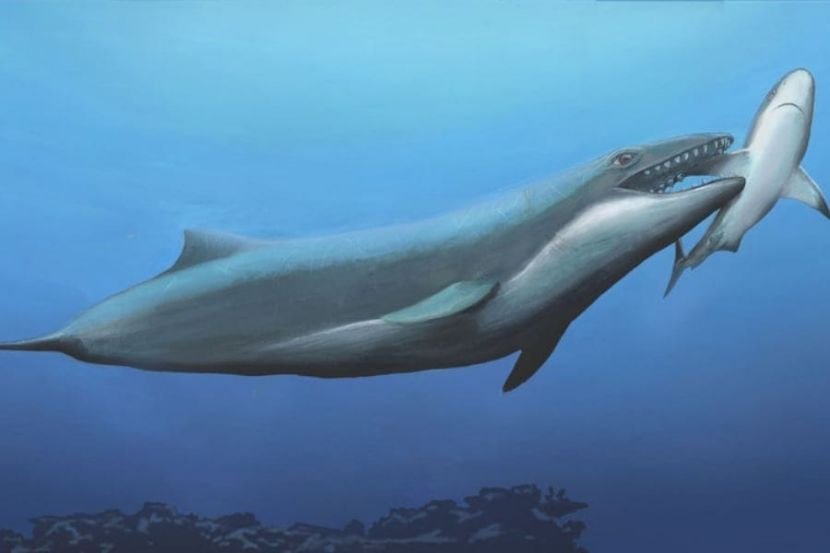
A newly identified species of ancient whale that once prowled the waters off Australia’s southern coast may have been small and endearingly cute — but with its forward-facing eyes and razor-sharp teeth, it was a formidable predator in its day.
Discovery along Victoria’s Surf Coast
The fossil, a partial skull with an attached ear bone, was discovered in 2019 by local resident Ross Dullard along Victoria’s Surf Coast. Recognising its scientific potential, Dullard donated the specimen to Museums Victoria Research Institute, where researchers spent years studying it.
Their findings, published in the Zoological Journal of the Linnean Society, identify the animal as Janjucetus dullardi, one of the earliest known cousins of modern whales. It belongs to the extinct group mammalodontids, which lived between 30 and 23 million years ago.
“Ross’ discovery has unlocked an entire chapter of whale evolution we’ve never seen before,” said Dr. Erich Fitzgerald, senior curator at Museums Victoria. “It’s a reminder that world-changing fossils can be found in your own backyard.”
Ancient Whale: A predator disguised in a cute package
Despite its dolphin-like size, Janjucetus dullardi was built for speed and hunting efficiency. According to lead author Ruairidh Duncan, the whale had:
- A short, powerful snout.
- Eyes about the size of tennis balls, facing forward for better depth perception.
- A mouth full of sharp, slicing teeth, ideal for tearing into prey.
“They were small and deceptively cute, but not harmless,” Duncan explained. “This was a whale designed for precision hunting.”
How it differs from modern whales
Today’s baleen whales filter-feed on krill and plankton, but Janjucetus dullardi was a toothy hunter. Scientists believe its size and agility allowed it to chase down fish and squid in Australia’s ancient seas.
The discovery provides an evolutionary snapshot of a transitional period — before modern baleen whales lost their teeth and adopted filter-feeding. It also reveals that southern Australia was once home to multiple unusual whale species, each adapting to its own niche in the marine ecosystem.
Why this fossil matters
This find sheds light on:
- Whale evolution — bridging the gap between early toothed whales and today’s baleen whales.
- Ancient marine ecosystems — revealing predator-prey relationships in Australia’s Oligocene seas.
- Public science contributions — highlighting the role of citizen discoveries in advancing paleontology.
Museums Victoria emphasized the importance of public involvement: “This kind of public discovery and its reporting to the museum is vital,” Fitzgerald said.