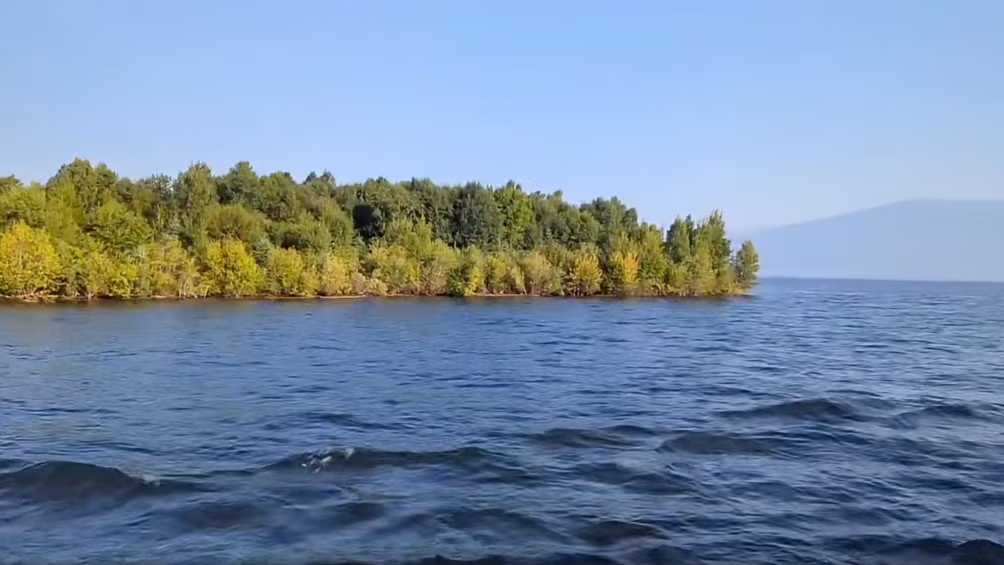
A strange floating island has been playing an unlikely game of hide-and-seek in a huge Canadian reservoir, appearing in one location, disappearing from view, and then turning up somewhere else weeks later.
The wandering landmass was spotted in British Columbia’s Williston Reservoir, where a giant chunk of vegetation and soil has broken away from the shoreline and begun drifting across the water.
BC Hydro, which operates the reservoir, first noticed the floating island on July 21. It was roughly the size of two NFL football fields.
By August 5, however, the island could no longer be seen in the area where it had first been documented. A resident spotted it again on August 12, this time farther east in the reservoir’s Peace Reach. Another search then located the unusual landmass again on August 30.
The mystery is not supernatural. Scientists and utility officials believe the “island” is a large piece of shoreline that became detached and is now floating through the reservoir.
Where is the mysterious floating island?
The island is drifting through Williston Reservoir in northeastern British Columbia.
The reservoir is enormous, covering about 1,761 square kilometres. Its size makes monitoring floating debris and unusual objects a considerable challenge, so BC Hydro relies on satellite imagery as well as reports from residents, boaters and other people using the reservoir.
The floating landmass was initially spotted near one part of the reservoir before vanishing from that location.
Because it was later reported much farther away, officials believe it has been moving with currents and wind rather than remaining in one place.
Why does the island keep disappearing?
The island is not actually disappearing and reappearing in the way the word might suggest.
It is floating.
That means its position can change as wind, currents, and changing water conditions move it across the reservoir.
The landmass can also become difficult to spot from shore because trees and vegetation make it resemble other patches of shoreline or floating debris.
At a reservoir as large as Williston, a floating island can quickly move out of the area being monitored.
That explains why it was visible in one location on one date and apparently missing several days later.
How did the floating island form?
BC Hydro believes the unusual landmass developed naturally along the reservoir’s shoreline over a period of years.
The likely process begins with trees and other vegetation accumulating near the edge of the water.
As dead vegetation breaks down, it can create layers of organic material resembling mulch or soil. Roots from living plants and trees can then bind that material together.
Over time, the resulting mass can become substantial enough to detach from the shoreline.
Once it separates, the vegetation and interconnected roots can help hold the structure together as it floats.
The result is effectively a miniature mobile ecosystem.
Why did the island break away now?
Water levels appear to have played an important role.
According to BC Hydro community relations coordinator Bob Gammer, the region experienced steady summer rainfall following a winter with a large mountain snowpack.
Those conditions contributed to unusually high water levels in the reservoir.
When water rises against the shoreline, it can weaken and erode sections of land. Trees and their root systems can then become destabilised.
A large section can eventually break free and enter the reservoir.
The timing of the island’s appearance therefore appears to be connected to unusually wet conditions and elevated water levels rather than the sudden creation of new land.
Is this really an island?
Not in the conventional geological sense.
A true island is a relatively permanent piece of land surrounded by water.
The floating object in Williston Reservoir is better described as a floating island, floating mat of vegetation, or detached shoreline.
Its unusual appearance comes from the fact that trees remain rooted in the soil-like material even after that section of shoreline has separated from the mainland.
Because the roots continue to hold the structure together, the vegetation can remain alive while the entire mass travels across the reservoir.
Could there be more floating islands?
Possibly.
A resident, Patrick Tutin of Dawson Creek, said he had seen other large pieces of debris and root masses that looked like small islands while travelling on the reservoir.
He described seeing substantial amounts of debris and several large root balls.
That suggests the wandering island may not be an isolated event.
Large reservoirs can collect enormous amounts of wood and vegetation, particularly after periods of heavy rainfall, erosion or high water.
Some pieces may remain small and eventually break apart, while others can become large enough to resemble islands.
Why does Williston Reservoir have so much floating debris?
Williston Reservoir is an artificial lake created by the W.A.C. Bennett Dam and is surrounded by extensive forested terrain.
When water levels change, shoreline vegetation and woody debris can become detached.
Seasonal changes, snowmelt, storms, rainfall, and erosion can all contribute to the movement of trees and other material into the reservoir.
Because the reservoir covers such a large area, even a relatively small percentage of floating debris can translate into a substantial amount of material that needs to be monitored.
That is why BC Hydro has systems specifically designed to manage it.
How does BC Hydro deal with floating debris?
BC Hydro conducts surveys to identify loose trees and other potentially dangerous material in the reservoir.
The utility also uses debris-management measures, including structures designed to collect or redirect floating wood.
These efforts are not simply about keeping the reservoir visually tidy.
Large floating logs and tree trunks can pose serious risks to boats, especially when they are partially submerged or difficult to see.
BC Hydro warns visitors to remain alert for both floating and submerged debris.
Why is the floating island dangerous?
The island itself may look fascinating, but large floating masses of trees, roots, and debris can be hazardous.
A vessel hitting a submerged section could suffer damage or lose control.
The danger increases because floating material does not necessarily remain visible above the waterline. A tree root ball might be obvious from a distance while another section remains largely underwater.
That makes debris particularly difficult for boaters to spot in time.
BC Hydro has therefore warned people using the reservoir to maintain caution around floating and submerged material.
How big is Williston Reservoir?
Williston Reservoir is one of the largest artificial lakes in Canada.
At approximately 1,761 square kilometres, it is larger than many entire urban areas.
Its huge scale is one reason a floating island can apparently vanish without actually going anywhere mysterious.
A landmass that moves several kilometres can quickly disappear from a particular viewing area.
Satellite monitoring and reports from people on the water can therefore be more useful than simply searching from the shoreline.
Why are satellites being used to find it?
The reservoir’s size makes satellite imagery an important monitoring tool.
A floating object that is difficult to locate from a boat can sometimes be identified in aerial or satellite images, especially when it is large enough to cast a visible shape on the water.
BC Hydro also benefits from reports from people who happen to spot the island while travelling through the reservoir.
The combination of technology and local observations has turned the search into something of a real-world treasure hunt.
Could the island keep moving?
Yes.
As long as the floating structure remains intact, it can continue drifting.
Wind and water currents can push it toward different sections of the reservoir, while waves and changing water levels can alter its position.
At the same time, the island will not necessarily remain intact forever.
Its roots and accumulated vegetation may gradually break apart, and some material could eventually sink or wash back toward the shoreline.
So the mysterious island may eventually disappear for good, but not because it has vanished into thin air.
It may simply disintegrate.
Is this phenomenon unique?
No.
Floating islands made from vegetation, soil, and intertwined roots have been documented in lakes, rivers, and reservoirs in different parts of the world.
They can form naturally when wetlands or shoreline sections become detached.
Artificial reservoirs can be particularly favourable environments for such events because fluctuating water levels can destabilize shorelines and mobilize trees and organic material.
What makes the Williston example unusual is its size and the fact that residents have repeatedly watched it turn up in different parts of the reservoir.
What does the floating island reveal about changing water levels?
Beyond its novelty value, the island offers a visible example of what happens when water interacts with a large, forested shoreline.
Higher water levels can change erosion patterns, destabilise trees, and alter the amount of organic material entering a reservoir.
In the Williston case, BC Hydro has linked the floating landmass to the combination of summer rainfall and the previous winter’s substantial mountain snowpack.
The island is therefore a physical reminder that water-level changes can reshape shorelines in ways that may not be immediately obvious from land.
What happens to the mysterious island next?
For now, BC Hydro and local observers are continuing to look for it.
The island has already demonstrated that it can move considerable distances and disappear from view for days at a time.
Officials do not know exactly where it will turn up next.
Eventually, however, its journey is likely to end naturally as the floating structure breaks apart, becomes waterlogged or returns to the shoreline.
Until then, the two-football-field-sized patch of trees will remain one of the strangest sights on one of British Columbia’s largest reservoirs.
The bottom line
The mysterious “island” in British Columbia’s Williston Reservoir is not a newly formed piece of land. It appears to be a section of shoreline that became detached after high water levels and wet conditions weakened the area.
The mass contains trees, roots and accumulated organic material that have kept it together while allowing it to float.
First spotted on July 21, it disappeared from view by August 5, was seen again on August 12 in the eastern part of the reservoir, and was reportedly spotted again on August 30.
Its ability to drift explains the vanishing act.
The episode also highlights a less whimsical reality: floating and submerged debris can pose a significant hazard in a huge reservoir, which is why BC Hydro surveys the water and warns boaters to remain cautious.
For now, the floating forest is still somewhere out on Williston Reservoir.
The next sighting may simply be a matter of knowing where to look.