A viral social media trend involving China’s so-called Natasha Doll has ignited widespread criticism, with activists and social media users accusing the phenomenon of promoting racism and normalising violence against Black people. What began as a quirky stress-relief toy has evolved into one of the internet’s most controversial trends, raising questions about racial stereotypes, online content moderation, and the pursuit of viral engagement.
Videos showing creators abusing the dark-skinned version of the toy have spread rapidly across Chinese social media platforms before reaching global audiences. Critics argue the trend goes far beyond harmless entertainment, highlighting deeper concerns about racial representation in digital culture and the ethics of viral content.
TL;DR
- The Natasha Doll is a human baby-shaped stress-relief toy available in multiple skin tones.
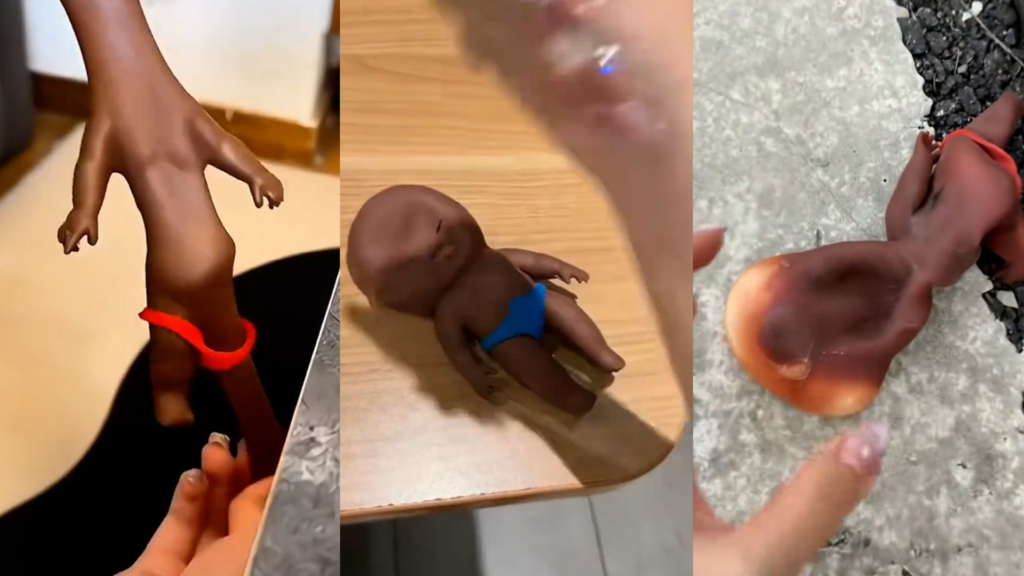
- Videos featuring the dark-skinned version being stretched, beaten, boiled, and stomped have gone viral on Chinese social media.
- The trend reportedly began after a Chinese content creator jokingly treated the doll as his “daughter” and named it Natasha.
- Activists and members of the Black community say the videos reinforce racist stereotypes and normalise violence against Black people.
- The controversy has revived discussions about racial sensitivity, content moderation, and China’s online culture.
What Is the Natasha Doll?
The Natasha Doll is a small, squeezable stress-relief toy designed in the shape of a baby. Similar to many sensory toys marketed for relaxation, it can be stretched, squeezed, and compressed.
The toy is reportedly manufactured in three different skin tones:
- Light-skinned (white)
- Brown
- Dark-skinned (black)
While all versions exist, it is the dark-skinned doll—with exaggerated facial features—that has become the focal point of the controversy.
Critics argue that the doll’s design itself reflects long-standing racial caricatures, making the subsequent abuse depicted in viral videos particularly disturbing.
How Did the Natasha Doll Trend Start?
According to reports citing Chinese state media, the trend began innocently enough.
A Chinese vlogger reportedly purchased one of the dolls, jokingly referred to it as his daughter, and named it “Natasha.” The playful videos attracted attention and inspired other creators to buy the toy.
However, as often happens with viral internet trends, creators began escalating their content in search of more views, likes, and shares.
Instead of simply squeezing or playing with the dolls, videos soon featured increasingly extreme acts intended to shock audiences.
Why Is the Trend Receiving Global Backlash?
The criticism stems less from the existence of a stress toy itself and more from which version of the toy is predominantly being abused online.
Many viral videos feature creators:
- Stretching the doll until it deforms
- Stomping on it
- Throwing it
- Boiling it
- Hitting it with household objects
- Recording exaggerated acts of destruction for entertainment
Because these videos overwhelmingly feature the dark-skinned doll, many viewers believe the content reinforces harmful racial stereotypes rather than serving as harmless comedy.
Civil rights advocates argue that repeated portrayals of violence toward a Black baby-shaped toy risk desensitising audiences and normalising discriminatory attitudes.
Why Do Critics Consider the Doll Racist?
The debate extends beyond the videos themselves.
Critics argue the controversy involves several overlapping issues.
Exaggerated facial features
Many observers say the doll’s design resembles historical racist caricatures that exaggerated Black facial features for ridicule or entertainment.
Those depictions have long been criticised for dehumanising Black people.
Selective targeting
Although the toy reportedly comes in multiple colours, the dark-skinned version has become the dominant subject of violent content online.
Critics argue that this pattern cannot be separated from broader conversations about race and representation.
Entertainment through violence
When abuse directed toward a racialised figure becomes a source of comedy and online engagement, activists argue it reinforces harmful social attitudes rather than simply depicting fictional violence.
Social Media’s Pursuit of Viral Content
The Natasha Doll controversy also reflects a broader issue affecting platforms worldwide: creators often escalate increasingly shocking content to attract attention.
Algorithms tend to reward engagement, regardless of whether that engagement comes from amusement, outrage, or controversy.
As competition for views intensifies, some creators produce more extreme videos because:
- They attract more comments.
- They generate higher watch times.
- They increase the likelihood of shares.
- Viral controversy can translate into advertising revenue and follower growth.
The Natasha Doll trend illustrates how online incentives can amplify content that many viewers consider unethical.
Reactions From the Black Community
The backlash has been swift.
Members of the Black community, both within China and internationally, have condemned the videos as deeply offensive.
Some described the trend as “absolutely diabolical,” arguing that repeatedly depicting violence toward a Black caricature trivializes racism and reinforces damaging stereotypes.
Writer and publisher Monique Franz also criticised the product on social media, arguing that products are never designed or marketed in a social vacuum.
She wrote that the creation and commercialisation of a Black baby doll intended for abuse reflects broader societal attitudes and helps explain why movements such as Black Lives Matter continue to highlight systemic racial issues.
Her comments have been widely shared in discussions surrounding the controversy.
Is This an Isolated Incident?
Many observers say no.
The Natasha Doll controversy has revived discussion of previous incidents involving racial imagery on Chinese social media.
One example frequently cited is a 2022 investigation that found children in parts of sub-Saharan Africa were paid small amounts to record personalized videos for Chinese customers.
Some of those videos included humiliating or degrading messages requested by buyers.
Critics argue that both incidents reveal a troubling pattern in which Black individuals or Black imagery become objects of entertainment or commercial exploitation for online audiences.
At the same time, experts caution against portraying these incidents as representative of all Chinese society, noting that racism and discriminatory online trends exist in many countries and should be understood within broader global discussions about prejudice and platform governance.
What Does This Mean for Social Media Platforms?
The controversy raises difficult questions for digital platforms operating worldwide.
Among them:
- Should platforms remove videos that promote racial stereotypes?
- How should companies distinguish between satire, stress-relief demonstrations, and discriminatory content?
- What responsibility do algorithms bear when controversial content goes viral?
- Can stronger moderation reduce the spread of harmful trends without limiting legitimate expression?
These questions are becoming increasingly important as viral trends routinely cross national borders within hours.
The Bigger Conversation About Representation
While the Natasha Doll trend may eventually fade, the debate surrounding it is likely to continue.
The controversy highlights how products, memes, and viral challenges can take on meanings far beyond their original purpose once they enter social media ecosystems driven by engagement.
It also underscores the importance of considering cultural sensitivity in product design, content creation, and platform moderation.
For many critics, the issue is not merely about a toy but about the messages repeated images and viral videos can send—particularly when they appear to target a specific racial group.