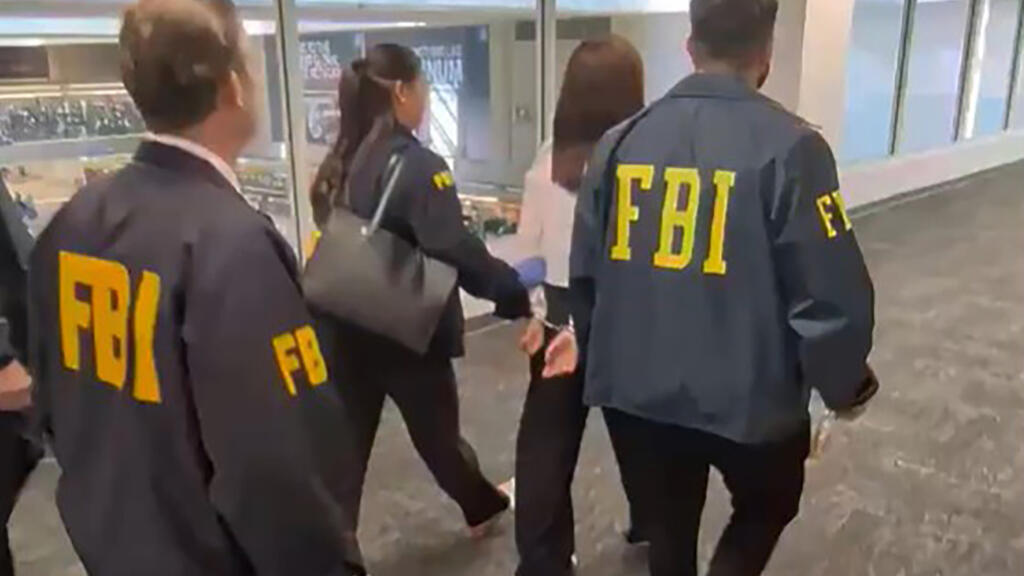
A 34-year-old California woman was arrested at Los Angeles International Airport after U.S. authorities accused her of conducting surveillance on the family of Taiwanese President Lai Ching-te on behalf of Chinese officials.
Wanying Zhang, also known as Heather Zhang, was detained Sunday, October 4, as she prepared to leave the United States for China. Prosecutors accuse her of acting as an unregistered agent of the People’s Republic of China and targeting Lai’s son and his family while they were living in the United States.
The allegations put an unusually personal face on the broader dispute between Washington, Beijing and Taipei. Rather than focusing on military secrets or government facilities, the alleged operation involved watching a senior Taiwanese official’s family, recording their movements and collecting information about their vehicles.
U.S. authorities say Zhang carried out the surveillance in Seattle in 2025 and sent photographs, videos, and license-plate information to Chinese handlers. She is expected to appear in federal court in Los Angeles.
What happened in the China spy arrest?
According to U.S. authorities, Zhang’s alleged activities began before her arrest at LAX.
Prosecutors say she traveled to Seattle in 2025 at the direction of Chinese officials and conducted surveillance of a close relative of a Taiwanese government official. The FBI later said the target was Lai Ching-te’s son and his family.
The alleged surveillance included:
- Filming the family’s home.
- Recording vehicles associated with the family.
- Collecting license-plate information.
- Taking photographs and videos.
- Sending the material to Chinese officials.
- Coordinating travel with an associate.
- Using what prosecutors described as “tradecraft” intended to avoid detection.
The FBI arrested Zhang at LAX as she was preparing to board a flight to China. First Assistant U.S. Attorney Bill Essayli announced the arrest and said Zhang had allegedly failed to disclose that she was working on behalf of a foreign government.
The timing of the arrest is notable. Authorities intercepted Zhang while she was attempting to leave the United States, rather than after she had already returned to China.
Who is Wanying Zhang?
Zhang, 34, lives in Irvine, California, and is also known as Heather Zhang.
Multiple reports identify her as a Southern California real estate professional. CBS News reported that her husband, Edric Ding, also works in real estate and declined to comment when contacted about the arrest. It was not immediately clear whether Zhang had retained a defence attorney.
Authorities have charged her with acting as an unregistered agent of a foreign government. That charge is distinct from simply alleging that someone gathered information for another country.
Under the Foreign Agents Registration Act, people who fall within the law’s definition of an agent of a foreign principal generally must register with the U.S. Department of Justice and disclose their relationship and activities. The Congressional Research Service says the registration framework includes disclosure and recordkeeping requirements as well.
Why was Taiwan President Lai Ching-te’s son allegedly targeted?
The alleged surveillance takes place against a highly sensitive political backdrop.
Lai Ching-te was elected Taiwan’s president in January 2024 and took office in May that year. His Democratic Progressive Party supports Taiwan’s separate political identity, while Beijing claims Taiwan as part of China and strongly opposes Lai’s position.
For Beijing, Lai is a particularly controversial figure.
China has repeatedly criticized Lai as a separatist and has opposed moves that it believes strengthen Taiwan’s separate identity. The dispute has become one of the most consequential flashpoints in U.S.-China relations because Washington maintains close unofficial relations with Taiwan while recognizing Beijing diplomatically under its longstanding one-China policy.
That context helps explain why surveillance of a presidential family member could have intelligence value even if the person being watched does not hold public office.
A family member’s:
- Residence
- Daily movements
- Vehicles
- Travel patterns
- Personal contacts
- Security arrangements
can potentially provide information about a political figure’s wider network.
What does “transnational repression” mean in this case?
Taiwan’s government has described the alleged operation as a case of transnational repression.
The term generally refers to governments extending intimidation, surveillance, coercion or other forms of pressure beyond their own borders to target people overseas.
The U.S. State Department has previously described transnational repression as including tactics such as surveillance, online harassment, coercion through relatives and attempts to pressure governments into returning targeted individuals. U.S. officials have specifically identified the People’s Republic of China as one of the governments associated with such activities.
That makes the alleged Zhang operation different from a conventional espionage case centered on classified documents.
The reported target was not described as a U.S. government employee carrying military secrets. Instead, the alleged operation focused on the family of a foreign political leader living in the United States.
Taiwan’s Presidential Office condemned the alleged surveillance and thanked U.S. authorities for protecting Taiwanese citizens. Presidential spokeswoman Karen Kuo described the incident as behavior that should not be tolerated.
Why does the arrest matter to the United States?
The case highlights how U.S. officials increasingly view foreign intelligence activity as a domestic security issue.
The alleged surveillance occurred on American soil, involved a person living in California and extended to a U.S. city hundreds of miles away from the suspect’s home.
It also illustrates why counterintelligence investigations can involve ordinary-looking activities. Taking photographs, recording cars or watching a residence can appear innocuous in isolation. Investigators become concerned when those actions are allegedly coordinated, directed by a foreign government and repeatedly communicated to foreign handlers.
FBI Director Kash Patel welcomed the arrest, arguing that foreign adversaries should not be able to conduct espionage operations freely inside the United States. His comments framed the case as part of the FBI’s broader counterintelligence mission.
The allegations therefore raise a broader question for U.S. authorities: How much foreign-government activity can occur through people who otherwise appear to be ordinary residents before it becomes a national-security threat?
How does this fit into broader China-Taiwan tensions?
The alleged operation comes as relations across the Taiwan Strait remain deeply strained.
China regards Taiwan as part of its territory and has not ruled out using force to bring the island under Beijing’s control. Taiwan, meanwhile, operates as a self-governing democracy and has its own elected government, military and institutions.
The United States does not maintain formal diplomatic relations with Taiwan but remains the island’s most important international security partner and weapons supplier. Washington has repeatedly emphasized maintaining peace and stability across the Taiwan Strait.
That creates a difficult three-way relationship:
- Taiwan seeks to protect its democratic system and maintain its de facto autonomy.
- China claims sovereignty over Taiwan and opposes moves toward permanent separation.
- The United States maintains unofficial relations with Taiwan while seeking to deter conflict and preserve the existing cross-Strait status quo.
A surveillance operation targeting the family of Taiwan’s president inside the United States therefore carries significance beyond the individuals involved.
Is this the first alleged Chinese operation targeting a Taiwanese leader in the U.S.?
No.
The arrest also recalls an earlier U.S. case involving alleged surveillance of a Taiwanese president.
Reuters reported that the current case follows the prosecution of Yaoning “Mike” Sun, who was sentenced to four years in prison after being accused of surveilling Taiwan’s then-President Tsai Ing-wen during her 2023 visit to California on behalf of Chinese authorities.
The comparison is important because it shows that U.S. authorities are not treating alleged Chinese activity involving Taiwanese political figures as an isolated concern.
The alleged Zhang operation is particularly striking because the target was a family member rather than the president himself.
That could reflect a basic counterintelligence reality: people close to political figures can sometimes be easier to observe than the officials they are connected to.
What happens next for Zhang?
The arrest is only the beginning of the legal process.
Zhang is expected to appear in federal court in Los Angeles. At this stage, the allegations made by prosecutors must still be tested through the U.S. judicial system. Reporting has not established that Zhang has entered a plea or that a court has determined her guilt.
Several questions remain open:
- What evidence did investigators collect before the arrest?
- Who allegedly directed Zhang’s activities?
- Was money or other compensation provided?
- Who was the alleged associate who coordinated the Seattle trip?
- How long had the surveillance operation been active?
- What information, if any, was ultimately delivered to Chinese officials?
- What will Zhang’s defense argue about the government’s allegations?
Those details could determine whether the case develops into a broader counterintelligence investigation.
What has China said about the allegations?
Chinese authorities have rejected or challenged the characterization of such cases as evidence of Chinese espionage.
Reuters reported that China’s Foreign Ministry did not immediately respond to requests for comment in the initial reporting on Zhang’s arrest. Other reporting has said Beijing has criticized the portrayal of Chinese nationals as spies in similar cases.
That distinction matters. The U.S. allegations concern Zhang’s conduct and her alleged relationship with Chinese officials; they do not, by themselves, establish that the Chinese government has publicly acknowledged directing the operation.
Further statements from Beijing, Taipei or Washington could provide additional context as the case moves through court.
The bigger issue: espionage is increasingly personal
The Zhang case illustrates a broader shift in how modern intelligence and influence operations can work.
Espionage does not always look like someone stealing classified files from a government building. It can involve gathering small pieces of information that become useful when combined.
A photograph of a vehicle may reveal a license plate. A license plate can identify a person’s movements. Repeated observations can establish a routine. A routine can potentially reveal where someone lives, works or travels.
That is why the alleged surveillance of Lai’s family matters even though authorities have not publicly accused Zhang of stealing military secrets.
The case is ultimately about who is watching whom, on whose behalf, and where the boundaries of a foreign government’s activities end.
For Taiwan, the alleged operation reinforces concerns about pressure extending beyond the island itself. For the United States, it presents another test of its ability to identify and prosecute foreign intelligence activity without compromising the legal protections afforded to people accused of such crimes.
And for Beijing-Washington relations, it is another reminder that the competition between the United States and China increasingly plays out not only in diplomatic meetings and military exercises, but also in American cities.
TL;DR
- Wanying “Heather” Zhang, 34, was arrested at Los Angeles International Airport on October 4.
- U.S. authorities accuse her of acting as an unregistered agent of China.
- Prosecutors allege she surveilled Taiwanese President Lai Ching-te’s son and his family in the United States.
- Investigators say she traveled to Seattle in 2025 and sent photos, videos and license-plate information to Chinese officials.
- Taiwan has condemned the alleged operation as transnational repression.
- Zhang’s arrest comes amid intense tensions between China, Taiwan and the United States.
- She has been accused, not convicted, and the allegations will now proceed through the U.S. federal court system.