China is preparing to test an experimental supersonic aircraft capable of reaching Mach 2, or roughly 2,470 kilometers per hour, as researchers work on a new approach to one of aviation’s biggest problems: the sonic boom.
The aircraft, known as the TMS-10, has entered its final assembly and integration phase, with a first supersonic test flight planned for the end of 2026, according to Chinese state media reports. The project is being developed by Tianmushan Laboratory with support from Beihang University.
The TMS-10 is not yet a passenger aircraft. It is a technology demonstrator intended to test the aerodynamic and propulsion concepts that could eventually be used in a 10- to 15-seat supersonic business aircraft.
One of its most ambitious proposed applications is a future Beijing-to-Shanghai journey in around 30 minutes, compared with roughly two hours on today’s conventional flights. That target describes a potential future aircraft, not the current TMS-10 test vehicle.
What is China’s TMS-10 supersonic jet?
The TMS-10 is an experimental aircraft being developed to investigate high-speed passenger flight.
Its design is centered on a cruise speed of about Mach 2 while also addressing the noise generated when an aircraft crosses the speed of sound.
The aircraft is being developed by Tianmushan Laboratory, an aerospace research institution based in Hangzhou, in collaboration with Beihang University.
Researchers have already completed important development milestones, including aerodynamic wind-tunnel testing, flight-control design and airframe manufacturing. The project has now moved into final assembly and integration before the planned high-speed flight tests.
Unlike an ordinary commercial aircraft, the TMS-10’s job at this stage is to prove whether its underlying technology works.
How fast will China’s TMS-10 fly?
The aircraft has been optimized around a target supersonic cruise speed of Mach 2.
At standard sea-level conditions, Mach 2 corresponds to roughly 2,470 kilometers per hour, although the exact conversion varies with altitude and atmospheric temperature.
The aircraft is also designed to operate at subsonic speeds of around Mach 0.95, or approximately 1,173 kilometers per hour.
That combination is important because a future passenger aircraft would not spend its entire journey traveling at Mach 2. Takeoff, landing and some portions of a flight would occur at much lower speeds.
The engineering challenge is therefore not simply reaching Mach 2. It is creating an aircraft that can transition efficiently between subsonic and supersonic flight while remaining stable, controllable and economical enough for practical use.
Why is the sonic boom such a big problem?
The biggest obstacle to widespread supersonic passenger travel is not simply speed.
When an aircraft flies faster than the speed of sound, it produces shock waves. Those pressure waves can reach the ground as a loud sonic boom.
The noise was one of the factors that limited earlier generations of supersonic passenger aircraft.
The Concorde could cross the Atlantic at more than twice the speed of sound, but its sonic boom prevented routine supersonic operations over land in many places.
That means a commercially viable new generation of supersonic aircraft needs to solve more than the problem of going fast. It needs to make that speed acceptable to people living below the flight path.
How does the TMS-10 plan to reduce its sonic boom?
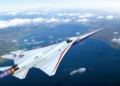
The Chinese project is taking a different aerodynamic approach from NASA’s X-59.
Instead of simply trying to soften a single large sonic boom, the TMS-10 is designed to prevent multiple shock waves from combining into a stronger pressure wave.
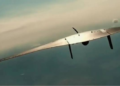
Its configuration includes a forward canard, the small wing positioned ahead of the main wing, along with a T-tail at the rear.
Researchers say these surfaces help control the shock waves generated around the nose and wings. The geometry is intended to keep those waves from merging into one more powerful wave.
The rear section then helps redistribute and weaken the remaining pressure disturbances.
The goal is not to eliminate the physics of supersonic flight. That would be unrealistic. Instead, the objective is to control how the shock waves form and spread so the resulting boom is substantially less intense.
How is NASA’s X-59 different?
NASA is pursuing a similar broad objective but uses a different design philosophy.
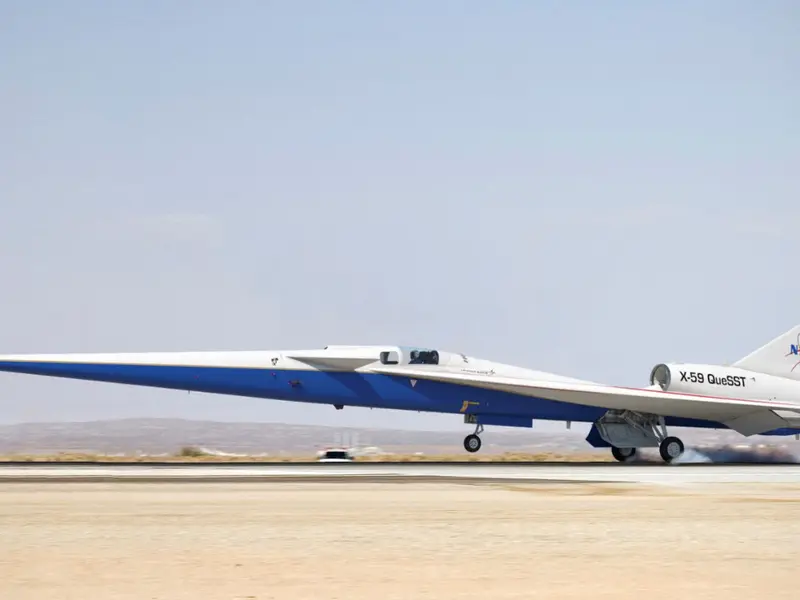
The X-59 is specifically designed to replace the traditional loud sonic boom with a much quieter “sonic thump.”
NASA’s aircraft has already entered supersonic testing. In June 2026, the X-59 reached Mach 1.4 at about 55,000 feet during a mission-conditions flight, after first breaking the sound barrier earlier that month.
NASA’s approach relies heavily on the aircraft’s long, slender shape and carefully controlled shock-wave formation. The agency plans to fly the X-59 over US communities and collect data on how people perceive the resulting sound.
China’s TMS-10 and NASA’s X-59 are therefore pursuing the same broad objective, quieter supersonic travel over land, but their aerodynamic solutions are different.
China TMS-10 vs NASA X-59
| Feature | China’s TMS-10 | NASA’s X-59 |
|---|---|---|
| Current role | Experimental technology demonstrator | Experimental quiet-supersonic research aircraft |
| Target speed | Mach 2 | Mach 1.4 design condition |
| Approx. top target speed | 2,470 km/h | 1,490 km/h |
| Main objective | Demonstrate high-speed, low-boom technology | Demonstrate a much quieter sonic signature |
| Passenger concept | Future 10-15-seat aircraft | Research aircraft, not a commercial passenger jet |
| Current testing | Supersonic flight planned by end of 2026 | Supersonic flight testing underway |
| Noise strategy | Disperse and weaken shock waves | Shape and weaken shock waves to produce a “sonic thump” |
NASA’s published figures confirm that the X-59 reached Mach 1.4 in June and is intended to support future research into quieter supersonic flight over land.
When will China’s TMS-10 fly supersonically?
The project has not yet completed its first supersonic flight.
The aircraft is currently moving through final assembly and integration. Developers plan to conduct its first major high-speed test around the end of 2026, assuming the remaining technical and flight-readiness requirements are met.
Earlier development work has already produced useful data.
A 1:18-scale prototype reportedly completed a low-speed flight in June 2025, remaining below Mach 0.2. That test was designed to examine basic characteristics such as takeoff, landing, stability and control.
The upcoming full-size test represents a much more demanding stage because the aircraft will have to cross the sound barrier while engineers measure its aerodynamic and acoustic performance.
What will the first supersonic test measure?
The speed itself will be only one part of the test.
Engineers will be looking at how the aircraft behaves as it accelerates through the transonic region, where airflow becomes especially complex.
They will also examine the aircraft’s flight-control system, propulsion integration, aerodynamic performance and the shock waves generated once it becomes supersonic.
One of the most closely watched measurements will be the aircraft’s sonic signature.
The data should help researchers determine whether the unusual aerodynamic configuration actually produces the lower-intensity shock-wave pattern predicted by computer simulations and wind-tunnel work.
That is the point where the project moves from promising engineering concept to measurable flight performance.
Could TMS-10 really fly from Beijing to Shanghai in 30 minutes?
That is the long-term ambition rather than a current capability.
Chinese reports say the technology could eventually be used in a 10- to 15-seat supersonic business aircraft capable of covering the roughly 1,075-kilometer route between Beijing and Shanghai in about half an hour.
At Mach 2, the aircraft’s cruise speed would make such a flight physically plausible from a pure speed perspective.
But actual journey time would also depend on acceleration, climb, descent, routing and air-traffic restrictions.
The proposed 30-minute figure therefore represents an engineering target for a future aircraft rather than a promised travel time for the present demonstrator.
Why is a 10- to 15-seat aircraft being considered?
The project appears to be aimed at the business-aviation and premium-travel market rather than mass passenger transport.
A smaller aircraft requires fewer passengers to fill each flight and could potentially operate more like a business jet.
That could give a future supersonic aircraft a clearer initial market among travelers who place a high value on saving time.
But smaller aircraft also face a difficult economic equation. Supersonic flight requires significant power, advanced materials and highly specialized aerodynamic design.
A commercially successful aircraft would therefore have to balance speed with operating cost, maintenance, range, passenger comfort and regulatory requirements.
What happened to supersonic passenger travel after Concorde?
The Concorde proved that commercial supersonic travel was possible, but it also exposed the limits of the first generation of the technology.
The aircraft could travel at around Mach 2 and dramatically reduce transatlantic travel times. However, it was expensive to operate and faced significant restrictions because of its sonic boom.
The Concorde retired in 2003.
Since then, aerospace companies and government agencies have continued investigating whether modern materials, computing, aerodynamics and propulsion systems can make supersonic travel quieter and more practical.
The TMS-10 and X-59 represent two current attempts to tackle one of the central technical barriers.
What are the biggest challenges for China’s supersonic jet?
A successful test flight would be only the beginning.
The first challenge is the sonic boom. Engineers must demonstrate that their theoretical calculations translate into measurable improvements in real flight conditions.
The second is efficiency. Flying at Mach 2 requires substantial energy, and commercial operators would need an aircraft with manageable operating costs.
The third is durability. A passenger aircraft must withstand repeated high-speed cycles while maintaining safe and predictable performance.
The fourth is regulation. Quieter supersonic aircraft still need to satisfy aviation safety and noise requirements before they could operate commercially over populated areas.
Finally, there is the question of economics. A 10- to 15-seat aircraft would likely have to command premium fares to offset its development and operating costs.
Is China trying to restart supersonic passenger travel?
The TMS-10 project fits into a broader global effort to revive high-speed civilian aviation.
China is developing several advanced aviation concepts as it expands its aerospace industry, while the United States, Europe and private companies are also investigating new approaches to supersonic travel.
The difference today is that reducing the sonic boom has become almost as important as increasing speed.
A Mach 2 aircraft that cannot fly over populated areas would have a limited commercial market. A slower aircraft that can operate quietly over land could potentially serve far more routes.
That is why the TMS-10’s noise-reduction technology may ultimately prove more important than its headline speed.
What happens after the TMS-10 test?
If the aircraft performs as expected, developers will have to repeat the tests under different conditions and build a larger body of evidence.
The next step would be to demonstrate that the aerodynamic concept can be scaled into a practical passenger aircraft.
That process could require new propulsion systems, stronger structures, revised thermal-management systems and more extensive flight testing.
Certification would then become another major hurdle.
In other words, a successful Mach 2 test flight would be a milestone, not the finish line.
Why the TMS-10 matters
China’s TMS-10 is interesting not simply because it promises extreme speed.
Its more consequential goal is to show that an aircraft can travel at supersonic speeds while reshaping the shock waves that normally produce a disruptive boom.
That is the same fundamental problem NASA’s X-59 is investigating from a different engineering direction.
If the concept works, a future generation of smaller supersonic aircraft could make long domestic and regional journeys dramatically shorter.
For now, though, the TMS-10 remains an experimental aircraft on the ground, preparing for a crucial test of whether its aerodynamic ideas can survive the transition from laboratory calculations to real-world flight.