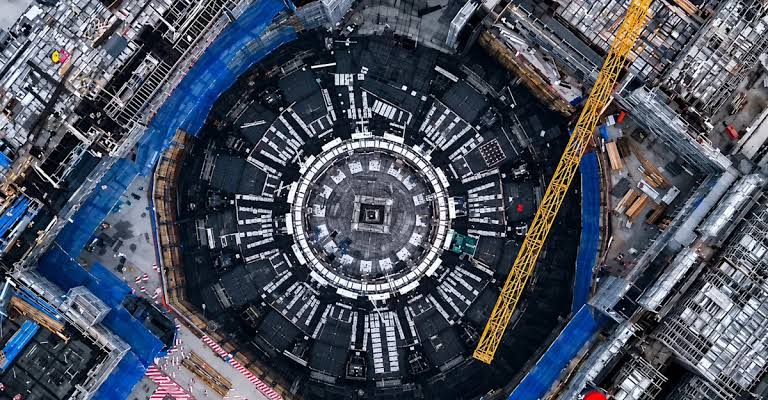
China has announced a major milestone in its pursuit of nuclear fusion by completing and testing what it says is the world’s largest superconducting fusion magnet—a critical component for future fusion reactors. Developed by the Institute of Plasma Physics (ASIPP) under the Chinese Academy of Sciences in Hefei, the giant magnet is designed to confine plasma heated to more than 100 million degrees Celsius, around six times hotter than the Sun’s core.
Often referred to as an “artificial sun”, the technology is not a miniature star or a functioning power plant. Instead, it is part of an experimental effort to recreate the same nuclear fusion process that powers the Sun, with the long-term goal of generating clean, low-carbon electricity.
The newly completed magnet is designed to confine superheated plasma inside a fusion reactor using powerful magnetic fields, bringing scientists another step toward practical fusion energy.
What Is China’s ‘Artificial Sun’?
The term “artificial sun” is a popular nickname for experimental nuclear fusion projects.
Unlike conventional nuclear power plants, which generate energy by splitting heavy atoms (nuclear fission), fusion aims to produce energy by combining light hydrogen isotopes under extreme temperatures and pressures.
This is the same process that powers the Sun and other stars.
China’s latest announcement concerns a key piece of fusion infrastructure, a massive superconducting magnet, not a completed fusion power station.
Why Is the Magnet So Large?
The newly completed magnet is an enormous engineering structure.
According to reports, it
- Measures approximately 21 meters (69 feet) long.
- Is about 12 meters (39 feet) wide.
- Weighs roughly 582 tonnes.
Its primary role is not to generate electricity but to create powerful magnetic fields capable of confining plasma inside a fusion reactor.
Because plasma is extremely hot, it cannot be allowed to touch the reactor walls.
Instead, the magnetic field acts as an invisible containment system that keeps the plasma suspended away from the reactor structure.
Why Does the Plasma Reach 150 Million°C?
One of the most surprising aspects of fusion research is that laboratory plasmas are much hotter than the Sun’s core.
The Sun’s core reaches temperatures of approximately the following:
- 15 million°C (27 million°F).
Fusion experiments on Earth typically require temperatures around the following:
- 150 million°C (270 million°F).
This does not mean Earth-based reactors are “hotter than the Sun” in an overall sense.
The Sun achieves fusion because its immense gravity compresses hydrogen nuclei together under enormous pressure.
Since scientists cannot recreate those pressures on Earth, they compensate by heating the plasma to much higher temperatures, increasing the likelihood that atomic nuclei will collide and fuse.
Why Must the Magnet Be So Cold?
While the plasma is extraordinarily hot, the superconducting magnet surrounding it must remain extremely cold.
The reported operating temperature is approximately:
- -269°C (-452°F).
This is only a few degrees above absolute zero, the theoretical lowest possible temperature.
Superconducting materials lose nearly all electrical resistance at these temperatures, allowing enormous electrical currents to flow efficiently while generating very strong magnetic fields.
Maintaining such different temperatures within the same system is one of fusion engineering’s greatest technical challenges.
Why Is 100,000 Amps Important?
The superconducting magnet is designed to carry electrical currents exceeding 100,000 amperes.
These powerful currents generate the magnetic fields needed to confine the plasma continuously.
Any significant electrical resistance would produce excessive heat and reduce efficiency.
Engineers therefore design superconducting systems so current can circulate with minimal energy loss.
Why Is the Magnet Designed to Last 60 Years?
Fusion reactors are expected to operate under some of the harshest conditions ever engineered.
According to project reports, the superconducting magnet is intended to function for around 60 years while enduring:
- Intense magnetic forces.
- Repeated heating and cooling cycles.
- High-energy neutron radiation generated during fusion.
- Significant mechanical stress.
Achieving such long-term reliability is considered one of the major engineering challenges facing commercial fusion energy.
Why Is the World Investing in Fusion?
Governments and private companies around the world are investing billions of dollars in fusion research because of its potential advantages.
If commercial fusion becomes practical, it could offer:
- Fuel derived largely from hydrogen isotopes, including deuterium found in seawater.
- No direct carbon dioxide emissions during electricity generation.
- No risk of a runaway chain reaction like those associated with nuclear fission reactors.
- Less long-lived radioactive waste than conventional nuclear power plants.
However, fusion facilities would still generate some radioactive materials through neutron activation, so they are not entirely waste-free.
When Could Fusion Power Become Reality?
China has ambitious goals for advancing fusion technology, and various research programs worldwide continue to make progress.
However, completing a superconducting magnet is only one step toward building a commercially viable fusion power plant.
Many scientists believe significant engineering challenges remain before fusion can reliably generate electricity on a commercial scale.
While demonstration reactors may emerge during the coming decades, widespread commercial deployment is generally expected to take longer than current experimental milestones alone might suggest.
Why This Matters
Fusion has often been described as the “holy grail” of clean energy because it promises abundant electricity with lower carbon emissions and fewer long-lived radioactive byproducts than today’s nuclear reactors.
China’s latest achievement represents progress in one of the most technically demanding areas of modern science: containing matter hotter than the Sun’s core using magnets operating only a few degrees above absolute zero.
Although commercial fusion remains a long-term goal, advances in superconducting technology, plasma physics, and reactor engineering continue to move researchers closer to making fusion energy a practical reality.
The Bottom Line
China’s completion of a 582-tonne superconducting fusion magnet marks an important engineering milestone in the global effort to develop nuclear fusion energy. While the achievement does not mean commercial fusion power is imminent, it advances one of the critical technologies needed to safely confine ultra-hot plasma inside future fusion reactors. Scientists around the world continue working toward the long-term goal of producing clean, reliable electricity from the same process that powers the stars.
TL;DR
- China says it has completed and tested the world’s largest superconducting fusion magnet.
- The magnet is designed for use in a nuclear fusion reactor, not a commercial power plant.
- It weighs 582 tonnes and measures about 21 meters in length.
- The reactor’s plasma is expected to reach around 150 million°C, while the superconducting magnets operate near -269°C.
- Fusion remains an experimental technology, and commercial electricity generation is still considered years—likely decades—away by many experts.