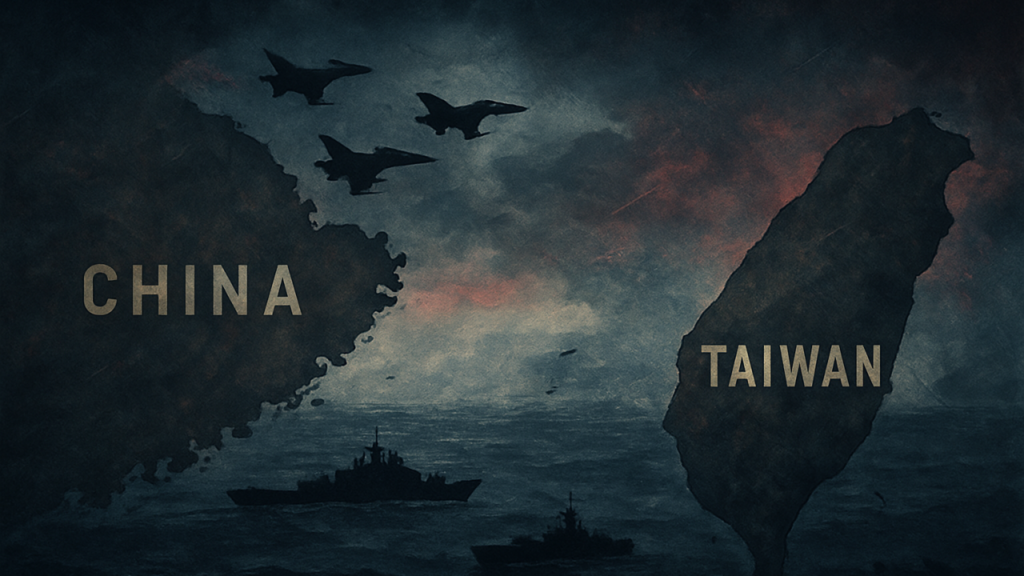
The phrase “Davidson Window” has quietly become one of the most closely watched concepts in global security circles.
It refers to a warning made by former US Indo-Pacific Commander Admiral Philip Davidson in 2021, when he told lawmakers that China could develop the military capability to attempt to take Taiwan by force by 2027.
Over time, that assessment evolved into a broader strategic benchmark, one that now shapes military planning in Washington, Taipei, Beijing, and across the Indo-Pacific.
Importantly, the Davidson Window was never intended as a prediction that China would invade Taiwan in 2027. Instead, it was framed as a timeline for military readiness: the point by which the People’s Liberation Army (PLA) could potentially possess the tools needed for such an operation if Chinese leadership chose to pursue it.
Five years later, as Chinese military activity around Taiwan intensifies and Taipei accelerates its defense preparations, the debate around the Davidson Window is returning with new urgency.
What Is the Davidson Window?
The Davidson Window emerged from testimony delivered by Admiral Philip Davidson before the US Congress in 2021.
Davidson warned that China’s military modernization efforts were advancing rapidly and that Beijing could potentially develop the capability to challenge Taiwan militarily within six years, by 2027.
That warning quickly gained traction in strategic circles because it aligned with broader trends:
- Rapid PLA modernization
- Expanding Chinese naval power
- Growing pressure campaigns against Taiwan
- Increasing US-China rivalry in the Indo-Pacific
The concept later became embedded in US defense planning.
Congress subsequently approved billions of dollars in military support and security assistance tied to strengthening Taiwan’s deterrence posture during the 2021–2027 period.
Why Is 2027 So Important for China?
The year carries enormous symbolic and political significance in China.
PLA’s 100th Anniversary
2027 marks the centenary of the People’s Liberation Army, founded in 1927.
Chinese President Xi Jinping has repeatedly tied military modernization goals to that anniversary, urging the PLA to become capable of “fighting and winning modern wars.”
Xi Jinping’s Political Timeline
The year also comes just before the Chinese Communist Party’s 21st National Congress.
Xi is widely expected to seek another five-year term, which would further cement his position as China’s most powerful leader since Mao Zedong.
Any major progress on Taiwan-related objectives before that congress would carry substantial political symbolism domestically.
PLA Modernisation Targets
Xi has pushed sweeping military reforms over the last decade:
- Advanced missile systems
- Aircraft carrier expansion
- Amphibious assault capabilities
- Cyberwarfare infrastructure
- AI-enabled battlefield systems
- Hypersonic weapons
Many analysts view 2027 as a benchmark for whether those reforms have successfully transformed the PLA into a force capable of sustaining large-scale regional operations.
Is China Actually Planning to Invade Taiwan in 2027?
Not necessarily.
That distinction is critical.
US intelligence agencies and senior American officials have increasingly emphasized that 2027 should be viewed as a readiness target, not a war deadline.
Former CIA Director William Burns stated that Xi had instructed the PLA to be ready for a Taiwan contingency by 2027 but clarified that readiness does not equal intent.
A US intelligence assessment released in March 2026 reportedly concluded:
- China currently has no fixed timetable for reunification
- Beijing still prefers non-military methods if possible
- The PLA continues developing contingency plans regardless
China itself has repeatedly rejected claims that it has set 2027 as an invasion deadline.
Xi reportedly told US officials in 2023 that Beijing had no such plan.
That reflects an important nuance often lost in public discussion:
China may want the option of force without necessarily wanting to use it.
China’s Strategy Is Increasingly Focused on Pressure, Not Immediate War
Military analysts increasingly believe Beijing’s near-term strategy centers less on launching a sudden invasion and more on gradually increasing coercive pressure.
This includes:
- Large-scale military exercises
- Naval encirclement drills
- Airspace incursions
- Economic pressure
- Cyber operations
- Information warfare
The goal may be to weaken Taiwan psychologically and politically over time while normalizing constant Chinese military presence near the island.
PLA Drills Around Taiwan Are Growing More Aggressive
China has significantly expanded military exercises around Taiwan since 2024.
Recent drills have included:
- Simulated blockades
- Encirclement operations
- Amphibious assault scenarios
- Missile deployment exercises
In December 2025, the PLA conducted “Justice Mission” exercises reportedly focused on isolation and pressure tactics targeting Taiwan.
These drills matter because they allow China to rehearse operational logistics while simultaneously sending political signals.
How Taiwan Is Preparing for a Potential Conflict
Taiwan is rapidly adapting its defense strategy around the idea that it cannot match China symmetrically.
Instead, Taipei is investing heavily in asymmetric warfare capabilities designed to make any invasion extremely costly.
Taiwan’s Expanding Missile Arsenal
Taiwan is increasing the deployment of the following:
- Harpoon anti-ship missiles
- Indigenous Hsiung Feng missile systems
- Mobile rocket launchers
- Armed drones
- HIMARS rocket systems purchased from the US
Some deployments are expected on strategically sensitive outlying islands like Penghu and Dongyin.
The broader strategy focuses on creating a so-called “porcupine “defense,” making Taiwan difficult and expensive to invade.
US Arms Support Continues
Taiwan is also accelerating discussions over major US weapons purchases reportedly worth up to $14 billion.
Washington continues supporting Taiwan militarily under longstanding security arrangements, although US policy deliberately maintains some ambiguity regarding direct military intervention.
Domestic political debates inside Taiwan, however, continue over the following:
- Defence budgets
- Conscription reforms
- Military readiness spending
- Civil defence preparation
Trump’s Mixed Signals Add Strategic Uncertainty
US President Donald Trump has sent somewhat inconsistent messages regarding Taiwan.
At times, Trump has claimed Xi Jinping assured him China would not attack Taiwan during his presidency. Beijing has not publicly confirmed such claims.
At the same time, US officials continue reaffirming support for Taiwan’s self-defence capabilities and approving arms sales.
That ambiguity reflects a longstanding feature of US-Taiwan policy:
Strategic uncertainty is often viewed as a deterrent tool.
But critics argue mixed messaging could also create confusion during a crisis.
Why the Davidson Window Still Matters
Even if China has no immediate plans for invasion, 2027 remains deeply important because it represents a military capability threshold.
The key strategic question is no longer
“Will China invade Taiwan in 2027?”
Instead, it is:
“Will China possess by 2027 the credible military capability to make invasion a realistic option?”
That distinction shapes everything from the following:
- US military deployments
- Japanese defence policy
- Taiwan’s arms purchases
- Indo-Pacific alliance coordination
- Global semiconductor security planning
The Taiwan Strait remains one of the world’s most dangerous geopolitical flashpoints precisely because uncertainty cuts both ways:
- China wants leverage without triggering war
- Taiwan wants deterrence without provoking escalation
- The US wants stability while countering Chinese influence
The Davidson Window sits at the center of that balancing act.