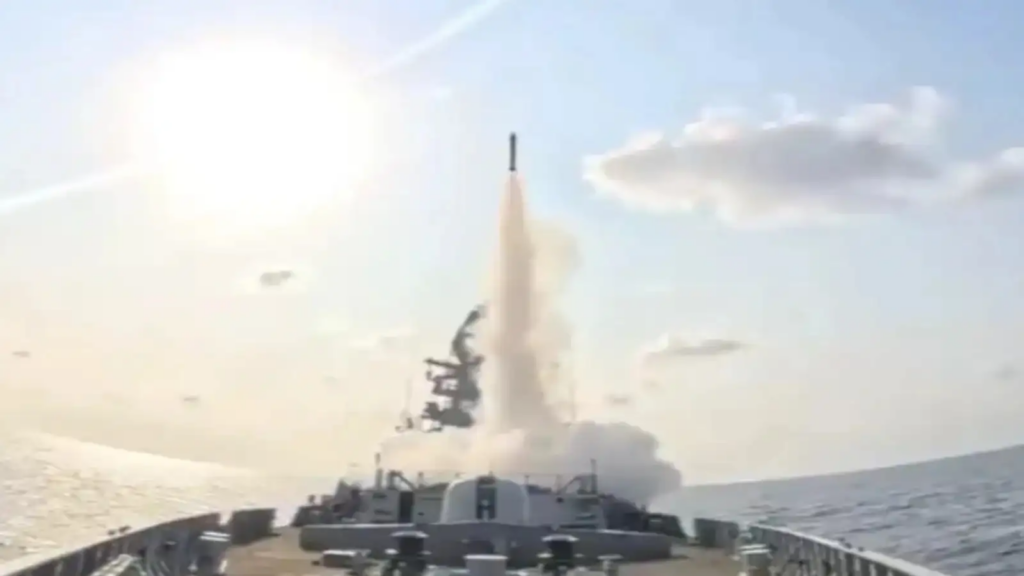
Taiwan is rapidly expanding one of the most important pillars of its defense strategy: anti-ship missiles. Taiwan is building a new strategy to counter China, calling it the “kill zone” strategy.
According to a Reuters calculation based on arms trade data, US export approvals, defense analysis, and official interviews, Taiwan is on track to field roughly 1,850 anti-ship missiles by 2029, creating a dense network of coastal and mobile strike capabilities designed to deter a potential Chinese invasion.
The buildup reflects a major shift in Taiwan’s military thinking. Rather than attempting to match China’s vastly larger navy ship-for-ship, Taipei is investing in a strategy built around mobility, survivability, and precision strikes. Defense planners believe that a large missile force could transform the Taiwan Strait into a dangerous “kill zone” for any invading fleet.
The approach is increasingly viewed as one of Taiwan’s most realistic options for countering China’s growing military power.
What is Taiwan’s ‘kill zone’ strategy?
The term “kill zone” refers to an area where military forces can concentrate firepower to inflict heavy losses on an adversary attempting to pass through it.
In Taiwan’s case, the concept centers on the Taiwan Strait, the roughly 110-mile-wide body of water separating the island from mainland China.
If Chinese forces attempted an amphibious invasion, they would need to transport troops, vehicles, supplies, and equipment across the strait while remaining exposed to attack for hours.
Taiwan’s kill zone strategy aims to exploit that vulnerability.
Rather than destroying China’s military outright, the objective is to make any invasion so costly and risky that Beijing decides it is not worth attempting.
Asymmetric warfare lies at the heart of this concept.
Why Taiwan is embracing asymmetric warfare
Taiwan faces a stark military imbalance.
China possesses:
- The world’s largest navy by number of vessels
- Vast missile inventories
- Advanced air power
- A significantly larger defense industrial base
- Greater manpower and resources
Given those realities, Taiwan has increasingly adopted what defense analysts call the “porcupine strategy.”
The idea is simple: make the island difficult and painful to attack.
Instead of investing primarily in expensive platforms such as large warships or fighter aircraft, Taiwan is emphasizing:
- Mobile missile launchers
- Coastal defense systems
- Sea mines
- Unmanned Aerial Vehicles
- Drone swarms
- Distributed command networks
These systems are cheaper, easier to disperse, and harder to eliminate in a single strike.
Which missiles form the backbone of Taiwan’s arsenal?
Two missile families sit at the center of Taiwan’s anti-ship defense plans:
Harpoon Block II
The US-made Harpoon is one of the world’s most widely used anti-ship missiles.
Key capabilities include:
- Sea-skimming flight profile
- All-weather operation
- GPS-assisted navigation
- Active radar terminal guidance
- Over-the-horizon targeting
- Ability to strike both ships and coastal targets
The missile carries a 500-pound warhead and can be launched from:
- Ships
- Aircraft
- Submarines
- Mobile coastal defense launchers
Its low-altitude flight path makes detection and interception more challenging.
Hsiung Feng III
Often described as Taiwan’s most formidable indigenous anti-ship weapon, the Hsiung Feng III is designed to attack enemy vessels at supersonic speeds.
Its key characteristics include:
- Supersonic flight
- High maneuverability
- Rapid terminal attack profile
- Range of approximately 150 kilometers
- Extended-range variants reportedly approaching 400 kilometers
Because the missile travels significantly faster than subsonic cruise missiles, defenders have less time to react.
Military planners view it as a crucial tool for targeting high-value naval assets.
The numbers behind the buildup
Current projections suggest Taiwan could possess by 2029:
- Around 850 Harpoon missiles
- More than 1,000 Hsiung Feng II and Hsiung Feng III missiles
Together, these systems would create one of the densest coastal anti-ship missile networks in the Indo-Pacific region.
Why anti-ship missiles are considered cost-effective
One of the strongest arguments for Taiwan’s strategy is economics.
The cost asymmetry problem
Modern warships are extraordinarily expensive.
For example:
- Guided-missile destroyers can cost billions of dollars
- Amphibious assault ships require years to build
- Aircraft carriers represent some of the most expensive military assets ever constructed
By contrast, anti-ship missiles cost only a fraction of the price of the vessels they target.
This creates what defense planners call cost asymmetry.
A relatively inexpensive missile that damages or sinks a major warship can impose massive financial and operational losses on an attacker.
The mathematics strongly favor defenders.
Even if only a percentage of incoming missiles penetrate a ship’s defenses, the consequences can be severe.
How Taiwan plans to defend the Taiwan Strait
The missile buildup is only one component of a broader defensive network.
Taiwan is working to integrate:
- Coastal radar systems
- Mobile launchers
- Intelligence networks
- Surveillance assets
- Unmanned systems
- Drone reconnaissance platforms
Officials have announced plans for a new Littoral Combat Command intended to improve coordination between these elements.
The goal is to create a resilient system capable of surviving an initial wave of attacks and continuing operations during a conflict.
Lessons from recent conflicts
Taiwan’s planners have closely studied conflicts in:
- Ukraine
- The Middle East
- The Red Sea region
These conflicts have demonstrated how relatively inexpensive missiles and drones can threaten larger and better-equipped military forces.
The lessons reinforce Taiwan’s belief that precision weapons can offset conventional disadvantages.
What are the challenges facing Taiwan’s missile strategy?
Despite its advantages, the strategy is not without risks.
Vulnerability to preemptive strikes
Some missile systems remain located on:
- Naval vessels
- Fixed installations
- Known military facilities
These locations could become targets during the opening stages of a conflict.
Dependence on logistics
A prolonged confrontation would require:
- Missile resupply
- Communications resilience
- Sustained intelligence gathering
Maintaining those capabilities under wartime conditions could prove difficult.
China’s evolving countermeasures
China continues investing heavily in:
- Missile defense systems
- Electronic warfare
- Long-range precision strikes
- Surveillance technologies
As Taiwan improves its defenses, Beijing is also adapting its military planning.
Why the missile buildup matters
The expansion of Taiwan’s anti-ship arsenal reflects a broader strategic reality.
Taipei does not need to defeat China militarily in a traditional sense. Its objective is deterrence.
By making an invasion prohibitively costly, Taiwan hopes to convince Chinese leaders that military action would carry unacceptable risks.
Whether that deterrent proves effective remains one of the most consequential questions in Indo-Pacific security.
With tensions continuing across the Taiwan Strait, anti-ship missiles have become more than weapons. They are increasingly central to Taiwan’s strategy for preserving its security and maintaining the balance of power in one of the world’s most sensitive geopolitical flashpoints.
TL;DR
Taiwan plans to expand its anti-ship missile arsenal to roughly 1,850 weapons by 2029, centered on US-made Harpoon missiles and indigenous Hsiung Feng systems. The buildup is part of an asymmetric “porcupine strategy” designed to turn the Taiwan Strait into a costly “kill zone” for any invading force, deterring military action by raising the potential price of an amphibious assault.