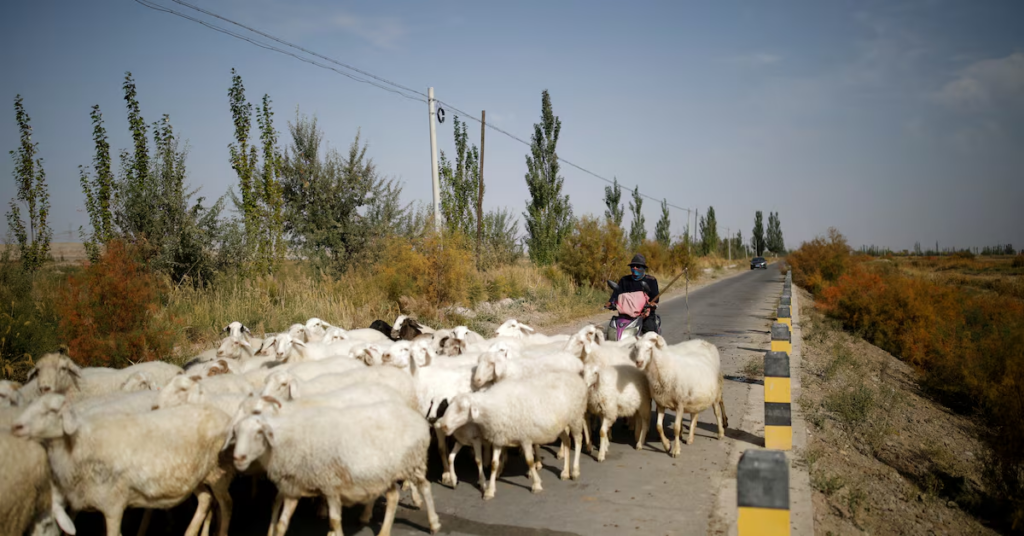
A simple job advertisement for two shepherds in northern China has unexpectedly turned into a national conversation about youth unemployment, burnout, and the growing frustration many young workers feel toward the modern Chinese labour market.
The ad, posted by farm owner Zuo Xiaoyong in late April, offered work tending sheep on remote grasslands near Inner Mongolia.
Within hours: More than 700 people applied.
Soon after, the story exploded across Weibo, drawing nearly 59 million views and triggering widespread debate online.
The reason was not simply the job itself.
It was what the reaction revealed about China’s economy.
What made the shepherd’s job go viral?
At first glance, the role sounded almost cinematic:
vast grasslands, open skies, thousands of sheep, and escape from city life.
The actual conditions were much harsher.
Applicants would need to:
- manage 3,000 sheep
- oversee a 2,000-hectare pasture
- endure freezing winters below minus 30°C
- live in relative isolation
Yet despite the demanding conditions, young people across China rushed to apply.
The applicants reportedly included:
- factory workers
- office employees
- university graduates
- urban professionals
from major cities such as:
- Shanghai
- Chongqing
Why did so many people want the job?
The answer says less about sheep and more about exhaustion.
Many applicants reportedly told Reuters they were:
- overwhelmed by long work hours
- struggling with debt
- burned out by factory work
- discouraged by shrinking career prospects
For some, the remote shepherd role symbolised escape from the pressures of urban employment.
Cnotoriousorious:
“996” work culture, referring to: 9am to 9pm, six days a week has long faced criticism from younger workers.
Many employees increasingly feel trapped between the following:
- stagnant wages
- intense competition
- rising living costs
- unstable job markets
Against that backdrop, a lonely grassland job started looking oddly attractive.
Not glamorous.
Just breathable.
The salary surprised many people
One reason the ad gained attention: The pay was relatively high.
The shepherd position offered:
8,000 yuan per month,
roughly:
$1,178.
That exceeds China’s average urban private-sector salary of around
6,000 yuan monthly.
The job also included:
- free accommodation
- groceries
- basic living support
For younger workers struggling in cities with:
- expensive housing
- punishing schedules
- unstable contracts
The trade-off suddenly appeared reasonable.
The shepherd’s job effectively became an accidental referendum on urban work culture.
China’s youth labour market is under growing strain
Officially, China’s unemployment rate remains slightly above 5 percent.
But economists increasingly warn that the real issue is broader:
underemployment and job insecurity.
Lynn Song described the shepherd job frenzy as symptomatic of the following:
“a highly competitive and often low-rewarding labor market.”
Millions of young Chinese now face:
- intense hiring competition
- slower economic growth
- fewer white-collar openings
- declining confidence in traditional career paths
This summer alone, China expects the following:
12.7 million university graduates
to enter the labor market.
That is a record.
And many are entering an economy already under pressure from the following:
- Weak consumer demand
- Property sector troubles
- Automation
- AI adoption
- Manufacturing slowdowns
AI and automation are adding to employment anxiety
Part of the growing concern comes from automation.
Factories and companies across China are increasingly adopting:
- AI systems
- robotics
- automated manufacturing tools
That shift is reducing demand for some entry-level and repetitive jobs.
At the same time, companies are raising productivity expectations for remaining workers.
The result: Many younger employees feel squeezed from both sides.
Work is becoming
- harder to secure
- more demanding
- less stable
Ironically, herding sheep began to look more future-proof than certain office careers.
What is China’s ‘curse of 35’?
The story also revived discussion around China’s “curse of 35.”
The phrase refers to hiring discrimination against workers older than 35.
Many Chinese companies, especially in the tech and corporate sectors, increasingly favor the following:
- Younger employees
- Lower-cost workers
- Staff willing to endure longer hours
Experts say this pressure is now spreading beyond the technology industry into wider parts of the economy.
Victoria University of Wellington researcher Christian Yao reportedly described the issue as becoming
“a broader economic reality.”
That fear is pushing many workers to reconsider traditional career ladders entirely.
The fantasy versus the reality of rural escape
Farm owner Zuo himself tried to temper expectations.
“This is not tourism,” he reportedly warned applicants.
The romantic idea of abandoning office life for nature often collides with difficult realities:
- isolation
- physical labour
- harsh climates
- limited social life
Still, the emotional appeal was undeniable.
For many young applicants, the shepherd job represented something increasingly scarce in modern urban employment:
a sense of simplicity and control.
Not ambition.
Not prestige.
Just fewer notifications.
Why this story matters beyond China
The viral shepherd ad resonates globally because similar frustrations are emerging in many economies.
Across different countries, younger workers increasingly report:
- burnout
- dissatisfaction with corporate culture
- declining work-life balance
- fears about automation
- economic insecurity
The details differ from country to country, but the emotional pattern feels familiar.
A generation raised on promises of upward mobility is increasingly asking: upward into what exactly?
The bigger picture: a warning sign for China’s economy
China’s leadership has repeatedly emphasized:
- youth employment
- economic stability
- consumption growth
But stories like this reveal the social mood beneath the statistics.
When hundreds of educated young workers compete for isolated shepherd jobs in freezing grasslands, it suggests more than curiosity.
It suggests disillusionment.
The viral ad became a mirror reflecting:
- labour market stress
- fading confidence
- changing attitudes toward success
And perhaps most strikingly: for many applicants, escaping modern work culture mattered more than escaping hardship itself.