Amid fresh warnings of a looming arms race, recent satellite imagery and think-tank analyses suggest China may be conducting subcritical nuclear tests at its Lop Nur facility in Xinjiang. While Beijing denies any breach of international norms, the activity has reignited global debate over whether such tests exploit a loophole in nuclear non-proliferation treaties, allowing China to modernize its nuclear arsenal without technically violating the law.
What are subcritical nuclear tests, and why do they matter
Subcritical tests are controlled experiments involving plutonium or uranium under extreme pressure but without triggering a self-sustaining chain reaction. In other words, there’s no nuclear explosion.
Unlike full-scale (“supercritical”) detonations banned under the Comprehensive Nuclear-Test-Ban Treaty (CTBT), subcritical tests are considered legal because they produce no explosive yield. However, they are far from harmless.
These tests enable countries to:
- Analyze nuclear material behavior under detonation conditions.
- Refine warhead design and reliability.
- Maintain weapons stockpile efficiency without live testing.
The result? A technical and moral grey area where nations can enhance nuclear capabilities while claiming compliance with non-proliferation treaties.
The treaty loophole: How countries exploit legal grey zones
The CTBT prohibits any test “that produces a nuclear explosion,” but subcritical tests — by design, fall outside its enforcement scope. This creates what experts call the “zero-yield loophole.”
- China, which signed but never ratified the CTBT, has maintained a testing moratorium since 1996.
- The United States has conducted over 30 subcritical tests since 1997 at the Nevada National Security Site.
- Russia has reportedly done 25 or more at Novaya Zemlya.
In essence, all three nuclear powers are keeping their arsenals modern while technically adhering to international norms.
What’s happening at China’s Lop Nur site?
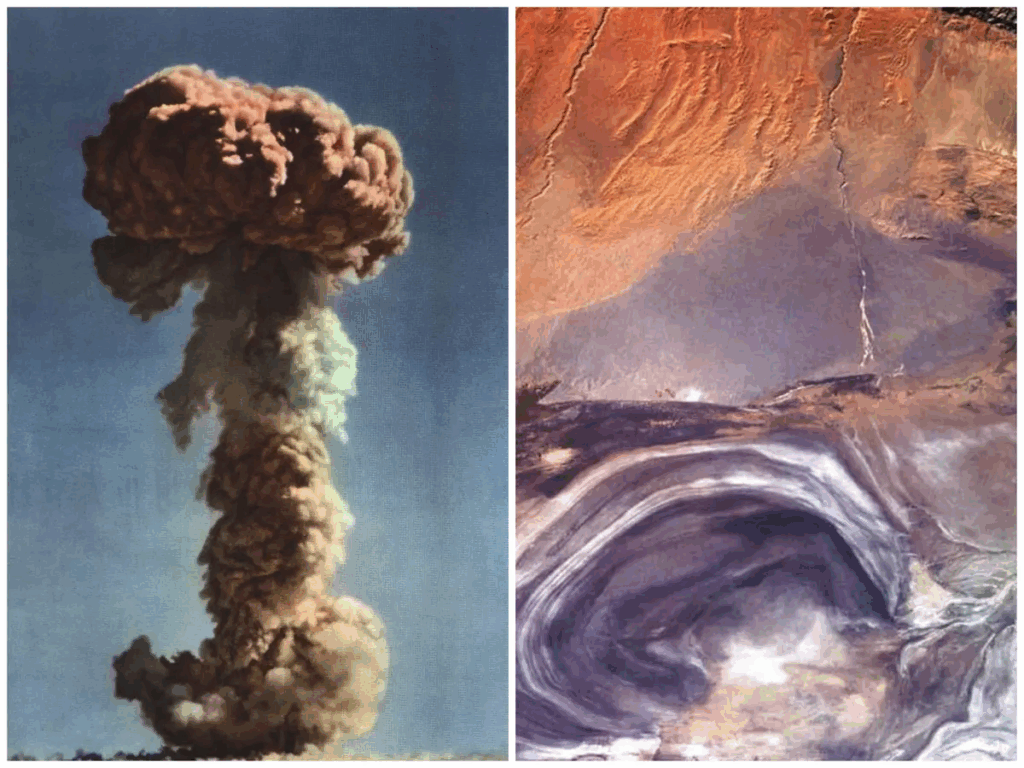
Once dormant, China’s Lop Nur nuclear testing site has seen renewed construction since 2023, according to analyses by organizations like the Sasakawa Peace Foundation and satellite imagery from Planet Labs.
The evidence includes:
- New tunnels under excavation (possibly a sixth underground test tunnel).
- Ventilation shafts and sealed entrances, typically used to contain radiation.
- New roads, spoil piles, and expanded support buildings, consistent with test preparation infrastructure.
Experts such as Jeffrey Lewis of the Middlebury Institute of International Studies argue these patterns mirror subcritical testing facilities used in the US and Russia.
However, others caution that such infrastructure could also support hydrodynamic or civilian nuclear research, particularly China’s Accelerator-Driven Systems (ADS) — a technology used for both nuclear energy and weapons-related experiments.
China’s dual-use research: Civilian front, military advantage?
A 2025 paper by the China Institute of Atomic Energy highlighted advancements in accelerator-driven subcritical systems (ADS) and high-powered laser facilities. While officially focused on civilian nuclear energy and thorium reactor research, these technologies overlap significantly with those used in subcritical weapons testing.
This dual-use nature raises concerns that Beijing could be developing or simulating new warhead designs under the guise of scientific research, maintaining plausible deniability while gaining a military advantage.
Pentagon and think-tank warnings: Rapid expansion of China’s arsenal
Between 2020 and 2024, successive Pentagon reports to the US Congress projected that China’s nuclear warhead stockpile — once estimated at 200 warheads — could exceed 1,000 by 2030 and reach 1,500 by 2035.
According to data from the Nonproliferation Policy Education Center (NPEC) and SIPRI, China is also expanding:
- Reprocessing plants and breeder reactors at Jiuquan and Guangyuan.
- Production capacity for weapons-grade plutonium, estimated at up to three tonnes — enough for hundreds of additional warheads.
The Federation of American Scientists (FAS) estimates each new silo-based warhead uses 3–5 kilograms of plutonium, suggesting China’s future output could massively scale its deterrent capabilities.
Does this mean China is violating treaties?
No concrete proof has emerged of China conducting supercritical or explosive tests. The Comprehensive Nuclear-Test-Ban Treaty Organization (CTBTO)’s global monitoring system — which detects seismic or radioactive activity, has not recorded any violations.
That said, subcritical tests enable a nation to refine weapon systems while staying technically within treaty limits. This undermines the spirit of the CTBT and NPT (Nuclear Non-Proliferation Treaty), even if not the letter.
The broader fallout: Toward a new arms race?
If China continues advancing its arsenal under this grey zone, the ripple effects could be global.
Regional domino effects
- India, which has not tested since 1998, could revisit its nuclear policy if it perceives an imbalance with China.
- North Korea might accelerate testing, citing Chinese precedent.
- Japan and South Korea could push for American nuclear deployments or develop indigenous capabilities, destabilizing East Asia.
Global treaty fatigue
Article 6 of the NPT obliges nuclear powers to pursue disarmament “in good faith.” But with Russia withdrawing from the CTBT in 2023, the US never ratifying it, and China leveraging loopholes, these commitments are fast eroding.
Without collective restraint, the credibility of global non-proliferation regimes could collapse, pushing the world closer to a modernized arms race driven by “legal” nuclear experiments.
Can the loophole be closed?
Experts propose three main policy solutions:
- Define “zero yield” more clearly in the CTBT to explicitly include subcritical and hydrodynamic tests.
- Mandate real-time international monitoring of underground and laboratory nuclear experiments.
- Encourage full ratification of the CTBT by all nuclear powers, including the US and China.
Without these reforms, subcritical testing may continue to blur the line between scientific research and weapons development, rendering future disarmament efforts meaningless.
The bottom line
There’s no public evidence that China has resumed explosive nuclear testing. Yet, the country’s technological advancements, site expansions, and dual-use programs point to a strategic exploitation of treaty grey zones.
Beijing may not be breaking the rules, but it’s certainly bending them. Unless global powers act to redefine what constitutes a nuclear “test,” the world could be watching the dawn of a new, legally invisible arms race.