
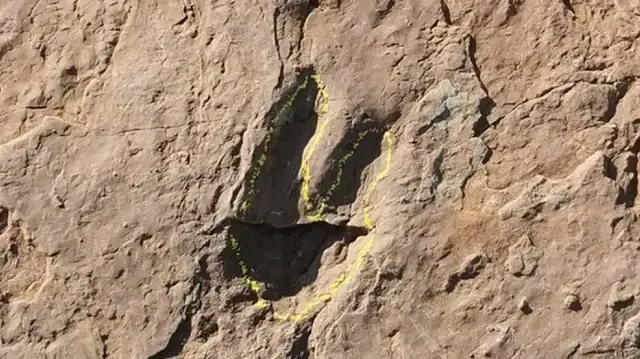
In a discovery that is reshaping what scientists know about dinosaur life in prehistoric Europe, thousands of dinosaur footprints in Italy have been uncovered high in the Italian Alps—an area better known today for skiing and, soon, the 2026 Winter Olympics. Dating back roughly 210 million years, these remarkably preserved tracks offer a rare, almost cinematic snapshot of how dinosaurs moved, rested, and possibly defended themselves long before the Alps even existed.
What makes this find extraordinary isn’t just the sheer number of tracks, but where they were found, how intact they are, and what they reveal about dinosaur behavior during the Triassic period.
What Was Discovered in Italy’s Alps?
The discovery centers on a massive set of fossilized footprints embedded in a vertical mountain wall inside Stelvio National Park, near Italy’s border with Switzerland. The tracks span hundreds of meters, making this one of the largest known dinosaur track sites in Europe—and possibly the world.
Some of the prints measure up to 15 inches in diameter, with toes and claw marks so sharply defined that they appear almost recent. Yet these impressions were made 210 million years ago, when dinosaurs were just beginning to dominate Earth.
A Discovery Hidden in Plain Sight
Remarkably, the footprints weren’t found during a formal excavation. They were spotted last September by Elio Della Ferrera, a photographer exploring the remote mountain terrain. The wall, steep and largely inaccessible, had somehow escaped detailed scientific scrutiny until now.
That chance observation triggered a deeper investigation by palaeontologists—and what they found exceeded expectations.
Which Dinosaurs Made These Footprints?
Experts believe the tracks belong primarily to prosauropods, early relatives of the giant sauropods that would later include creatures like Brachiosaurus and Diplodocus.
Who Were the Prosauropods?
Prosauropods were:
- Long-necked herbivores
- Typically bipedal, walking on two legs
- Between 6 and 10 meters long
- Among the dominant plant-eaters of the late Triassic period
While they usually moved on their hind legs, researchers identified front-limb impressions at the site as well, suggesting moments when the animals paused, rested, or shifted posture.
This level of detail is rare in footprint sites and adds depth to how scientists interpret dinosaur movement.
Why Are These Dinosaur Footprints So Well Preserved?
One of the most compelling questions surrounding the discovery is how these tracks survived intact for more than two centuries of millions of years.
From Coastal Mudflat to Mountain Wall
According to researchers, the landscape looked nothing like today’s rugged Alps when the tracks were made. During the Triassic period (250–201 million years ago), the area was:
- A low-lying coastal plain
- Rich in mud and sand
- Shaped by tidal flats
As dinosaurs walked across these soft surfaces, their footprints were quickly buried by sediment. Over time, geological forces lifted and folded the land, transforming a flat coastal area into part of the Alpine mountain chain.
That slow, dramatic process preserved the prints while turning them nearly vertical—creating the unusual cliffside display visible today.
“This mountain wall wasn’t like this during the period of these dinosaurs,” experts explained during a press briefing.
What Do the Footprints Reveal About Dinosaur Behavior?
Beyond size and age, the most exciting aspect of the Italian find may be what it reveals about social behavior among early dinosaurs.
Evidence of Group Living
Milan-based paleontologist Cristiano Dal Sasso noted that the density and arrangement of the tracks suggest these dinosaurs were not solitary wanderers.
Instead, the footprint patterns indicate:
- Group movement, with multiple animals traveling together
- Repeated pathways, suggesting commonly used routes
- Circular formations, possibly used as defensive positions
These circles may have formed when dinosaurs grouped to protect themselves from predators, a behaviour previously difficult to confirm from fossil bones alone.
Footprints, unlike skeletons, capture behavior in motion. In this case, they offer rare clues that early herbivorous dinosaurs may have had more complex social structures than once believed.
Why This Discovery Matters for Paleontology
“This set of dinosaur footprints is one of the largest collections in all of Europe, in the whole world,” said Attilio Fontana, head of the Lombardy region, during a news conference.
That’s not political hyperbole—it’s a scientific reality.
Why Track Sites Are So Valuable
Unlike bones, footprints provide:
- Direct evidence of movement
- Insights into speed, posture, and gait
- Clues about group behaviour
- Information on habitat and environment
In regions like Europe, where complete dinosaur skeletons are rarer than in North America or Asia, trackways play an outsized role in reconstructing prehistoric life.
How Will Scientists Study the Site?
The Italian culture ministry has confirmed that the site is remote and inaccessible by established paths, making traditional excavation difficult and potentially dangerous.
Technology Takes the Lead
To study the tracks without damaging them, researchers plan to use:
- Drones for high-resolution imaging
- Remote sensing technology
- 3D mapping and photogrammetry
These tools will allow scientists to document every footprint in detail, measure spacing and depth, and create digital models for global research collaboration.
Why Are Dinosaur Discoveries Still Happening?
The Italian Alps underscore a humbling truth: we’ve only scratched the surface of Earth’s prehistoric record.
Even today, discoveries continue to challenge long-held assumptions.
A Reminder From North America
A few years ago, scientists working in Hell Creek, North Dakota, uncovered a T. rex tooth, only to later find a mosasaur tooth nearby. Mosasaurs were marine reptiles believed to live exclusively in saltwater oceans.
The location of the tooth, thousands of kilometers from the sea, suggested that some mosasaurs had adapted to freshwater environments, forcing scientists to rethink their ecology.
The lesson is clear: the fossil record still holds surprises, often in places scientists least expect.
Why This Matters Beyond Science
Italy’s dinosaur footprints arrive at a symbolic moment. The region is preparing to host the 2026 Winter Olympics, welcoming the world to landscapes shaped not just by glaciers but by deep time.
The discovery also raises important questions about:
- Conservation of fossil sites
- Balancing tourism and preservation
- How modern infrastructure intersects with ancient history