A group of thieves has carried out a remarkably fast raid on a Spanish museum, stealing much of the Treasure of Villena, a Bronze Age collection containing some of Europe’s most important prehistoric goldwork.
The burglary at the Museum of Villena, or MUVI, in Alicante province lasted less than four minutes after the museum’s alarm was triggered. Authorities said the alarm sounded at about 5:20 a.m. Thursday, and the thieves had escaped by 5:24 a.m.
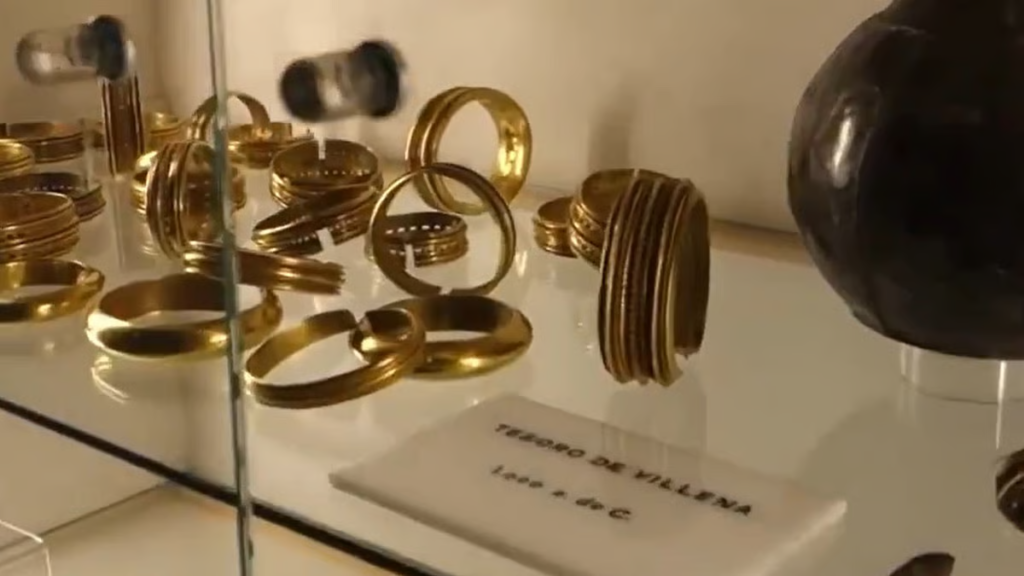
The stolen collection dates to roughly 1,000 BC and includes elaborate gold bracelets, bowls and vessels, along with objects made from silver, iron and amber. Although the stolen gold has an estimated raw value of about €1.7 million, its archaeological and historical value is far greater and cannot realistically be measured by the price of the metal.
The Guardia Civil and local police are investigating the raid, which early evidence suggests was coordinated and carefully planned.
What was stolen from the Villena Museum?
The Treasure of Villena is not simply a collection of antique jewelry. It is a major archaeological record of Bronze Age metalworking in the Iberian Peninsula.
The museum’s official description lists 28 gold bracelets, 11 gold bowls, two gold bottles, 13 gold sheet fragments and several other objects. The wider hoard contains 67 pieces in total when the silver, iron, amber and gold components are counted together. The gold alone weighs more than 9 kilograms.
Recent reports about the museum robbery have described 59 prehistoric objects as the main collection targeted or displayed in the affected exhibit. Differences in the number reflect how the collection and the stolen pieces are being counted, so the exact inventory recovered or missing remains a matter for investigators and museum officials to establish.
What is clear is that thieves removed most of the collection that served as the museum’s main attraction.
They also reportedly stole three crowns of the Virgin and Child that were being kept by the museum, adding religious artifacts to the archaeological losses.
Why is the Treasure of Villena so important?
The collection is considered one of the most significant Bronze Age discoveries in Europe.
Its importance comes from a combination of age, quantity, craftsmanship and the unusual concentration of precious metal. The museum describes it as one of the most important collections of gold vessels from the European Bronze Age, placing it in the same broad category of archaeological significance as the royal grave treasures of Mycenae in Greece.
The official Spanish heritage record also classifies the Treasure of Villena as a protected cultural asset. It describes the hoard as containing 67 objects deposited together in a ceramic vessel at the Rambla del Panadero near Villena.
That context makes the theft fundamentally different from the disappearance of ordinary valuables.
The objects are evidence of how Bronze Age societies produced, used and valued precious materials more than 3,000 years ago. Their historical context cannot be recreated if individual pieces vanish into a private collection or are dismantled for their metal.
How did the thieves carry out the four-minute raid?
The speed of the operation is one of its most striking features.
The museum alarm was activated around 5:20 a.m. The thieves had left the building by approximately 5:24 a.m., according to the Villena town council.
Investigators believe the operation may have involved a diversion.
An alarm at a municipal sports center on the outskirts of Villena reportedly went off several minutes before the museum alarm. Authorities are examining whether that earlier incident was deliberately triggered to draw security personnel away from the museum.
The sequence is striking: a potential diversion, a rapid entry, removal of the valuable objects and an escape before police could reach the museum.
That is one reason investigators have described the burglary as appearing to have been professionally organized.
How did the thieves enter the museum?
The initial information indicates that the burglars struggled to gain access through the main entrance and ultimately entered through a side window or another opening in the building’s exterior.
Some Spanish reporting says the perpetrators opened a breach near the side of the building after an initial attempt through the main entrance failed. Other reports have described entry through windows despite security and reinforced systems. Investigators are still reconstructing exactly how the group got inside.
That uncertainty is important because the investigation is still in its early stages.
Authorities have not publicly established how many people participated, although early reports have described a small, coordinated group.
Did the museum’s security system fail?
Officials have pushed back against the idea that the museum simply had no functioning alarm system.
A Villena spokesman said the security systems were activated during the incident and insisted there had been no failure by the museum. The thieves were already gone by the time officers reached the building.
That distinction matters.
An alarm can work exactly as intended while still failing to prevent a theft if criminals can complete the burglary faster than police can respond.
The suspected sports-center diversion, if confirmed, would make the timing even more significant because it could have been designed specifically to exploit that response gap.
Why can’t the stolen gold simply be sold?
The thieves may have taken objects containing millions of dollars’ worth of precious metal, but that does not mean the artifacts have an equivalent value on the legitimate market.
Archaeological artifacts of this kind are heavily restricted and are internationally recognizable.
Their historical importance also makes them difficult to dispose of without attracting attention. A rare Bronze Age gold bowl is not an anonymous piece of bullion. Museums, auction houses, archaeologists, customs authorities and law enforcement agencies can potentially recognize and trace such objects.
There is therefore a major difference between the metal value of an artifact and its value as cultural heritage.
For this reason, investigators will likely be concerned not just with locating the thieves but with preventing the objects from being melted down, dismantled or moved across borders.
When was the Treasure of Villena discovered?
The treasure was discovered in 1963 by archaeologist José María Soler.
It was found inside a vessel buried in a dried riverbed in the Villena area. The discovery eventually revealed a collection of extraordinarily elaborate objects dating to the Bronze Age.
The circumstances of the discovery have become part of the collection’s historical importance.
The hoard had survived underground for more than 3,000 years before being recovered and preserved for public display.
The irony is striking: a collection that survived millennia underground was then removed from a modern museum in minutes.
What objects are in the Treasure of Villena?
The goldwork includes bowls and bracelets with detailed decorative patterns.
According to Spain’s official heritage documentation, the gold portion weighs about 9.1 kilograms and includes 28 bracelets, 11 bowls, two gold bottles and 13 fragments of gold sheet. The hoard also contains three silver vessels, iron objects and an item combining gold and amber.
The mix of materials is especially valuable to archaeologists.
Iron is unusual in Bronze Age contexts because it was exceptionally rare at the time and could itself have been regarded as a precious material. The official heritage record notes iron components within the hoard alongside the gold and silver objects.
The collection therefore offers more than evidence of wealth. It provides clues about technology, trade, craftsmanship and social status in prehistoric Iberia.
How much is the stolen treasure worth?
The mayor of Villena has said the gold alone is worth about €1.7 million, or approximately $2 million.
That figure represents the approximate value of the precious metal.
The cultural value is another matter entirely.
A museum artifact that can be weighed in grams of gold cannot be meaningfully priced in the same way as newly manufactured jewelry. Removing one object from its archaeological collection also destroys part of the information that comes from seeing the pieces together.
For museums and archaeologists, the loss can therefore be effectively irreplaceable even when the raw material has a clear market price.
Why might recovering the objects be difficult?
The greatest danger after a museum theft is not necessarily that the artifacts disappear forever. It is that they are altered beyond recognition.
Gold objects can be melted down relatively easily compared with stone or ceramic artifacts. Once an ancient object is reduced to raw metal, much of its archaeological value is destroyed.
That is why international alerts and cooperation can be particularly important in cases involving stolen cultural property.
The objects are distinctive, documented and likely photographed extensively. Their unusual designs could make them identifiable if they appear on the legitimate antiquities market.
Is this the latest major museum heist in Europe?
The Villena burglary comes amid a series of high-profile thefts involving European cultural institutions.
In October 2025, thieves stole jewelry from Paris’s Louvre Museum in a daytime operation that lasted less than eight minutes. The estimated value of the stolen items was around $102 million.
Italy has also experienced notable museum thefts and recoveries.
The recent wave of incidents has increased concern about whether criminals are becoming more adept at exploiting security weaknesses in museums and cultural institutions.
But each case is different. The Villena theft’s significance lies not only in the speed of the burglary but in the fact that the targets are prehistoric objects whose value is inseparable from their historical context.
What happens to the investigation now?
The Guardia Civil and local police are leading the investigation.
Authorities are expected to examine surveillance footage, alarm records, vehicle movements and possible evidence from the museum and surrounding area. They will also investigate the earlier sports-center alarm to determine whether it was connected to the burglary.
Determining exactly which objects were stolen will be another priority.
That inventory is essential for law enforcement because every missing artifact can potentially become part of an international alert and recovery effort.
The investigation will also need to determine whether the thieves were acting on behalf of an organized criminal network, a private collector or another buyer.
Why the four-minute heist is so significant
The Villena theft exposes a difficult problem for museums.
The very objects that require the most protection are often impossible to replace. A damaged or stolen modern artwork may sometimes be reconstructed or re-created. A Bronze Age artifact carries information that exists nowhere else.
The burglars may have needed only a few minutes to remove the treasure.
Recovering it could take years.
And even if every stolen item is eventually returned, the incident will likely force questions about museum design, overnight staffing, alarm response times, physical barriers and whether precious archaeological collections should ever be concentrated in a single display.
For Villena, the immediate priority is recovery.
For the wider museum world, the heist is another warning that three thousand years of history can still be remarkably vulnerable to a few minutes of organized crime.
Key takeaways
- Thieves raided the Museum of Villena in Alicante province, Spain, on August 27, 2026.
- The museum alarm sounded at about 5:20 a.m., and the thieves were gone by 5:24 a.m.
- Much of the Bronze Age Treasure of Villena was stolen.
- The collection dates to around 1,000 BC and contains gold, silver, iron and amber objects.
- The official heritage record describes 67 pieces in the broader hoard, including 53 gold objects weighing more than 9 kilograms.
- Recent reports have described 59 prehistoric objects as part of the museum’s displayed collection affected by the theft.
- The raw gold value of the stolen material is estimated at about €1.7 million, but its archaeological value is far higher.
- Authorities are investigating whether an earlier alarm at a municipal sports center was used as a diversion.
- The treasure was discovered by archaeologist José María Soler in 1963.
- Police are investigating the burglary and attempting to determine the exact number and identity of the perpetrators.