

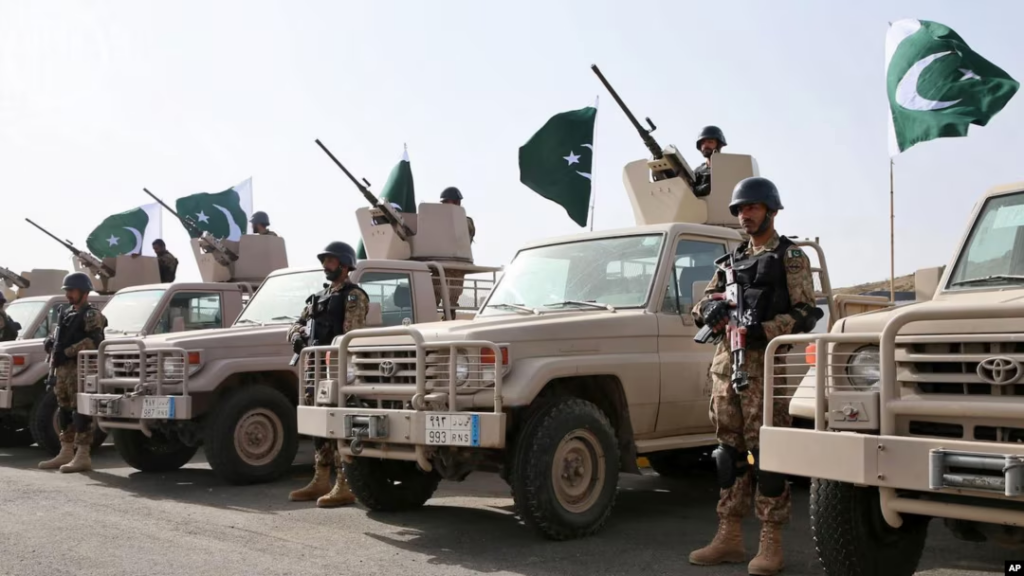
Pakistan has reportedly deployed thousands of troops, fighter jets, drones and air defense systems to Saudi Arabia under a confidential defense pact signed in 2025, according to reports citing Pakistani security officials.
The scale of the deployment is striking:
- Around 8,000 troops
- A squadron of roughly 16 JF-17 fighter jets
- Drone squadrons
- Chinese-made HQ-9 air defense systems
- Potential naval cooperation
If accurate, the move marks one of the most significant expansions of Pakistan-Saudi military cooperation in decades, reported Reuters.
But this is not just about bilateral defense ties.
The deployment sits at the intersection of:
- Iran-Gulf tensions
- China’s growing military footprint
- Pakistan’s economic dependence on Gulf states
- The emerging security architecture of West Asia
And perhaps most intriguingly, Pakistan is simultaneously trying to play mediator between Iran and the United States.
That balancing act could become increasingly difficult.
What exactly has Pakistan reportedly deployed?
According to reports citing Reuters and Pakistani security officials, Islamabad’s deployment includes:
Air power
- Around 16 JF-17 fighter jets
- Drone squadrons
- Pakistani Air Force personnel
The JF-17 Thunder is jointly developed by Pakistan and China and serves as one of Islamabad’s primary combat aircraft.
Air defense systems
Pakistan reportedly deployed the Chinese-made:
- HQ-9 air defense system
The HQ-9 is designed to intercept:
- Aircraft
- Cruise missiles
- Certain ballistic threats
Ground forces
The reported deployment includes:
- 8,000 troops initially
- Possibility of additional deployments later
One report suggested the defense pact could theoretically allow up to 80,000 Pakistani troops in Saudi Arabia during a major crisis.
That would represent an enormous overseas military commitment.
Why Saudi Arabia relies on Pakistan militarily
Pakistan and Saudi Arabia have maintained close defense ties for decades.
The relationship is built on three pillars:
1. Military cooperation
Pakistani personnel have long trained Saudi forces and assisted with defense operations.
Thousands of Pakistani troops have previously served in the kingdom under older agreements.
2. Financial dependence
Saudi Arabia has repeatedly provided Pakistan with:
- Bailout support
- Oil credit facilities
- Financial deposits
- Emergency economic assistance
In moments of economic crisis, Riyadh has often acted as Islamabad’s financial backstop.
3. Strategic alignment
Saudi Arabia sees Pakistan as:
- A major Sunni military power
- A nuclear-capable ally
- A reliable regional security partner
That final point matters enormously.
The “nuclear umbrella” question
One of the most sensitive aspects of the relationship is the long-running speculation that Pakistan could indirectly extend nuclear protection to Saudi Arabia.
Pakistan has never officially confirmed this.
But Pakistan’s defense minister previously implied Riyadh falls under Islamabad’s broader security protection framework.
That matters because Saudi Arabia has long worried about:
- Iran’s missile capabilities
- Regional proxy conflicts
- Nuclear escalation risks
Even without formal guarantees, Pakistan’s nuclear status gives Saudi Arabia added strategic reassurance.
Why this deployment matters for Iran
From Tehran’s perspective, the deployment may look deeply concerning.
Several elements could alarm Iranian planners:
- Pakistani fighter jets near the Gulf
- Chinese air defense systems protecting Saudi infrastructure
- Expanded military integration
- Potential naval cooperation
Iran already sees itself increasingly surrounded by hostile US-aligned military networks.
Now Pakistan, a neighboring Muslim-majority nuclear power, appears more deeply embedded within Saudi defense planning.
That could complicate Pakistan’s attempt to act as mediator.
Pakistan’s balancing act between Riyadh and Tehran
Pakistan occupies a uniquely awkward geopolitical position.
It has:
- Strong military ties with Saudi Arabia
- A long border with Iran
- Economic dependence on Gulf states
- Domestic sectarian sensitivities
- Close relations with China
Islamabad has traditionally tried to avoid choosing sides outright in Saudi-Iranian rivalry.
That explains why Pakistan is simultaneously:
- Deploying forces to Saudi Arabia
- Hosting US-Iran talks
- Calling for regional de-escalation
This dual-track strategy allows Pakistan to:
- Maintain Saudi financial support
- Avoid direct confrontation with Iran
- Position itself diplomatically
- Increase regional influence
But if tensions escalate again, neutrality could become difficult to sustain.
China’s shadow looms over the deployment
One overlooked detail is the growing Chinese influence embedded within this arrangement.
The deployment reportedly includes:
- JF-17 jets
- HQ-9 air defense systems
Both are heavily tied to Chinese military technology.
That means Beijing’s defense footprint in the Gulf may be quietly expanding through Pakistan.
China already has deep regional interests tied to:
- Oil security
- Maritime trade
- Belt and Road investments
- Gulf infrastructure
Using Pakistan as an indirect security partner allows China to increase influence without deploying large numbers of its own forces.
That dynamic will likely concern Washington.
Why the Strait of Hormuz changes everything
The timing matters enormously.
The deployment comes amid fears that:
- The US-Iran ceasefire could collapse
- Oil infrastructure may face renewed attacks
- Shipping routes could be disrupted
The Strait of Hormuz remains one of the world’s most important energy chokepoints.
Roughly a fifth of global oil flows through it.
Saudi Arabia wants:
- Better air defenses
- Stronger military coordination
- Additional deterrence capacity
Pakistan’s deployment strengthens that posture significantly.
Is Pakistan becoming a Gulf security power?
The broader implication is that Pakistan may be evolving into a more active regional military actor.
Historically, Pakistan focused heavily on:
- India
- Afghanistan
- Internal security
But Gulf deployments increasingly give Islamabad:
- Strategic leverage
- Financial opportunities
- Diplomatic influence
- Regional military relevance
That could reshape Middle Eastern security politics over the next decade.
Risks Pakistan now faces
The deployment also carries serious risks for Islamabad.
Potential Iranian distrust
Iran may begin viewing Pakistan less as neutral mediator and more as a Saudi-aligned military actor.
Domestic political tensions
Pakistan’s internal sectarian divisions could become more sensitive if Gulf conflicts intensify.
Military overstretch
Large overseas deployments are expensive and operationally demanding.
Regional escalation
If Saudi-Iran tensions spiral into direct conflict, Pakistani personnel could become exposed.
That would dramatically complicate Islamabad’s strategic calculations.
Why this story matters globally
This is not simply a regional military story.
It reflects a much larger transformation underway:
- The Gulf is militarizing faster
- China-linked systems are spreading
- Middle Eastern alliances are shifting
- Secondary powers like Pakistan are becoming more influential
At the same time, Washington’s traditional dominance in Gulf security architecture is becoming more complicated by:
- Chinese defense exports
- Regional balancing strategies
- Multipolar diplomacy
Pakistan’s deployment may be one of the clearest signs yet of that transition.
TL;DR
- Pakistan has reportedly deployed 8,000 troops, fighter jets, drones and air defense systems to Saudi Arabia
- The deployment follows a confidential 2025 defense pact between the two countries
- Saudi Arabia relies heavily on Pakistan for military cooperation and strategic support
- The move could alarm Iran despite Pakistan simultaneously trying to mediate regional tensions
- Chinese military technology plays a major role in the deployment
- The development reflects broader shifts in Gulf security and rising regional militarization


