
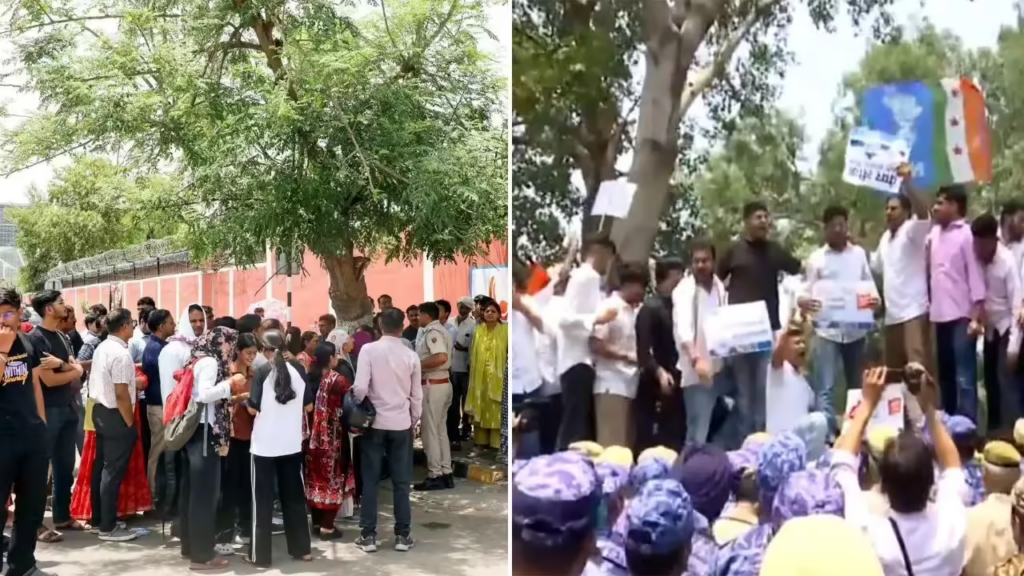
India’s biggest medical entrance exam has collapsed into chaos after investigators uncovered what now appears to be a multi-state NEET-UG 2026 paper leak network involving medical students, coaching circles, digital groups, and alleged cash payments running into lakhs of rupees.
What initially looked like another pre-exam “guess paper” circulating among anxious aspirants has rapidly evolved into a major criminal investigation involving the Central Bureau of Investigation, state police units, and more than 150 students and parents.
At the center of the controversy is a PDF document investigators believe closely matched large portions of the actual NEET-UG 2026 examination conducted on May 3.
Now, with the exam officially cancelled for nearly 22.8 lakh candidates, the scandal is raising urgent questions about exam security, coaching industry influence, and the growing commercialization of competitive entrance tests in India.
What investigators say was leaked
According to Rajasthan’s Special Operations Group (SOG), the leaked material contained:
- Around 45 chemistry questions
- Roughly 90 biology questions with answers
- Content allegedly matching the real NEET-UG 2026 paper
Investigators say the material was initially dismissed by many students as just another prediction booklet or coaching “guess paper,” a common phenomenon before major Indian entrance exams.
That assumption changed after comparisons reportedly revealed significant overlap with the actual examination.
The scale of the alleged match transformed what may have appeared harmless into a potential nationwide leak operation.
How the alleged leak trail began
Investigators believe the PDF can be traced back to a medical student originally from Rajasthan’s Sikar district who was studying MBBS in Kerala.
According to reports:
- The student allegedly received the material from a friend
- The PDF was forwarded to contacts in Rajasthan
- The content spread through hostel groups and coaching networks
- Password-protected online groups allegedly helped distribute access
One group reportedly under scrutiny was named “Private Mafia.”
The case took an unexpected turn when a hostel owner in Sikar who had allegedly circulated the material later informed police himself, triggering deeper investigation into the distribution chain.
That tip-off appears to have opened the first major crack in the case.
Why Sikar is once again under scrutiny
The Rajasthan city of Sikar has emerged as a recurring focal point in India’s competitive exam ecosystem.
Known for its large coaching industry, Sikar has increasingly become a parallel hub to Kota for NEET and JEE preparation.
The concentration of:
- Coaching centers
- Hostels
- Test preparation groups
- Competitive student networks
creates an environment where unofficial papers, prediction sets, and insider rumors circulate rapidly before major exams.
Investigators are now examining whether the alleged leak exploited those existing informal distribution channels.
What the CBI is investigating
The CBI has reportedly widened the probe beyond Rajasthan after evidence suggested the operation may involve an organized interstate syndicate.
According to investigators:
- Students may have paid between Rs 2 lakh and Rs 5 lakh for access
- Multiple medical college students are under suspicion
- Phones and laptops containing chats have been seized
- Investigators are tracing digital payment and communication trails
One accused, identified in reports as Yash Yadav, allegedly helped route the paper into Rajasthan.
Another suspect’s father is accused of scanning a hard-copy version into PDFs that could be digitally distributed.
Authorities say recovered chats suggest a structured money trail rather than random sharing between students.
That distinction is critical because it shifts the case from academic misconduct to organized criminal conspiracy.
Why digital “guess papers” complicate modern exam leaks
One reason cases like this become difficult to detect early is because India’s exam-prep culture already runs on prediction material.
Before competitive exams, students routinely receive:
- Expected-question booklets
- Coaching prediction sets
- Topic probability lists
- Telegram and WhatsApp PDFs
- “Most likely” mock papers
Most are legal and speculative.
That creates a gray zone where genuine leaks can initially hide in plain sight.
A leaked paper disguised as a “guess PDF” can circulate widely before authorities recognize something is wrong.
In this case, investigators believe that may have been exactly what happened.
Consider adding a visual explainer here comparing legitimate coaching “guess papers” versus characteristics of actual exam leaks.
Why the cancellation of NEET-UG 2026 is such a massive disruption
The cancellation of NEET-UG 2026 has enormous consequences because the exam serves as India’s primary gateway into:
- MBBS programs
- Dental colleges
- Medical institutions
- Several allied health science courses
This year’s exam reportedly involved nearly 22.8 lakh students in India and abroad.
For many candidates, NEET preparation consumes:
- Multiple years of study
- Significant family savings
- Coaching expenses
- Relocation costs
- Emotional and psychological pressure
The cancellation effectively resets that process for millions of students already navigating one of the world’s most competitive examination systems.
The emotional fallout has been immediate, with protests and outrage spreading online and offline.
The larger crisis facing India’s exam system
The NEET scandal is part of a broader pattern that has repeatedly exposed vulnerabilities in India’s high-stakes examination infrastructure.
In recent years, multiple recruitment and entrance exams have faced allegations involving:
- Paper leaks
- Proxy candidates
- Solver gangs
- Insider collusion
- Digital distribution networks
The economics behind these leaks are powerful.
With limited seats and intense competition, even a small advantage can command huge payments from desperate candidates and families.
That demand creates fertile ground for organized networks operating between:
- Coaching ecosystems
- Printing chains
- Exam logistics
- Digital communication groups
The NEET-UG 2026 case now appears to be one of the most expansive examples yet.
What happens next?
Investigators are expected to focus on:
- Tracing the original source of the questions
- Identifying how the paper left secure custody
- Mapping interstate communication networks
- Examining financial transfers
- Determining whether insiders were involved
Authorities will also face pressure to answer a politically explosive question: how did one of India’s most tightly controlled national exams allegedly circulate before test day?
The answer could reshape how future entrance examinations are conducted.
Potential reforms may include:
- Stronger digital monitoring
- Reduced paper handling points
- AI-assisted pattern tracking
- Stricter coaching center oversight
- Encrypted distribution systems
But for millions of students, those reforms will arrive too late for the 2026 cycle.
The bigger story behind the NEET leak
The NEET-UG scandal is not just about one leaked paper or one PDF circulating in student groups.
It reflects the enormous pressure cooker surrounding India’s education system, where a single exam can influence careers, family finances, and social mobility.
In that environment, leaks become more than criminal acts. They become symptoms of a system where opportunity is scarce, stakes are enormous, and trust is fragile.
For students who spent years preparing honestly, the greatest damage may not be the cancellation itself, but the growing fear that merit can be quietly outbid behind encrypted chats and hostel corridors.