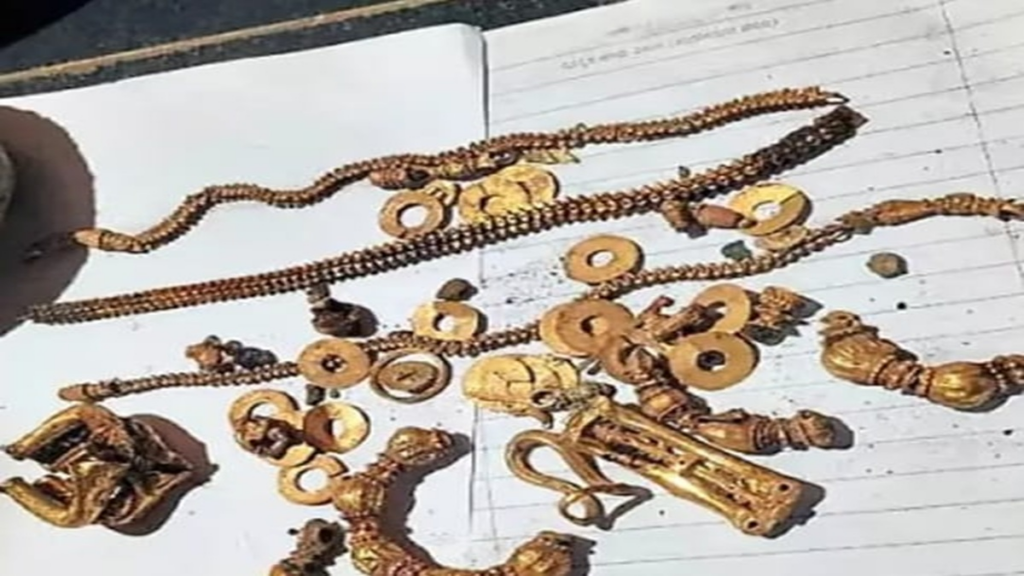
A routine house construction in southern India has unexpectedly opened a window into medieval life and a modern legal dilemma. In Lakkundi, a historic village in Karnataka, a family digging the foundation for a new home unearthed a copper vessel filled with gold jewelry believed to be around 900 years old.
What initially sounded like a classic “hidden treasure” story has now turned into a debate over heritage, ownership, and how governments should treat accidental archaeological finds. Is this gold a protected artifact belonging to the state or private property hidden by ancestors centuries ago?
This question is now at the centre of a growing dispute involving local authorities, archaeologists, and the family that found the ornaments.
What exactly was discovered in Lakkundi village?
Gold ornaments found during house construction
The discovery was made by Gangavva Basavaraj Ritti while excavating land to build a house in Lakkundi village, located in Karnataka’s Gadag district. Buried beneath the soil was a copper pot containing several gold ornaments, many of them broken or incomplete.
According to initial assessments:
- The jewellery weighs around 470 grams
- The items include household-style ornaments rather than ceremonial pieces
- No gold coins were found alongside the jewellery.
Local authorities were alerted soon after the discovery, and the gold was taken into government custody for examination.
Why Lakkundi drew immediate attention
Lakkundi is not just any village. It was once a major urban and commercial centre between the 10th and 12th centuries, during the rule of the Western Chalukyas. Over the years, archaeologists have documented:
- More than 150 stone inscriptions
- Numerous Hindu and Jain temples
- Sculptures and stepwells reflecting advanced urban planning
Because of this history, any buried object found in Lakkundi is likely to attract scrutiny. A location map or timeline graphic showing Lakkundi’s prominence during medieval India would help readers understand why the discovery caused such interest.
Is the gold actually an archaeological “treasure”?
What archaeologists are saying
Despite the village’s historical significance, officials from the Archaeological Department have played down the importance of the find.
Ramesh Mulimani, Superintendent of the Archaeological Department (Dharwad Circle), said the ornaments do not qualify as treasure or protected antiquities. According to him, the jewelry appears to be household gold buried for safekeeping, a common practice in earlier centuries.
In many traditional homes, valuables were hidden underground, often near kitchen hearths, to protect them from theft or invasion. The broken condition of the ornaments supports this explanation.
Why the absence of coins matters
One key detail shaping the official view is the lack of gold coins. Archaeologists note that royal hoards or state-linked treasures almost always include coins, seals, or insignia that can be tied to a ruler or dynasty.
In this case:
- The jewellery designs are simple and functional
- There are no royal motifs or inscriptions
- The craftsmanship matches everyday ornaments worn by common people
Researcher Appanna Hanje, who has studied the site, believes the jewelry dates back to the 11th or 12th century but stresses that it is distinctly non-royal in nature.
Why is ownership of the gold now being questioned
The family’s argument
The family that discovered the gold says the government’s own explanation strengthens their claim. If the ornaments were hidden by an ordinary family centuries ago and hold no archaeological significance, they argue, then the gold should be returned.
Their demand is straightforward:
- If the gold is not a treasure, it is ancestral property
- If the government keeps it, the family wants compensation in the form of housing support
The family has stated that they are not insisting on keeping the gold if the state helps them rebuild their home. Otherwise, they want the ornaments back, believing they belonged to their forebears.
What Indian law says about such finds
Indian law draws a fine line between “treasure trove” and private property. Under the Antiquities and Art Treasures Act and related state laws:
- Objects with historical or cultural significance can be claimed by the state
- Accidental finds must be reported to authorities
- Compensation may be considered if ownership is disputed
Because officials have publicly stated the gold lacks archaeological value, legal experts say the case becomes more complicated. A short explainer box on how India’s treasure trove laws work would add value for readers unfamiliar with the system.
How the Karnataka government has responded
State-level attention on the case
The issue has reached the highest levels of the state government. Karnataka Chief Minister Siddaramaiah has asked for a detailed report on the discovery from Gadag District Superintendent of Police Rohan Jagadish.
Meanwhile:
- The gold remains in government custody
- Further examination has been ordered
- Officials are reviewing whether the ornaments qualify as antiquities under state law
Smita Reddy, an expert from the State Archaeology Department, is scheduled to visit Lakkundi to conduct a more detailed investigation into the age and context of the jewelry.
Why the government is proceeding cautiously
Even when objects appear non-royal, governments tend to move carefully in such cases. Once returned, artifacts are often melted, sold, or altered, permanently erasing historical evidence.
Officials are likely weighing:
- Legal precedent for similar discoveries
- Public backlash if the gold is handed over
- The need to preserve potential historical data
Why this discovery matters beyond the gold itself
A glimpse into everyday life 900 years ago
While the ornaments may not be museum-worthy treasures, they still offer insight into how ordinary families lived centuries ago. Household jewelry tells historians about:
- Social status and wealth distribution
- Design trends outside royal courts
- Daily practices for protecting valuables
In many ways, this find humanizes history. It is not about kings or empires, but about families who lived, saved, and worried about security, much like people do today.
A broader debate on heritage and rights
The Lakkundi case highlights a recurring tension in archaeology:
- Should all ancient objects belong to the state?
- Do local communities have a stronger claim to their own past?
- How can governments balance preservation with fairness?
Similar debates have played out worldwide, from farmers discovering Roman coins in Europe to accidental fossil finds in the United States.
What happens next in the Lakkundi gold dispute?
The final decision will likely hinge on expert reports and legal interpretation. Possible outcomes include:
- Returning the gold to the family
- Providing compensation while retaining the ornaments
- Declaring the items state property despite their non-royal nature
For now, the copper pot of gold remains locked away, symbolising both the richness of India’s past and the complexity of managing it in the present.
TL;DR
- A family in Karnataka’s Lakkundi village found gold jewellery buried about 900 years ago
- Archaeologists say it is household jewellery, not a historical treasure
- The family wants the gold returned or compensation from the government
- The state is reviewing the case amid legal and heritage concerns
- The dispute raises bigger questions about ownership of the past