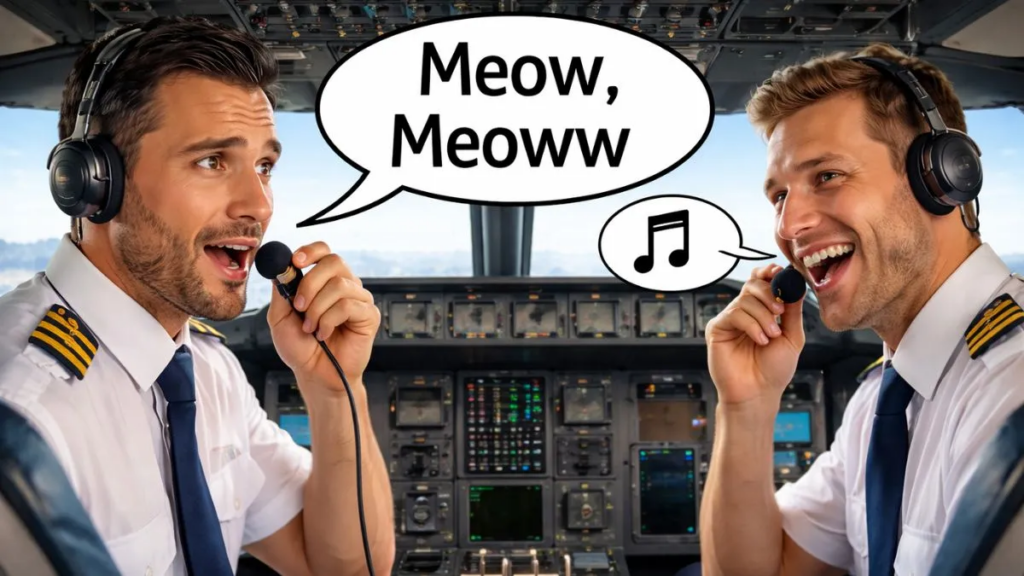
A bizarre audio clip of pilots making animal sounds over an air traffic control channel has taken off online, but the reaction on the ground has been far less amused. The “meow meow” ATC incident, which occurred near Ronald Reagan Washington National Airport, is now under investigation by the Federal Aviation Administration, raising serious questions about professionalism and safety in aviation communication.
What happened in the ‘meow meow’ ATC incident?
The viral clip captures a short but unusual exchange between pilots on an active radio frequency.
The exchange that sparked the controversy
According to widely circulated audio:
- One pilot said “meow meow” over the channel
- Another responded with a barking sound
- A third voice intervened, urging professionalism
- A fourth added a sarcastic remark referencing regional jet pilots
What may have seemed like harmless banter quickly turned into a case study in what not to do on a shared aviation frequency.
Why is the FAA investigating this incident?
The FAA’s involvement signals that this is not being treated as a joke.
The rules are clear
The FAA prohibits:
- Non-essential communication during critical phases of flight
- Any conversation unrelated to safe aircraft operation below 10,000 feet
This is part of what’s known in aviation as the “sterile cockpit rule.”
Why it matters
Air traffic control frequencies are not casual chatrooms. They are:
- Shared by multiple aircraft
- Time-sensitive
- Often used to relay critical instructions
Even a few seconds of irrelevant chatter can: - Block important transmissions
- Cause confusion
- Increase risk in already complex environments
What is the ‘guard frequency,’ and why is it sensitive?
Some reports suggest the exchange may have occurred on or near the “guard frequency,” a channel reserved for emergencies.
What makes this frequency special
The guard frequency is used for:
- Distress calls
- Urgent safety alerts
- Communication with aircraft that have lost contact
Because of its purpose, it is treated as a sacred space in aviation.
Dennis Tajer of the Allied Pilots Association emphasized this point, noting that such behavior is not taken lightly within the industry.
Why jokes don’t land here
Even brief misuse can:
- Delay emergency communication
- Distract pilots monitoring the channel
- Undermine discipline in high-stakes situations
Is this kind of behavior common in aviation?
Surprisingly, variations of this behavior have surfaced before, though rarely at this level of visibility.
The culture behind the cockpit
Aviation, like many high-pressure professions, has its moments of levity. Pilots often spend long hours in controlled environments, and humor can be a coping mechanism. But there’s a line, and it’s clearly defined.
Where the line is drawn
Acceptable:
- Casual conversation during non-critical phases
- Professional, relevant communication
Unacceptable: - Non-essential chatter on active frequencies
- Disruptive or irrelevant transmissions
- Anything that interferes with safety protocols
This incident crossed into the second category.
Why did this go viral?
The internet has a soft spot for absurdity, especially when it appears in serious settings.
The viral formula
This clip had all the ingredients:
- Unexpected behavior in a high-stakes environment
- A contrast between professionalism and playfulness
- A short, easily shareable format
But what makes it viral also makes it problematic.
Humor vs. risk
To the public, it’s amusing.
To aviation professionals, it’s a breach of discipline.
That gap in perception is what’s driving the debate.
What could happen to the pilots involved?
The FAA has not yet identified the individuals or airlines involved, but investigations like this typically follow a structured path.
Possible outcomes
Depending on findings, consequences could include the following:
- Warnings or reprimands
- Mandatory retraining
- Suspension of licenses in severe cases
The severity depends on factors such as the following: - Whether safety was compromised
- The phase of flight during the exchange
- Prior conduct records
What does this incident reveal about aviation safety today?
Beyond the humor and headlines, the “meow meow” ATC incident highlights deeper issues about communication discipline in modern aviation.
The margin for error is shrinking
Airspace is becoming more crowded, and communication is more critical than ever.
- More flights mean more congestion on frequencies
- Faster decision-making leaves less room for distraction
- Even minor disruptions can have outsized consequences
Visibility has changed accountability
In the past, such incidents might have stayed within aviation circles.
Now:
- Audio leaks quickly
- Social media amplifies it
- Regulators face public pressure to respond
This shift is reshaping how professional standards are enforced.
What should readers take away from the ‘meow meow’ ATC incident?
This story is not just about a strange exchange. It’s about the invisible systems that keep aviation safe.
Key takeaways:
- Air traffic communication is tightly regulated for a reason
- Even small deviations can carry risk
- Professional discipline is non-negotiable in aviation
- Viral moments can have real-world consequences
In aviation, silence is often as important as speech. And when someone fills that silence with a joke, it can echo much louder than intended.
TL;DR
A viral audio clip of pilots making animal sounds over an air traffic control channel has triggered an FAA investigation. While humorous to some, the incident raises serious concerns about communication discipline and aviation safety.