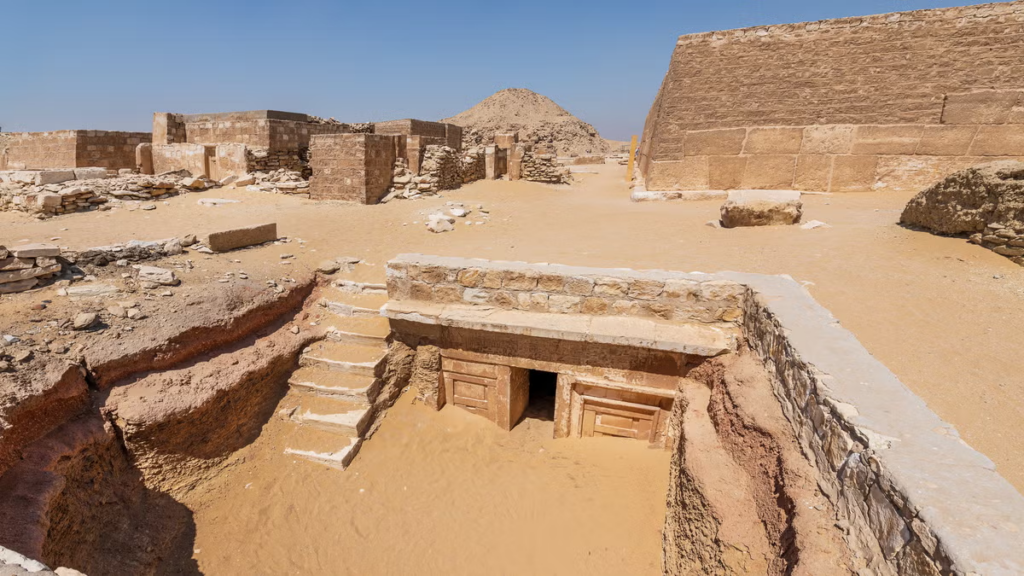
A pair of remarkably ancient tombs uncovered in Egypt may help archaeologists answer one of history’s biggest architectural questions: how did the Egyptians progress from simple burials to building the world’s iconic pyramids?
The newly discovered tombs, dating back more than 5,000 years, predate Egypt’s famous pyramids by several centuries. Researchers believe they represent an important stage in the evolution of royal and elite burial architecture, offering fresh clues about the engineering ideas that eventually culminated in the construction of the pyramids.
The discovery was made at the Jabal al-Tayr archaeological site by a team from Egypt’s Supreme Council of Antiquities.
Where were the tombs discovered?
The two tombs were unearthed at Jabal al-Tayr, an archaeological site that served as a cemetery for thousands of years.
According to archaeologists, the site was used continuously from Egypt’s Predynastic Period through the Late Period (roughly 664 to 332 BCE), making it an important location for studying the evolution of Egyptian funerary practices.
The latest discovery adds another chapter to the site’s long archaeological history by revealing burial structures that date to the dawn of ancient Egyptian civilization.
Why are these tombs important?
Although Egypt’s pyramids dominate popular imagination, they were not the country’s first monumental tombs.
Before pyramid construction began, Egyptians experimented with increasingly sophisticated burial designs.
The newly discovered tombs appear to capture one of those transitional phases.
Researchers say the structures demonstrate how builders gradually moved from simple underground graves to more elaborate stone monuments that eventually inspired pyramid architecture.
Rather than representing isolated structures, the tombs provide evidence that architectural innovations were spreading across ancient Egypt long before the pyramids were constructed.
What were Egypt’s earliest tombs like?
The earliest Egyptian elite tombs were far simpler than the pyramids that followed centuries later.
Around 3100 BCE, burials typically consisted of:
- Rectangular pits dug into the ground.
- Brick-lined burial chambers.
- Plastered walls.
- Underground spaces designed to protect the deceased.
Over time, these burial places became larger and more complex.
Elite tombs eventually included above-ground structures known as mastabas, flat-roofed rectangular buildings where offerings could be placed for the deceased.
These developments laid the architectural foundation for later pyramid construction.
How are the new tombs connected to the pyramids?
Archaeologists believe the tombs may represent an early step toward the engineering principles later used in pyramid building.
Several features suggest increasingly sophisticated construction techniques, including:
- Stone-block construction.
- Thick supporting walls.
- Carefully planned underground chambers.
- Structural reinforcement using wooden supports.
These innovations demonstrate how Egyptian builders were gradually experimenting with larger and more durable monuments.
While the tombs are not pyramids themselves, they illustrate the technological progression that eventually made pyramid construction possible.
What similarities do they share with King Hor-Den’s tomb?
Researchers say the newly discovered structures closely resemble the tomb of King Hor-Den, one of the most important rulers of Egypt’s First Dynasty.
Hor-Den’s tomb at Abydos, built around 2950 BCE, was among the largest and most sophisticated burial complexes of its era.
It included:
- A central burial chamber.
- Two large storage rooms.
- A ritual annex.
- More than 130 surrounding chambers.
The architectural similarities suggest that construction techniques and burial traditions were already being shared across different regions of Egypt during the Early Dynastic Period.
That finding strengthens the idea that pyramid architecture developed through centuries of experimentation rather than appearing suddenly.
Who was buried in these tombs?
That remains one of the biggest unanswered questions.
Unlike some royal tombs whose occupants have been identified through inscriptions, these newly discovered structures have not yet revealed who they were built for.
Archaeologists say additional excavation and analysis will be needed to determine:
- The identity of those buried there.
- Their social status.
- Whether they belonged to royal or elite families.
- The exact date of construction.
Future discoveries, including inscriptions or artifacts, could provide more definitive answers.
What else did archaeologists discover?
The excavation revealed notable differences between the two tombs.
The first tomb
Researchers found evidence that many of its stone blocks had been removed in antiquity, likely for reuse in later construction projects.
Only portions of the original structure remain intact.
The second tomb
The second tomb is much better preserved.
Most of its stone blocks remain in their original positions, giving archaeologists a clearer picture of how the structure was originally built.
Evidence of wooden supports also suggests builders used advanced engineering techniques to stabilize walls and internal chambers.
Why does this discovery matter?
The pyramids did not emerge fully formed.
They were the result of centuries of experimentation with burial architecture, construction materials, and engineering methods.
The Jabal al-Tayr discoveries help fill a critical gap in that story by documenting an intermediate stage between simple graves and monumental pyramids.
They also reinforce the idea that architectural knowledge spread across Egypt much earlier than previously understood.
As excavations continue, researchers hope the site will reveal even more about how one of history’s greatest engineering traditions first began.
The bigger picture
The discovery of these 5,000-year-old tombs provides archaeologists with an important new window into ancient Egypt’s formative years.
While the pyramids remain the country’s most recognizable monuments, it was smaller, experimental structures like these that likely paved the way for their creation.
Each new excavation helps scholars piece together the gradual evolution of Egyptian engineering, offering fresh insight into how one of the ancient world’s greatest architectural achievements came to be.
TL;DR
- Archaeologists have uncovered two Early Dynastic tombs at Jabal al-Tayr in Egypt.
- The tombs date back more than 5,000 years, centuries before the first pyramids.
- Researchers believe they illustrate how early Egyptian burial architecture evolved into pyramid construction.
- The structures share similarities with the tomb of King Hor-Den at Abydos.
- The identity of those buried inside the newly discovered tombs remains unknown.