
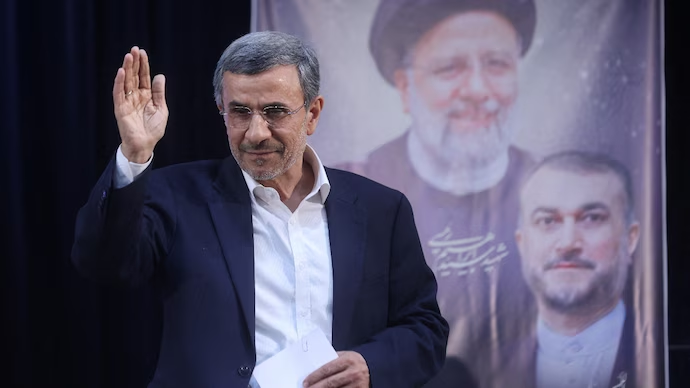
A startling report claiming that the United States and Israel explored installing former Iranian president Mahmoud Ahmadinejad as a postwar leader in Iran has triggered global debate, skepticism, and confusion in equal measure.
The claim, first reported by The New York Times and amplified across multiple international outlets, suggests that early US-Israeli regime change discussions after the reported killing of Iran’s Supreme Leader Ali Khamenei included Ahmadinejad as a potential transitional figure..
The story sounds almost politically surreal. Ahmadinejad was once among the most aggressively anti-American and anti-Israel leaders in modern Iranian history.
Yet according to the reports, that apparent contradiction may have been exactly why some officials believed he could help stabilize Iran internally after a leadership collapse.
What exactly do the reports claim?
According to reporting attributed to unnamed US officials:
- The US and Israel discussed potential regime change scenarios during the opening phase of the Iran war
- Ahmadinejad was allegedly consulted about succession planning
- An Israeli strike reportedly targeted his Tehran residence
- The operation was allegedly intended to free him from house arrest
- Ahmadinejad later distanced himself from the effort after narrowly surviving the attack.
The reports further claim that:
- Ahmadinejad disappeared from public view after the strike
- His whereabouts are reportedly unclear
- Internal disagreements existed within Israeli intelligence circles about using him as a political figurehead.
A useful timeline graphic here could map:
- The reported strike on Khamenei
- Early regime change discussions
- The alleged strike on Ahmadinejad’s residence
- His disappearance from public life
Why would the US or Israel even consider Mahmoud Ahmadinejad?
That is the central question driving the controversy.
The paradox of Mahmoud Ahmadinejad
During his presidency from 2005 to 2013, Ahmadinejad became internationally notorious for:
- Holocaust denial rhetoric
- Anti-Israel statements
- Defending Iran’s nuclear ambitions
- Harsh crackdowns on dissent after the 2009 protests
At face value, he seems like the last person Washington or Tel Aviv would support.
But geopolitical calculations are rarely ideological purity tests.
Why officials may have viewed him differently
Several reports suggest Ahmadinejad’s later political isolation inside Iran changed perceptions:
- He increasingly criticized Iran’s clerical establishment
- He clashed with the Islamic Revolutionary Guard Corps (IRGC)
- He was reportedly sidelined and monitored by Iranian authorities
- Some officials may have seen him as a nationalist figure with populist credibility inside Iran.
The logic appears to have been:
If regime collapse occurred suddenly, an insider with name recognition might prevent total state fragmentation.
That does not necessarily mean the plan was realistic.
Was Ahmadinejad actually under house arrest?
Several reports say Ahmadinejad had been heavily monitored or effectively restricted by Iranian authorities before the war. However:
- Iran never publicly confirmed formal house arrest
- Independent verification remains limited
- Much of the reporting relies on unnamed intelligence and diplomatic sources.
That distinction matters.
In highly opaque political systems like Iran’s, informal restrictions often blur into de facto detention without official acknowledgment.
Did Israel intentionally strike Ahmadinejad’s residence?
The reports claim the strike was designed to eliminate guards and “free” Ahmadinejad rather than kill him.
But several major questions remain unanswered:
- Why would Israel bomb a figure it allegedly wanted to empower?
- Was the operation poorly executed?
- Did intelligence failures occur?
- Or was Ahmadinejad never truly central to the plan?
No public evidence has emerged confirming:
- Operational details
- Official Israeli authorization
- Audio, documents, or direct quotations from policymakers
That leaves much of the story in the realm of sourced but unverified intelligence reporting.
How credible are these claims?
What supports the reports
- Multiple outlets independently referenced the same broad narrative
- Several cited unnamed US officials familiar with the discussions
- The reports align with broader evidence that regime change was considered during the war’s early phase.
What remains unverified
- No US official has publicly confirmed the plan
- Israel has not commented officially
- Ahmadinejad himself has not publicly addressed the claims
- No documentary evidence has been released
This is important context:
A discussion inside intelligence or military circles is not the same thing as a finalized operational policy.
Governments routinely examine extreme contingency scenarios during wars that never become formal strategy.
Why the story matters beyond Ahmadinejad
The bigger issue is not Ahmadinejad himself.
The real significance lies in what the reports reveal about:
- The scale of regime change thinking during the Iran war
- The uncertainty surrounding succession inside Tehran
- The absence of clear postwar planning
- The risks of power vacuums after decapitation strikes
A familiar historical pattern
The story also revives long-running debates about externally influenced regime change in the Middle East.
Critics argue:
- Removing governments without stable succession plans often creates chaos
- Foreign-backed leadership transitions can backfire politically
- Nationalist backlash frequently strengthens hardliners instead of weakening them
The irony here is especially striking: Ahmadinejad built his political brand on resisting Western influence.
What happens next?
Right now:
- Ahmadinejad’s status remains unclear
- Iran’s internal power structure appears unstable
- Regional tensions remain high
- Neither Washington nor Tel Aviv has publicly clarified the reporting
Until stronger evidence emerges, the story sits in an unusual space:
plausible enough to dominate headlines, but still heavily dependent on anonymous sourcing.
TL;DR
- Reports claim the US and Israel explored installing Mahmoud Ahmadinejad after Ali Khamenei’s reported death
- Ahmadinejad was allegedly consulted during early regime change discussions
- Israeli strikes reportedly targeted his Tehran residence in an operation meant to free him
- He later disappeared from public view and allegedly distanced himself from the plan
- The claims rely heavily on unnamed officials and remain unconfirmed publicly