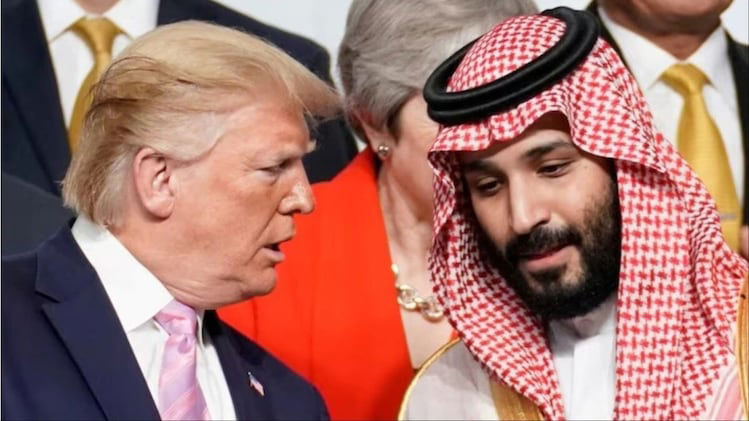
Within days of renewed U.S.-Iran tensions, a striking detail has emerged: Saudi Crown Prince Mohammed bin Salman has reportedly encouraged President Donald Trump to press forward with military operations against Iran.
The reported private push, first detailed by The New York Times, adds a new layer to an already volatile regional conflict. It also raises a deeper question: is this a tactical moment or the beginning of a broader geopolitical shift?
What did Mohammed bin Salman reportedly tell Trump?
According to the report, the Saudi crown prince framed the current conflict as more than just another flashpoint. He described it as a “historic opportunity” to weaken Iran’s regional influence.
At the heart of his argument is a long-standing Saudi concern: that Iran poses a sustained strategic threat to Gulf nations. This isn’t new rhetoric, but the timing matters.
With U.S. and Israeli military pressure already mounting, MBS appears to be signaling that now is the moment to escalate rather than contain.
Why this matters now
Three factors make this moment different:
- Active conflict environment: Unlike past tensions, military operations are already underway
- Regional alignment: Gulf countries appear more publicly aligned with Washington
- Perceived Iranian vulnerability: Analysts suggest Iran may be stretched across multiple fronts
How aggressive is the proposed military strategy?
One of the most consequential details in the report is the discussion of targeting Iran’s Kharg Island, a critical hub for its oil exports.
Such an operation would be high-risk and high-impact.
What makes Kharg Island so important?
- It handles a significant portion of Iran’s oil exports
- It is central to Iran’s economic stability
- Disrupting it could severely limit Tehran’s revenue stream
A potential operation could involve:
- Airborne U.S. Army forces
- Amphibious Marine assaults
- Coordinated Israeli support
But the risks are equally clear. Any direct strike on oil infrastructure could trigger wider retaliation, including attacks on shipping routes or energy facilities across the Gulf.
Is Saudi Arabia pushing for a wider war?
Publicly, Saudi Arabia denies advocating for prolonged conflict. Officials maintain that their primary goal is defense and regional stability.
Privately, however, the tone appears more assertive.
President Trump himself acknowledged that MBS has been urging action, calling him a “warrior” and praising Gulf allies, including the UAE and Qatar, for their support.
Public vs. private messaging
This contrast is not unusual in diplomacy. Governments often:
- Signal restraint publicly to avoid escalation
- Advocate for stronger measures behind closed doors
- Balance domestic opinion with strategic goals
For Saudi Arabia, the stakes are especially high. A weakened Iran could shift the regional balance of power. But a prolonged war could destabilize energy markets and invite retaliation.
How is Iran responding, and why does the Strait of Hormuz matter?
Iran has already responded in ways that highlight its strategic leverage, particularly in the Strait of Hormuz.
Why the Strait of Hormuz is critical
- Roughly 20% of global oil passes through it
- It is one of the world’s most important energy chokepoints
- Even minor disruptions can spike global oil prices
Recent Iranian actions have reportedly disrupted energy flows, affecting not just global markets but also Gulf economies, including Saudi Arabia.
Even though Saudi Arabia and the UAE have invested in alternative pipelines, these routes are not immune to attack.
The economic ripple effect
If disruptions continue, the consequences could include:
- Higher global oil prices
- Supply chain instability
- Increased insurance and shipping costs
Why Gulf countries fear a U.S. pullback
One of the underlying concerns driving Saudi Arabia’s position is the possibility that the U.S. could scale back its involvement too soon.
From Riyadh’s perspective, a premature withdrawal could:
- Leave Gulf nations exposed to retaliation
- Allow Iran to regroup and escalate
- Undermine regional deterrence
This fear is rooted in past experiences where shifting U.S. policies created uncertainty among allies.
Strategic dependency on the U.S.
Gulf states rely heavily on U.S. support for:
- Military protection
- Intelligence sharing
- Strategic deterrence
Without it, the balance of power in the region could shift quickly.
What are the risks of escalation?
Escalating military operations, especially against key infrastructure, carry significant risks.
Potential consequences
- Regional war: Involving multiple countries beyond Iran and Israel
- Energy crisis: Triggered by sustained disruptions in oil supply
- Global economic shock: Particularly affecting energy-dependent economies
- Military casualties: From complex ground or amphibious operations
This is not just a Middle East story. It has global implications, from fuel prices to financial markets.
What happens next?
The situation remains fluid. Much depends on how the U.S. weighs immediate tactical gains against long-term risks.
Key questions moving forward include:
- Will the U.S. pursue more aggressive operations?
- How far is Saudi Arabia willing to go in supporting escalation?
- Can diplomatic channels still de-escalate the conflict?
For now, the gap between public statements and private strategy suggests that the region may be entering a more unpredictable phase.
TL;DR
- Saudi Crown Prince Mohammed bin Salman reportedly urged President Donald Trump to continue military operations against Iran
- The proposal includes high-risk options like targeting Iran’s Kharg Island
- Saudi Arabia publicly calls for peace but may privately favor stronger action
- Iran’s response has already disrupted energy flows through the Strait of Hormuz
- A wider conflict could have major global economic and geopolitical consequences