
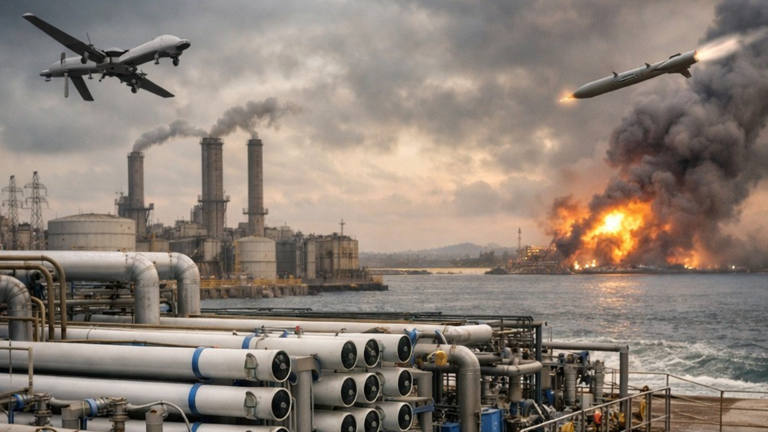
For decades, the global imagination has tied the Gulf’s fate to oil. But as tensions rise around the Strait of Hormuz, a quieter and far more immediate vulnerability is coming into focus: water. The idea is simple but stark. Oil disruptions in the Gulf can ripple through markets. Water disruptions can collapse daily life.
In a region where natural freshwater is nearly nonexistent, desalination plants are not infrastructure but survival systems. And increasingly, they are being pulled into the logic of war.
Why the “Gulf water crisis” matters more than oil right now
The Gulf water crisis is no longer a theoretical risk. It is becoming a frontline concern as threats expand beyond oil tankers and pipelines to include civilian infrastructure.
When Donald Trump warned of targeting Iranian power plants, Iran responded with a broader message: if its infrastructure is hit, similar facilities across the region, including desalination plants, could be considered legitimate targets.
That warning changes the equation.
Oil vs. water: a critical difference
Oil systems have built-in flexibility:
- Tankers can reroute
- Strategic reserves can stabilize supply
- Markets can adjust pricing
Water systems in the Gulf offer no such buffer:
- No large-scale freshwater reserves
- No alternative supply chains
- No quick replacement for damaged plants
If a desalination plant goes offline, the clock starts ticking immediately.
What are desalination plants, and how do they work?
Desalination plants turn seawater into drinking water, most commonly through a process called reverse osmosis.
The basic process
- Seawater intake from the ocean
- Filtration to remove debris and particles
- High-pressure pumping through ultra-fine membranes
- Salt and impurities are separated out
- Freshwater is stored and distributed
These plants depend on a delicate chain of systems:
- Continuous power supply
- Specialized membranes and filtration units
- Coastal intake and discharge infrastructure
Damage to any one of these components can halt production.
And unlike oil refineries, these systems are not easily repaired under conflict conditions.
How dependent is the Gulf on desalinated water?
The six Gulf Cooperation Council countries, Gulf Cooperation Council members, rely heavily on desalination to sustain over 60 million people.
Here’s how deep that dependence runs:
- Kuwait: ~90% of drinking water from desalination
- Oman: ~86%
- Saudi Arabia: ~70%
- Qatar: over 99% of drinking water
- Bahrain: nearly 90% for drinking use
- United Arab Emirates: majority dependence
These are not supplementary systems. They are the primary source of life-sustaining water.
Why natural water isn’t an option
The Gulf region has:
- No permanent rivers
- Minimal rainfall
- Limited and often saline groundwater
Seasonal streams, known as wadis, cannot support modern urban populations.
This is why one expert described these nations not just as petrostates, but as “saltwater-powered societies.”
Why desalination plants are vulnerable in conflict
Desalination plants were not designed with modern warfare in mind.
Key vulnerabilities
- Coastal locations make them easy to identify
- Large physical footprints limit concealment
- Dependence on electricity grids increases risk
- Complex machinery requires specialized repair
Even indirect damage can shut them down:
- Power outages
- Pipeline disruptions
- Contamination risks
In conflict zones, these risks multiply quickly.
A fragile system under pressure
A single successful strike could:
- Cut water supply to entire cities
- Trigger emergency rationing within hours
- Force reliance on bottled or imported water
Unlike oil, there is no global “water market” that can step in.
Has this risk appeared before?
Yes, and the warnings are not new.
Historical precedents
During the Gulf War:
- Retreating forces damaged power and desalination infrastructure
- Countries faced severe water shortages
- Emergency imports became necessary
Earlier intelligence assessments also warned:
- Major desalination outages could trigger national crises
- Repairs could take weeks or months
- Urban centers could become uninhabitable quickly
One U.S. diplomatic cable reportedly suggested that if key infrastructure near Riyadh were hit, evacuation could become necessary within days.
That is how tight the margin is.
Why the current escalation is different
What makes this moment more dangerous is the explicit inclusion of water infrastructure in strategic warnings.
This is not collateral risk. It is being discussed as a potential target.
The escalation ladder is widening
The conflict is no longer limited to:
- Military bases
- Energy exports
- Shipping routes
It is now brushing up against:
- Civilian infrastructure
- Essential services
- Human survival systems
That shift changes the stakes dramatically.
What happens if desalination plants are targeted?
The consequences would be immediate and severe.
Short-term impact (hours to days)
- Water supply disruptions
- Panic buying and hoarding
- Emergency rationing
Medium-term impact (days to weeks)
- Public health risks
- Economic slowdown
- Strain on emergency services
Long-term impact (weeks to months)
- Population displacement
- Infrastructure collapse in affected cities
- Regional humanitarian crisis
This is why experts argue that water shocks are fundamentally different from oil shocks.
They are not just economic events. They are survival events.
The bigger picture: a hidden fault line in global security
The Gulf water crisis highlights a broader truth about modern geopolitics:
Critical infrastructure is increasingly becoming a battlefield.
Oil once defined strategic vulnerability in the region. Now, water may be even more critical.
As tensions escalate, the question is no longer just who controls energy flows, but who can sustain civilian life under pressure.
TL;DR
- The Gulf water crisis is emerging as a major risk amid rising regional tensions
- Desalination plants supply most drinking water in Gulf countries
- Unlike oil, water systems have no backup or alternative supply
- These facilities are highly vulnerable to disruption or attack
- A single strike could trigger immediate humanitarian consequences